


March 1, 2026
Have Questions About HR?Our team of friendly, seasoned HR Pros have the answers to all of your HR questions. The HR On-Demand service features a Live HR Helpline, an online HR Helpdesk, and access to handbooks and HR documents. Let’s work together to find the solutions for your biggest challenges.
https://californiapayroll.com/human-resources/hr-services/?utm_campaign=WIN%20Campaign&utm_source=WIN&utm_medium=social%20media

March 1, 2026
SB 1162 California Pay Transparency Law – Here’s How It Works for Recruiting and HiringIn September of 2022, California Governor Gavin Newsom signed into law Senate Bill 1162, also known as SB 1162, the Pay Transparency Act, which went into effect on January 1 of this year. This new pay transparency law adds new requirements for payroll, hiring, and recruiting in the state of California.
SB 1162 sets new expectations for businesses operating and hiring in the state of California regarding pay scale and pay data reporting, making adherence to the new requirements especially important for payroll, hiring, and recruiting. This new development highlights the ever-changing nature of the landscape of California employment law and the importance of having HR support specialists who focus on these California requirements on your side.
How California Expands Pay Transparency Requirements
In an earlier blog post, we looked into the key points from SB 1162, namely its new requirements for pay scale and pay data reporting. For hiring and recruiting personnel, the former is most pertinent, while the latter is more critical for payroll personnel and managers. Together, SB 1162 is a critically important law for HR personnel to understand for any company that operates in and hires from the state of California.
Let’s take a look at some frequently asked questions about the new California salary transparency law for hiring and recruiting personnel and delve deeper into its purpose, requirements, and how to best ensure compliance.
What is SB 1162?
SB 1162 builds upon existing employment legislation intended to ensure that workers receive fair and equal pay in the work they do through California’s Pay Data Reporting (PDR) system. Established by legislation in 2020, the PDR system requires employers with 100 or more employees to submit annual reports to the California Department of Fair Employment and Housing to help employers identify and address potential wage disparities based on race, ethnicity, sex, and other protected characteristics.
California’s Pay Transparency Act (SB 1162) is a new law that requires employers with 15 or more employees to include a pay scale for job postings, including internal and external postings and job postings through third parties. In addition, SB 1162 also establishes new annual pay data reporting requirements for employers with 100 or more employees.
One of the new obligations SB 1162 creates for businesses is the obligation to report data not only for their W-2 employees but for workers supplied by labor contractors as well.
In building upon California’s existing wage and employment equity legislation, SB 1162 also requires certain employers to provide pay scales on job postings. While the majority of the new requirements of the Pay Transparency Act are enforced by the state of California Civil Rights Department (CRD), this requirement for pay scales on job postings is enforced by the Division of Labor Standards Enforcement or the Department of Industrial Relations.
How does SB 1162 protect consumer privacy?
As SB 1162 involves the collection of payroll data from a wide range of large businesses, including data for W-2 employees and workers supplied by labor contractors, by the California state government, the privacy of company data is taken extremely seriously.
The California Civil Rights Department uses end-to-end encryption to transmit and store all employer-submitted payroll data in a secure government cloud that meets all FedRAMP and NIST federal and state requirements for data protection. No employer’s pay data will be publicly available except under very specific circumstances, and any and all “individually identifiable information” submitted is considered confidential information.
When does the California pay transparency law go into effect?
The new California pay transparency law established by SB 1162 went into effect on January 1, 2023, widening the criteria for companies that must comply with California pay transparency legislation and establishing new obligations for companies of a certain size to disclose pay ranges in job postings.
The deadline for employers to submit their annual pay data reports is the second Wednesday of May of the following year. The deadline to submit pay data reports for 2022 was May 10, 2023. This is a change from the previous reporting deadline of March 31, giving employers some welcome extra time to prepare their data reports to meet their new legal standards and obligations.
The California Civil Rights Department provides further information on filing deadlines, procedures, certification, and compliance on its website’s PDR FAQ, which has been updated since the passage of SB 1162.
Pay Scale Transparency Compliance with SB 1162 for Recruiting and Hiring Personnel
SB 1162 requires the disclosure of pay scales in job openings for all positions, internal and external, with “pay scale” defined as the salary or hourly wage the employer reasonably expects to pay for a position. The pay scale does not need to include bonuses, commissions, tips, or other benefits.
This new pay transparency requirement for businesses with 15 or more employees extends not just to job postings on a company website but to third-party platforms such as LinkedIn or Indeed as well.
For remote work positions, the pay scale must be included on all job postings if the position may ever be filled remotely or in person by a California resident. The pay scale must be included on the posting itself as well, not through a link or QR code in an electronic or paper posting.
In addition, employers of any size—not just employers with 15 or more employees—must be able to provide any worker in their employ with the pay scale for their position upon request.
Failure to comply with the new requirements of SB 1162, whether for annual PDR or for pay scale transparency, can result in significant civil penalties. The civil penalty for pay scale transparency violations is no less than $100 and no more than $10,000 per violation of the pay scale disclosure requirement.
Let California Payroll help simplify the confusing landscape of California pay data reporting for you.
Our focus is on staying up-to-date with the latest labor and employment laws in the state. We want to make sure our clients fully understand what they need to know about their reporting obligations in the Golden State.
If you need help staying compliant with reporting standards and obligations for California pay transparency law SB 1162, reach out to us today about how we can assist you.
March 1, 2026
California’s Paid Sick Leave Expansion: Understanding and Preparing for New CA Labor LawsJust this month, the California state legislature passed Senate Bill No. 616 (SB 616), an amendment to the 2014 Healthy Workplaces, Healthy Families Act to set a statewide minimum standard for Paid Sick Leave. This is in response to local communities who, in recent years, across California have passed their own Paid Sick Leave ordinances to set minimums for Paid Sick Leave accrual, subjecting California businesses with multiple locations to a patchwork of regulations.
The new California Paid Sick Leave law takes effect on January 1, 2024. Virtually all employers with employees in California will be affected, except for railroad carrier employers — leaving only a few months for businesses to review and, if necessary, alter their Sick Leave policies to ensure compliance.
The New California Paid Sick Leave Law at a Glance
SB 616 lays out the following changes to statewide Sick Leave regulations:
- Employers must provide a minimum of 40 hours (5 days) of Paid Sick Leave per year.
- According to the new policy:
- Employees are still required to be provided 24 hours (3 days) of Paid Sick Leave time by the 120th day of employment.
- Employees are required to be provided an additional 16 hours of Paid Sick Leave by the 200th calendar day of employment (for a total of 40 hours).
- If employers use the accrual method, any remaining accrued Paid Sick Time must carry over to the next calendar year, year of employment, or 12-month period. Employers may limit this carry-over to 40 hours.
- Employers may limit the use of Sick Time to 40 hours (or 5 days) for each calendar year, year of employment, or 12-month period.
- According to the new policy:
- For employers who utilize an accrual model instead of offering a lump sum, employees must accrue at least one hour of Paid Sick Leave for every 30 hours worked.
- Employees are entitled to Paid Sick days if they work in California for the same employer for 30 or more days within a year from the start of their employment.
- Employers must provide written notice to employees about the amount of Paid Sick Leave they have available, such as including their current balance on their pay stubs.
- Any local cities’ Paid Sick Leave ordinances that provide a lower minimum than the new state minimum are superseded.
The text of the law also provides extensive information on how new changes to California Paid Sick Leave apply to employees covered by a collective bargaining agreement, defines protections against retaliation, outlines how the law applies to businesses with alternative accrual methods, and more.
Five Things Every California Company Should Do to Prepare for the Paid Sick Leave Expansion
California labor law is ever-changing, and businesses that operate in the Golden State must keep on top of the shifting legal landscape to ensure their operations can continue to run smoothly and in compliance.
- Carefully review and update your current Sick Leave policies and ensure they align with California’s new statewide requirements.
- Update your employee handbook and communicate the upcoming changes to your employees well in advance of January 1, 2024.
- Train your HR staff and specialists to ensure everybody understands the new requirements and how to administer them.
- Ensure your payroll and recordkeeping systems are capable of accurately tracking and documenting accrued Sick Leave and maintaining records of Sick Leave balance and usage for each employee.
- Review the new law with your company’s payroll processor and seek counsel from HR and labor law experts if necessary to ensure your practices and policies fully comply with SB 616.
Stay Compliant with SB 616 with California Payroll
California Payroll offers a wide variety of flexible, powerful timekeeping, HR, and payroll products to help businesses of all shapes and sizes track Sick Leave accrual, usage, and requests and maintain compliance with current and upcoming California laws.
California Payroll has a very robust, easy-to-use accrual tracking module to assist with staying in compliance with Paid Sick Leave accrual tracking. Contact us to find out more!
If you have any further questions about this new law and what it means for your Paid Sick Leave policies, our HR On-Demand solution is here to provide you with a vast array of HR resources to help you find the answers, including a dedicated number to connect you to knowledgeable HR specialists who can offer advice and guidance.

March 1, 2026
California’s Covid-19 Supplemental Paid Sick Leave (SPSL) Extended Until December 31, 2022California’s COVID-19 Supplemental Paid Sick Leave (SPSL) extended until December 31, 2022
California’s COVID-19 Supplemental Paid Sick Leave (SPSL) has been extended until December 31, 2022 under AB-152; however, this extension does not provide employees with additional hours of SPSL. The bill also allows employers to require additional COVID-19 testing in certain circumstances. The state is also establishing a grant program to reimburse qualifying small businesses and non-profits for SPSL costs. Governor Gavin Newsom signed AB-152 into law on September 29, 2022.
Here are the highlights of the newest changes:
SPSL Extension
COVID-19 SPSL is now extended through December 31, 2022; it was previously set to expire on September 30, 2022. This extension doesn’t provide employees with additional hours of SPSL; employees who have already used or exhausted their SPSL bank(s) are not entitled to more. Employees are still subject to a cap of 80 total hours of SPSL in 2022. This is still divided into two buckets of 40 hours each of leave with separate purposes and requirements. A few leaves may extend into 2023 because an employee who is taking SPSL on December 31, 2022, is allowed to continue the remainder of their covered absence uninterrupted.
Testing Requirements
Employers can now require employees to take a third COVID-19 test as a condition of continuing to receive SPSL. Employees are entitled to up to 40 hours of Standard SPSL for various COVID-19-related reasons, but can also access an additional bank of up to 40 hours of Positive Test SPSL if they, or a family member, test positive for COVID-19.
If the employee tests positive and is asking to use Positive Test SPSL, employers could already require that they submit to a second COVID-19 test at least five days later as a condition of continuing to receive SPSL. Now, if the second test result is also positive, employers can require a third COVID-19 test 24 hours or more after the second test. Employers can deny the employee’s request for additional SPSL if they refuse to take the test or provide documentation of the results.
Grants for Qualified Small Businesses and Non-profits
Small businesses and non-profits that have between 26 and 49 full-time employees can apply for a grant of up to $50,000 to reimburse SPSL costs for leave provided in 2022. Employers must meet certain eligibility criteria to qualify for the funds. For additional information, contact the California Office of the Small Business Advocate.
What actions do Employers need to take?
SPSL policies should be updated to reflect that it applies through December 31, 2022, and to indicate that you may require employees to take an additional COVID-19 test if their previous required test result is positive.
For the legislation on AB-152, please visit:

March 1, 2026
Save Time & Money With California Payroll’s Expense Tracking Module!Say goodbye to costly expense systems or time-consuming spreadsheets and hello to our Expense Tracking Module that automates the employee expense tracking process and reimbursement. Our software will play an innovative role in organizing, reporting, and managing your employees, payroll, and tax calculations. Request a demo today:
https://californiapayroll.com/payroll-software/?utm_campaign=WIN%20Campaign&utm_source=WIN&utm_medium=social%20media

March 1, 2026
Cal/OSHA Has Approved Its California Indoor Heat Illness Rule: Here’s What It Means for CA EmployersThe California Division of Occupational Safety and Health (Cal/OSHA) approved a long-awaited indoor heat-illness standard on June 20, 2024.
Before going live, the Office of Administrative Law (OAL) will have 30 days to approve or deny the standard. Cal/OSHA has requested that it go into effective immediately after OAL approval, so it could very well go live in a month.
The standard, Section 3396, requires employers with indoor workspaces of 87 degrees Fahrenheit and above to reduce the room temperature and offer workers other cool-down options.
For indoor workers who wear poor ventilating protective clothing or work near a heat source, employers will instead have to provide cool-down options when the inside temperature reaches 82 degrees Fahrenheit.
What California Employers Will Need to Prepare
While California has had an outdoor heat illness standard since 2006, indoor workers have been left unprotected. Cal/OSHA has been developing this rule since 2017 but has seen many delays due to fiscal concerns. Seven years later, section 3396 is ready to go into effect pending approval by the Office of Administrative Law (OAL), and employers will need to prepare fast.
While this law was designed for indoor workers doing manual labor like manufacturing, shipping, and construction, you could still be in hot water if your office or kitchen A.C. goes out in extreme heat. Here’s the gist of the requirements:
- Cool-Down Options

The standard suggests accommodations to combat indoor heat illness, including cooling the workplace (with air conditioning or fans), allowing ample break time in designated cool-off zones, and free access to cold water. In situations where the employer cannot reduce the temperature or heat index of the indoor workspace, they are required to provide employees with “personal heat protective equipment,” which would likely be a type of cooling vest.
- Heat Illness Monitoring, Assessment, and Emergency Plan

Supervisors are required to closely monitor staff when a heat wave is expected. They also need to monitor new employees to ensure they acclimate to the work environment safely and keep a record of temperature conditions when they are expected to be high.
It’s important to note that employers will be responsible for recording the temperature in addition to the heat index of indoor workspaces. *Heat index, also called apparent temperature, is what the temperature feels like to the human body when combined with humidity in the air.
In addition, employers will need to ensure that a quick and effective communication pipeline is ready to report a heat illness emergency. Employers are responsible for promptly facilitating appropriate medical attention for heat-related illnesses in an emergency.
*Heat index has important applications for the human body’s cooling mechanism. Perspiration cools the body only when sweat evaporates into the air. When an area’s humidity is higher, it makes it more difficult for perspiration to evaporate. In other words, 82 degrees Fahrenheit can feel much hotter if your workspace is humid.
- Heat Illness Prevention Plan
Employers must also create and maintain a detailed heat illness prevention plan with procedures for the abovementioned requirements. This plan may be included as part of the employer’s Illness & Injury Prevention Program, required by Section 3203, or the (outdoor) Heat Illness Prevention Plan, required by Section 3395. Employers must write this plan in English and the language understood by the majority of the employees.
As described in the proposed rule, here are the requirements for the heat illness prevention plan that employers must create:
“(1) Procedures for the provision of water in accordance with subsection (c).
(2) Procedures for access to cool-down areas in accordance with subsection (d).
(3) Procedures, in accordance with subsection (e), to measure the temperature and heat index, and record whichever is greater; identify and evaluate all other environmental risk factors for heat illness; and implement control measures.
(4) Emergency response procedures in accordance with subsection (f).
(5) Procedures for close observation during acclimatization in accordance with subsection (g).”
*Note: this is a detailed summary of the standard via Cal/OSHA. To further understand this rule and its future implications for your business, read it here with the counsel of your labor law attorney.
- Training on Heat Illness Prevention
Heat illness training is also required for employees and supervisors, and it must be administered before they begin work in an environment subject to heat illness risk. Guidelines for training differ between employees and supervisors.
For employees, training must include:
“(A) The environmental and personal risk factors for heat illness, as well as the added burden of heat load on the body caused by exertion, clothing, and personal protective equipment.
(B) The employer’s procedures for complying with the requirements of this section, including, but not limited to, the employer’s responsibility to provide water, cool-down areas, cool-down rests, control measures, and access to first aid as well as the employees’ right to exercise their rights under this section without retaliation.
(C) The importance of frequent consumption of small quantities of water, up to four cups per hour, when the work environment is hot and employees are likely to be sweating more than usual in the performance of their duties.
(D) The concept, importance, and methods of acclimatization and of close observation during acclimatization pursuant to the employer’s procedures under subsection (i)(5).
(E) The different types of heat illness, the common signs and symptoms of heat illness, and appropriate first aid and/or emergency responses to the different types of heat illness, and in addition, that heat illness may progress quickly from mild symptoms OSHSB-98(2/98) Page 11 of 14 STANDARDS PRESENTATION TO CALIFORNIA OCCUPATIONAL SAFETY AND HEALTH STANDARDS BOARD TITLE 8, DIVISION 1, CHAPTER 4 and signs to serious and life-threatening illness.
(F) The importance of employees immediately reporting to the employer, directly or through the employee’s supervisor, symptoms or signs of heat illness in themselves, or in co-workers.
(G) The employer’s procedures for responding to signs or symptoms of possible heat illness, including how emergency medical services will be provided should they become necessary.
(H) The employer’s procedures for contacting emergency medical services, and if necessary, for transporting employees to a point where they can be reached by an emergency responder.
(I) The employer’s procedures for ensuring that, in the event of an emergency, clear and precise directions to the worksite can and will be provided as needed to emergency responders. These procedures shall include designating a person to be available to ensure that emergency procedures are invoked when appropriate.”
For supervisors, training must include:
“(A) The information required to be provided by subsection (h)(1).
(B) The procedures the supervisor is to follow to implement the applicable provisions in this section.
(C) The procedures the supervisor is to follow when an employee exhibits signs or reports symptoms consistent with possible heat illness, including emergency response procedures.
(D) Where the work area is affected by outdoor temperatures, how to monitor weather reports and how to respond to hot weather advisories.”
Exceptions to This Rule
This rule will not apply to workplaces that meet either of these conditions:
- Workplaces that don’t have workspaces with indoor temperatures measuring 82 degrees Fahrenheit when employees are present.
- Remote workplaces that are out of the employer’s control (I.E., home, public coffee shop, library).
Why Did Cal/OSHA Create This Standard?
While California was the first state to pass a heat illness prevention standard in 2006, no similar standard has been released for indoor workers. A standardized plan for preventing these heat illnesses will mean better protection for warehouse and factory workers, especially those who work near a heat source or must wear poorly ventilated clothing.
Heat illness prevention is serious business in a warmer state like California. Southern California clocked the highest temperatures ever last year, putting unprotected workers at risk for heat illness such as heat stroke, heat exhaustion, rhabdomyolysis, heat syncope, and more. “Each year approximately 1,000 California workers submit workers’ compensation claims for heat-related illnesses from occupational heat exposure” reports a regulatory assessment conducted by Rand Education and Labor. A total of seven workers died directly from indoor heat illness between 2010 and 2017.
Heat stroke is the most fatal heat illness. It occurs when the human body’s internal cooling mechanisms can no longer lower its internal temperature. In heat stroke, internal body temperatures can climb to 106 degrees Fahrenheit and higher, causing permanent disability or death if left untreated.
California Payroll Is Your Ally
The Cal/OSHA Store
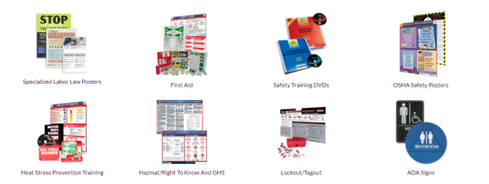
We understand how crucial workplace safety is for employers and employees. That’s why our Cal/OSHA store features compliance products and resources such as specialized labor law posters, ADA signs, and more to keep your business up-to-date and prepared for new legislation.
Heat Illness Resources
Show your workforce that their health & safety in the workplace matters with the heat exhaustion trainings, posters, guides, and postings from our Cal/OSHA Compliance Store.

For more information, visit the DIR’s page on Cal/OSHA’s proposal for heat illness prevention at https://www.dir.ca.gov/oshsb/Indoor-Heat.html.
March 1, 2026
Is there a rule about capping vacation at one-and-one-half times an employee’s accrual rate?Q: Is there a rule about capping vacation at one-and-one-half times an employee’s accrual rate?
A: Once an employee earns vacation time, it can not be taken away. The unused hours must be used by the employee, paid out as wages, or rolled over to the next year's available balance. An employer may limit the amount of unused vacation an employee accumulates, or their available balance, so the employee is limited from accruing vacation hours until the available balance is used or paid as wages. California does not require employers to provide vacation leave to employees; however, once a policy is established, certain rules apply.

October 2, 2025
OBBBA & Overtime: Upcoming Changes for 2026The One Big Beautiful Bill Act (OBBBA) introduces changes and new requirements for reporting overtime pay in 2026. The changes are required to enable employees to claim certain overtime deductions on their personal tax return.
The new tax deduction applies only to the ‘Qualified Overtime Compensation’ portion of overtime pay. The Qualified Overtime Compensation is the premium portion of overtime pay, or that extra “half” portion of “time-and-a-half” compensation.
For example, if an employee earns $20/hour and works overtime, the overtime pay is $30/hour. Of the $30/hour, in this example the $10/hour is the Qualified Overtime Compensation that may be deductible under the new rule.
Not all overtime will qualify for the deduction by employees. Only overtime pay required by the Federal law Fair Labor Standards Act (FLSA) is eligible. Overtime Pay required by California regulations will not be included in the tax deduction. This means the California Overtime Pay for working over 8 hours in a day, or double time for over 12 hours, will not be allowed to be deducted.
Starting in 2026, employers may need to make changes to how they track and report overtime. The IRS has recently announced transition relief for 2025, and tax forms for 2025 will not be adjusted. The IRS will provide further guidance on the specifications for the 2026 tax returns later this year.
While these deductions are in effect now, the tax deductions are taken into account on the employee’s individual tax return when it is filed. The new overtime tax deduction is not taken through payroll. Additionally, all overtime is still subject to Social Security, Medicare, unemployment, and state taxes.
Eligibility: The overtime deduction is available for both itemizing and non-itemizing taxpayers.
From 2025 to 2028, employees who qualify can deduct up to $12,500 annually for the Qualified Overtime Compensation’ (or $25,000 for joint filers). To claim the deduction the employee must Include their Social Security number on their return and file jointly if married, to claim the deduction. Employees who make over $150,000 individually (or $300,000 jointly) will have the deduction phase out. Whether the employee itemizes or not, overtime deduction may be available.
October 2, 2025
IRS Announces No Changes to Tax Returns for 2025 Related to the One Big Beautiful Bill ActThe One Big Beautiful Bill Act (OBBBA) requires changes to tax reporting on overtime and tips. However, the IRS announced that, as part of the phased implementation of the OBBBA, there will be no changes to tax returns or federal withholding tables for Tax Year 2025.
The IRS will not be making adjustments for 2025 related to the OBBBA, and forms will remain the same. Specifically, Forms W-2, existing Forms 1099, Form 941, and other payroll forms will not change for 2025. Federal income tax withholding tables will continue as they are. Employers should continue using current reporting and withholding procedures until 2026.
The IRS explained that delaying changes until 2026 is meant to reduce confusion during the upcoming tax filing season and give businesses and tax professionals more time to prepare for implementation.
“These decisions are intended to avoid disruptions during the tax filing season and to give the IRS, business, and tax professionals enough time to implement the changes effectively,” said the IRS in a written statement.
The IRS is developing guidance and updated forms for Tax Year 2026. One of the most significant changes will impact how tips and overtime pay are reported. The IRS has stated that additional guidance will be released in the coming months.
October 2, 2025
New California Minimum Wage Announced for 2026California’s minimum wage will be increasing in 2026. For hours worked on or after January 1, 2026, the new California minimum wage will be $16.90/hour, a 2.49% increase from the current rate of $16.50/hour. This new rate applies to all employers, regardless of size.
The wage increases also apply to full-time exempt employees, whose minimum salaries will increase to $70,304/year ($1,352/week), also an increase of 2.49% from the current salary minimum of $68,640/year ($1,320/week)
To view the certified letter from the California Department of Finance (DOF) regarding these new minimum wages, click here:
https://dof.ca.gov/wp-content/uploads/sites/352/2025/08/Minimum-Wage-Increase-Notification-Governor-and-Legislative-Letter.pdf
For a current listing of the California City & State Minimum Wages, view our page here: https://californiapayroll.com/california-minimum-wage/
Don’t forget, the required Labor Law Posters will also need to be updated. Contact us if you need an automated solution for your company’s posters.
August 25, 2025
Navigating Language Requirements for Workplace Posters in California
One often overlooked aspect is the language in which mandatory posters are displayed. California, known for its diverse population, has specific requirements to ensure that all employees have access to workplace information.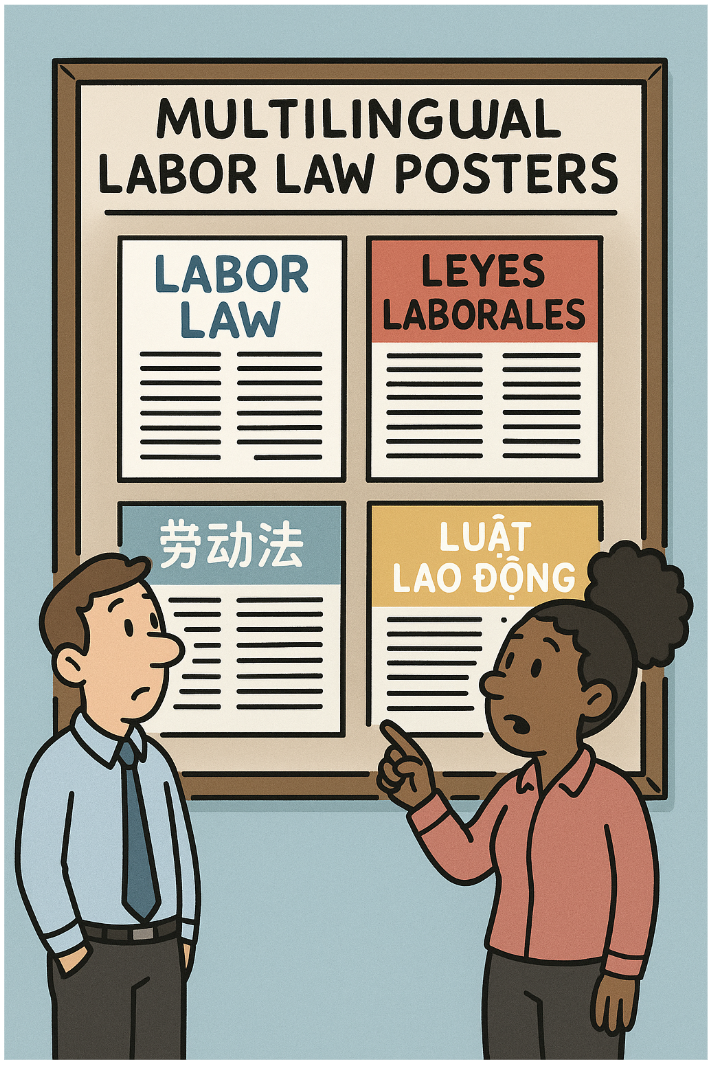
Federal Language Requirements for Workplace Posters
The U.S. Department of Labor (DOL) recognizes the importance of communicating with employees in their native languages:
- Family and Medical Leave Act (FMLA): Employers must provide notices in a language their workforce understands if a significant portion of employees are not literate in English.
- Migrant and Seasonal Agricultural Worker Protection Act (MSPA): Posters must be available in languages commonly spoken by migrant workers who are not fluent in English.
- Executive Order 13496: Federal contractors and subcontractors must post notices in languages spoken by employees who are not proficient in English. Translations are available through the DOL upon request.
- Immigration and Nationality Act (INA): Employers must provide notices in languages common to a significant portion of their workforce if they are not fluent in English.
California’s Additional Requirements
California agencies have specific language guidelines:
- California Civil Rights Department (CRD): If 10% or more of a company’s workforce speaks a language other than English, posters must also be displayed in that language. Employers can request additional translations through the CRD.
- California Department of Industrial Relations (DIR): Employers are required to display minimum wage posters in Spanish for workers who only speak and read Spanish.
Why Language Compliance Matters
California has the largest Hispanic and Latino population in the United States, making Spanish the most commonly required language alongside English. By addressing the linguistic needs of their workforce, employers meet legal obligations to ensure employees are provided important information.
Conclusion
Employers should stay informed about language requirements for workplace posters and adapt to the needs of their workforce. Requirements may differ for each company and regulation, and it’s ultimately the employer’s responsibility to stay informed.
This content is provided for general informational purposes as a courtesy and should not be interpreted, taken or construed as guidance or legal advice. California Payroll is not engaged in the practice of law or providing accounting, tax or legal advice. Employers and organizations are encouraged to consult with legal counsel, CPA, financial advisor, and/or a tax advisor to address any specific concerns, risks, or requirements relevant to their jurisdiction and circumstances.
There is much more to learn about labor law poster compliance in California. That’s why we wrote a 10-page guide on the topic and made it free.
 Download your copy today and stay in the know

January 15, 2025
Effortless Compliance for Wine & Ag Businesses with California Payroll Join us at the 2025 Unified Wine & Grape Symposium in Booths #120 and #A2502 to discover how our integrated HR/Payroll technology, Timekeeping solutions, and flexible Benefits Administration software provide effective workforce management solutions for wineries, growers, Farm Labor Contractors, and businesses across the Wine & Ag market supply chain.
Our enhanced HR, Payroll, Timekeeping, and Benefits Administration packages integrate completely with leading agribusiness HR platforms to help you navigate the complex compliance of:
- The fluctuating needs of seasonal workforces
- Agriculture-specific California labor laws
- Piece rate & job codes
- 941 and 943 Reporting
- Farm Labor Contractors (FLC’s)
Our flexible payroll systems are designed to accommodate your business’s unique circumstances, helping you streamline your operations, improve efficiency, and remain competitive in the Ag labor market with:
- Payroll solutions
- Benefits Administration
- Human Resource software
- Timekeeping
- Workforce Management
California Payroll
Unified Symposium Booth: 120 & A2502
For over two decades, California Payroll has offered comprehensive Payroll, Timekeeping, and Human Resource technology solutions to businesses of all shapes and sizes, from 5 to 10,000 employees, across all 50 states. Our modern software provides flexible and robust solutions tailored to the unique needs and policies of the Wine & Ag industry. Our dedicated support professionals will help you get the most out of every product and feature so you can HR faster and have more time to grow your business.
Visit us at the Unified Wine & Grape Symposium to discover how we can empower your business with the solutions you need to successfully navigate the complexities of the Wine & Ag industry.
January 3, 2025
2025 Mileage Reimbursement Rates Are Here!Employers reimbursing employees for mileage, take note: The IRS has updated the standard mileage reimbursement rates for 2025 to $0.70. 💰
To view all other reimbursement rates click below:
https://hubs.li/Q030Byq40

November 11, 2024
Simplify Workforce Management with Tailored HR and Payroll SolutionsJoin us at the 2024 WIN Expo in Booth #235 and discover how our integrated HR/Payroll technology, Timekeeping solutions, and flexible Benefits Administration software provide effective workforce management solutions for wineries, bottling companies, farm labor contractors, and businesses across the wine market value chain.
Our enhanced HR, Payroll, Timekeeping, and Benefits Administration packages integrate completely with leading agribusiness HR platforms to help you navigate the complex realities of:
- The fluctuating needs of seasonal workforces
- Compliance with agriculture-specific California labor laws
- Extensive record-keeping reporting requirements
- Union-related management and benefits administration
- Complicated job role and pay rate situations
- Worker safety and health benefits
Our flexible payroll systems are designed to accommodate your business’s unique circumstances, helping you streamline your operations, improve efficiency, and remain competitive in the labor market with:
- Tailored solutions for the wine industry
- Complete integration
- Automated annual census and enrollment processes
- Applicant Tracking
- Onboarding and Benefits Enrollment
- Performance Management
- Earned Wage Access and Financial Wellness programs
California Payroll
WIN Expo Booth: 235
For over two decades, California Payroll has offered comprehensive Payroll, Timekeeping, and Human Resource technology solutions to businesses of all shapes and sizes, from 5 to 10,000 employees, across all 50 states. Cutting-edge HR, Payroll, Timekeeping, and Benefits Administration software provides flexible and robust solutions tailored to suit the unique Payroll and Benefits policies and offerings of businesses across the wine industry.
Visit us at the WIN Expo to discover how we can empower your business with the solutions you need to successfully navigate the complexities of the wine and agricultural industry’s labor laws and regulations, streamline your operations, and get the most out of your workforce.
October 29, 2024
How Is Your Company Communicating Labor Law Postings to Remote Employees?What Are Labor Law Postings/Posters?
Every employer should be familiar with labor law posting requirements. Postings are required Federal, State, or local regulations regarding employee rights under their employer.
Various agencies issue labor law postings to ensure employees receive notice of their rights in the workplace or protocols they must follow. Some common topics in these postings are workplace safety, federal and state minimum wage laws, workplace conduct, and COVID-19 protocols.
Depending on the industry or state your company is based in, new postings or the content of existing postings may be updated by their issuing department at any time and often at different intervals. Once their content changes or there is a new posting, employers must display them within specific grace periods to stay compliant.
The Department of Labor (DOL) requires employers to display applicable postings at their place of business in an area frequented by all employees. Poster services condense these individual postings into one poster and replace them with updated legislation when needed.
Do I Have to Provide Labor Law Posters to Remote Employees?

The abovementioned process works well for in-person jobs, but how are employers expected to display important postings to remote employees who never visit a company’s worksite?
Employers must still communicate mandatory postings to workers who rarely or never visit the office. Fortunately, agencies like the DOL that require these postings have accepted digital postings and posters in addition to hard copies to keep remote employees informed of their rights in the workplace. Digital posters are available for employees who don’t visit their company location at least 3-4 times a month to update them on new labor laws or protocols.
If I Employ Remote and In-Person Employees, Do I Still Need Physical Posters in My Workplace?
Employers with physical workspaces must still display updated versions of required postings, even if they have only one in-person employee. Federal agencies only allow solely digital postings if all their employees work remotely and can readily access them electronically.
So, if your workforce is comprised of both remote and on-site employees, you’ll need to comply with both required labor law postings and ePosters.
Penalties for Non-compliance
All employers with at least one employee must post federal and state labor law postings at each of their locations in an area frequented by all employers. Allowances for digital posters have only been made recently to accommodate the rise of remote work.
If employers fail to keep all of these postings up to date, they can face fines of up to $17,000 per location or be liable for employee lawsuits. For example, if an employer fails to accurately notify employees of their most recent rights and resources regarding discrimination in the workplace and an employee files a discrimination lawsuit, they are more likely to be liable for damages.
How Do I Keep up With Changing Workplace Postings for Remote AND In-Person Employees?
Technically, employers can manage their postings, posters, and digital labor law posters on their own. Individual agencies provide required listings for free as PDFs. However, many employers prefer to outsource this task for several reasons.
• Many employers have to update required postings several times a year
• Agencies requiring postings don’t allows communicate required updates well, so employers must stay vigilant
• Required posters do not update on the same date annually, so they are difficult to anticipate
• Labor poster compliance is an essential prerequisite to running a business, but it’s not the work you want to scratch off your to-do list.
• Employers with remote teams must make other arrangements to provide current labor law postings to them effectively, in addition to their on-site posters
Our Solution

Fortunately, California Payroll offers a poster solution to help employers stay compliant, with a guaranteed $25,000 fine Reimbursement policy to protect you. Our poster service can compile applicable postings for your company into one poster and mail it to you whenever there is a new update.
As for your remote employees, our brand-new digital labor law posters Service Center can deliver current federal, state, county, and city notices to your remote workforce digitally. Learn more about this new product through our new blog. If you’re ready for a demo about the ePoster Service Center, request one on our website.
August 21, 2024
California's Minimum Wage Set to Increase in 2025
California's Department of Finance certified a minimum wage increase from $16 per hour to $16.50 per hour, beginning January 1, 2025. This determination will apply to most California employers regardless of size, that don't have special wages for their industry or localities.
Why was this CA minimum wage increase implemented?
The California Director of Finance analyzes inflation annually via a U.S. Consumer Price Index (CPI) and determines whether or not to adjust California's minimum wage accordingly. Per California's Labor Code, it's either increased by 3.5 percent or the actual rate of change per CPI, whichever is less.
Joe Stephenshaw, California Finance Director, certified the latter option, a 3.18 percent increase in accordance with the department's CPI calculations.

How does this minimum wage increase affect full-time exempt employees?
This increase also affects the minimum salary requirements for full-time exempt employees. It's currently $66,560 per year ($1,280 per week) and will increase to $68,640 per year ($1,320 per week) on January 1, 2025.
Exceptions to the CA Minimum Wage Increases Employers Should Know
Employers should remember there are some instances where this minimum wage increase does not apply:
- Many California cities and counties have their own local minimum wage rates that override the state requirements.
- Fast food restaurant employees covered in California Labor Code Section 1474-1476 have their own minimum wage of $20 per hour on April 1, 2024.
- Health care workers will also have a special minimum wage that will be effective no later than January 1, 2025, depending on their facility type.
For information directly from California's Director of Finance, view or download the full PDF on the 2025 minimum wage increase here.
August 8, 2024
Integrate Success into Your Business with Payroll and HR SolutionsDon't reinvent the wheel. Integrate success into your business with payroll and HR solutions that connect to leading platforms for benefits administration, applicant tracking, financial wellness, and more. Empower your HR staff to handle various tasks and duties without the hassle or headaches of juggling disparate systems.
https://hubs.li/Q02GsMc-0

June 26, 2024
California Local Minimum Wage Increases Effective July 1, 2024In addition to industry specific wage increases coming next month, several cities and counties in California are also increasing local minimum wages. Increased wages apply only to hours worked on and after July 1, 2024.
These Local Wage Increases are Effective July 1, 2024
- Alameda, CA: $17.00/hour;
- Berkeley, CA: $18.67/hour;
- Emeryville, CA: $19.36/hour;
- Fremont, CA: $17.30/hour;
- Los Angeles, CA (City): $17.28/hour; $20.32/hour for hotels with 60 or more rooms
- Los Angeles County, CA (unincorporated areas): $17.27/hour;
- Malibu, CA: $17.27/hour;
- Milpitas, CA: $17.70/hour;
- Pasadena, CA: $17.50/hour;
- San Francisco, CA: $18.67/hour; $16.51/hour for a small number of “Government Supported Employees”;
- Santa Monica, CA: $17.27/hour; $20.32/hour for hotels and businesses operating on hotel property
- West Hollywood, CA: $19.61/hour for hotel employees
California employers should adjust their wages to reflect their location. Employers with remote and hybrid employees may need to adjust wages according to the city or county they work from. To remain in compliance, employers must update their minimum wages according to these local increases by July 1, 2024.
California Payroll Provides Poster Compliance Services
Many of these local wage increases require corresponding postings. Disseminating information about wage requirements to employees is vital, but staying on top of it can be a headache.
California Payroll offers poster services to make workplace posting updates simple all year round. Visit California Payrolls Poster Compliance Services to learn more, and call today to speak to a specialist.

June 6, 2024
Efficient Time Clock Solutions for Employee ManagementFrom the simplest and most basic punch clocks to advanced biometrics solutions to convenient web and mobile apps, there are many different ways to track your workforce's time. Each has its advantages and disadvantages for different work environments and industries. Get in touch with our specialists and find out which is best for your business today!
https://californiapayroll.com/time-and-attendance/software-services/time-clocks/
May 7, 2024
California Payroll Offers a Number of Products to Assist Your HR DepartmentKeep your HR staff and your workforce well-informed and ensure compliance with labor law with our extensive selection of HR resources. From labor law posters to training materials to background check tools, everything you need to enhance the well-being and security of your employees and foster a positive and secure work environment is at your fingertips with California Payroll.
https://californiapayroll.com/hr-products/
