
Filter Post Type
NewsVideoProductEventLink
Sort:
Most Recent
1–6 of 6


The conversations I have about quality tend to focus on red wine. This is especially true in California, where Napa Cabs have historically garnered high prices, followed up by Coastal Pinot noirs and red Rhones. Honestly, in most places I’ve been where the climate allows for ripening red grapes, the reds are the main event with the whites being more of a warm-up act or even an afterthought. As a result, we know a lot about how to grow red grapes for quality – and less about how to grow whites. Consumer tastes are shifting though, and the big reds of yore are taking a back seat. Drinkers want lower alcohol wines with a lighter style and wineries are taking fewer risks with wine they can turn around in under a year. As a result, white varieties are in hot demand. If you’re a grower who can’t sell your grapes, you may very well be considering grafting some of your reds over to white. So how do you grow a good white? In many ways whites are harder than their r
00
May 20, 2024

In the 1880s, Pierce’s disease caused a devastating, total collapse of the Southern California grapevine industry. Today, growers have hope for the future thanks to new varieties. Adam Tolmach, owner of Ojai Vineyard, planted four of these new varieties as a field trial on a plot of land where Pierce's disease wiped out his grapes in 1995. Pierce’s disease is a bacterium spread by insects, typically a sharpshooter. One bite and the vine dies within two to three years. To develop resistant varieties, Andy Walker of the University of California at Davis crossed the European grape Vitis vinifera with Vitis arizonica. 20 years later, commercial growers have access to three red and two white varieties. Listen in to learn how Tolmach’s experiment is a success both in the vineyard and with customers. Plus get tasting notes for the new varieties. LISTEN IN Resources: REGISTER: The Ins & Outs of Developing a New Vineyard Site 89: New
00

September 29, 2023
Afternoon Brief, September 29th
Ohio Launches Appeal Over Wine Shipping: The state of Ohio has requested the Supreme Court to take on another wine shipping case....
California Sustainable Winegrowing AllianceArcanaVineyard TeamVine Cliff WineryMom JuiceKT WineryIWSRAtwater VineyardsGamble Family VineyardsIronstone VineyardsVitis ViniferaWagner Vineyards Estate WineryWhiteHall Lane WineryFoley Family WinesSonoma County WinegrowersSonoma County VintnersSonoma County Harvest FairAvalara
00
September 26, 2023
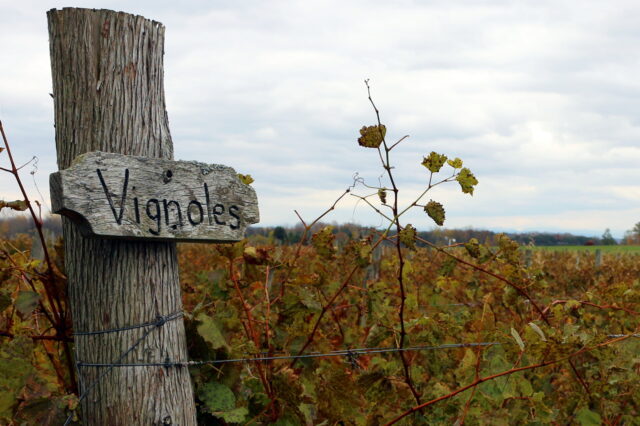
Time to Shine: A Second Honeymoon for Hybrid Grapes
Producers are rethinking their devotion to the nobles. By Kathleen Willcox The last few years have not been kind to vitis vinifera. Damage from wildfires, hail storms, late and […]
00
May 18, 2022

2022 ASEV Keynote Speaker to Present on the Interplay Between Biology and Environment During Fruit Ripening in Vitis Vinifera
DAVIS, Calif., May 17, 2022….Dr. Simone D. Castellarin, an Associate Professor in the Wine Research Centre at The University of British Columbia in Canada, will be the keynote speaker for […]
00
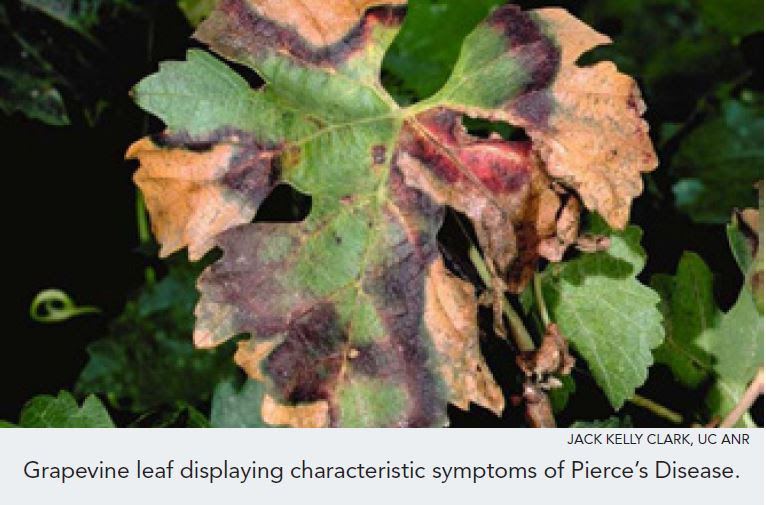
Pierce's Disease has been a scourge of vineyards for well over a century. It was discovered near the end of the 19th century by Newton Pierce, so the disease took on his name after originally being given the name Anaheim Disease (having been discovered in that area’s vineyards well before Disney and all that pavement moved in). Pierce’s Disease (PD) is a nasty disease caused by the bacterium Xylella fastidiosa, which is vectored by several different sharpshooter insects, including blue-green, red-headed and glassy-winged. The bacteria colonize the xylem vascular tissue. The bacterial colonies, along with gums that are exuded by the vine itself, clog the vessels and effectively choke off the vine’s water transport system. The disease is catastrophic in that it cannot usually be surgically removed from the vine and will most often quickly reduce both its fruit production and fruit quality before finishing off the job and killing the vine after a few years.
It is n
00