
Filter Post Type
NewsVideoProductEventLink
Sort:
Most Recent
1–3 of 3
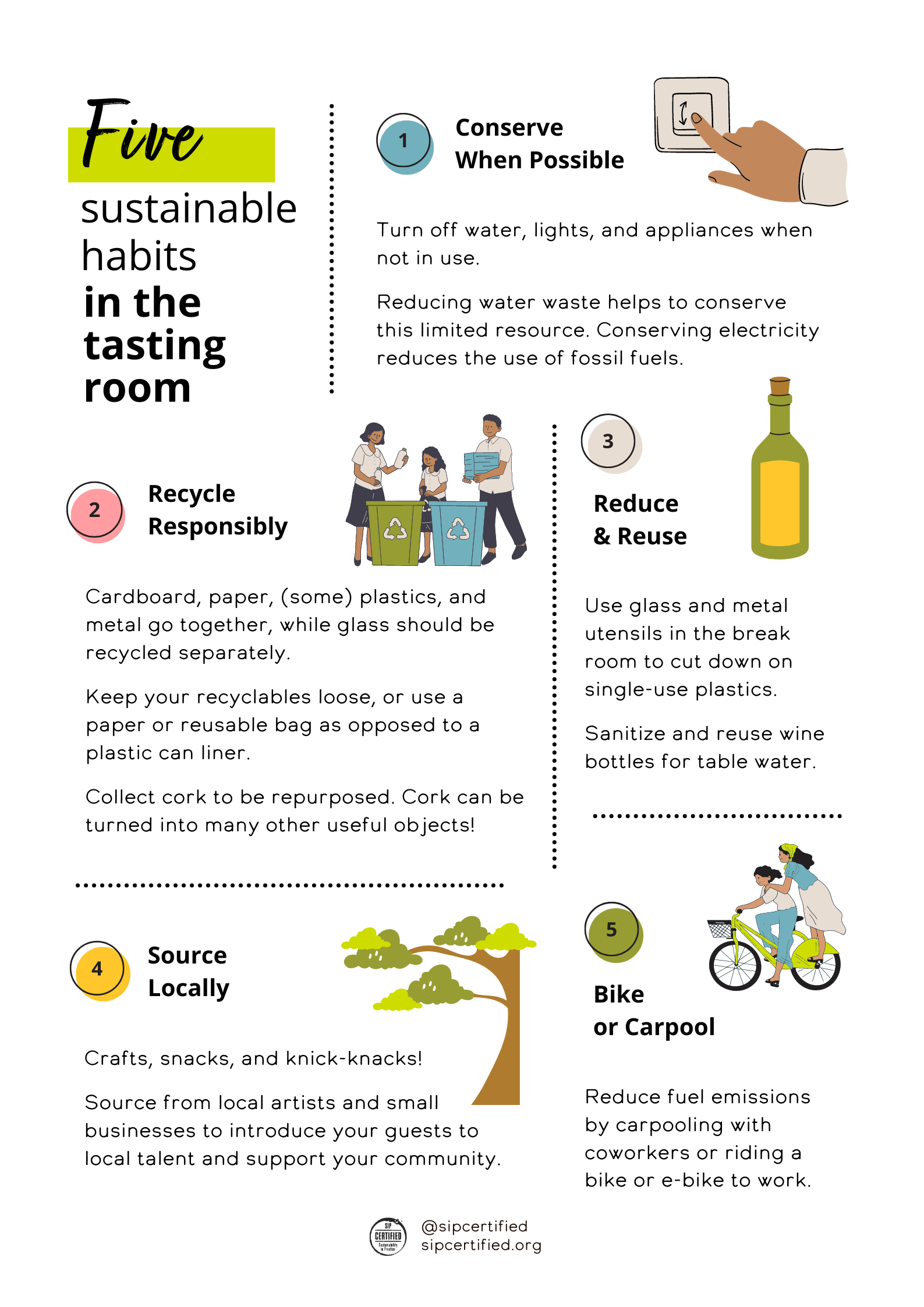
Listen to this article! By acting environmentally and socially responsible today, we give future generations a healthy place to call home. The actions that you as an individual take have an impact. The summer months bring more staff and guests into tasting rooms across the country. Invite your whole team to join in your brand’s sustainability efforts when you practice these 5 Sustainable Tasting Room Habits. 5 Sustainable Tasting Room Habits Tip #1: Conserve Simple actions like completely shutting off water faucets after use and notifying management of leaks help to conserve this limited resource. Turning lights and appliances off when not in use reduces electricity use. Although the commercial end-use energy sector uses the smallest amount of energy of the four sectors (transportation [36%], industrial [35%], residential [16%], commercial [13%]), the majority of the energy used comes from fossil fuels (EIA.gov, 2022). Small efforts in the workplace reduc
00

November 1, 2021

Afternoon Brief, November 1st
‘Theft of the Century’: ‘Couple’ Wanted After Stealing 45 Hugely Valuable Wines from Michelin-Starred Restaurant: Spanish media are calling it the “theft of the century.” A couple has seemingly pulled off a famous wine heist after stealing dozens of bottles of astronomically expensive wines, including a famous bottle of 1806 Château d’Yquem, from Atrio – a two Michelin-starred restaurant Caceres Spain...
00

Every year around 12 billion cork stoppers are sold worldwide. Recycling, in addition to increasing the reuse of raw materials, enables the life cycle of cork stoppers to be extended. Therefore, not only is it possible to decrease the costs associated with the production of other high value-added products, but also to contribute to a cleaner world. Cork stoppers absorb CO2 particles which they «inherited» from the bark of the cork oak, a tree which has the important ability to retain CO2 which causes the greenhouse effect. If they are decomposed or incinerated, the CO2 is released into the atmosphere and shall contribute to global warming. Conversely, recycling enables the CO2 retention capacity of cork to be extended. In each tonne of cork stoppers, around 1.83 tonnes of CO2 is retained, which, once they have been recycled, this capacity is ensured forever, as the reuse of this raw material is unlimited. At Amorim Cork America we are partnered with ReCORK™, North Ame
00