

March 1, 2026
Want Faster Support Without More Staff? Meet WineSpot — Your New AI Teammate
Wineries are overwhelmed with emails, voicemails, and repetitive customer questions — especially during wine club season. Most don’t have a dedicated support team, and existing tools weren’t built for this kind of workload.
In this session, we’ll introduce WineSpot, an AI-powered customer support solution designed specifically for wineries. You’ll see how it helps small teams automate up to 60% of incoming inquiries — from order questions to wine club updates — without sacrificing the personal touch.
We’ll cover:
- What today’s customers expect when they reach out
- Where traditional tools fall short (and cost wineries time and members)
- How WineSpot works and what it can handle on its own
- What kind of results wineries can expect
- How to join our early access program for free
This is a casual, 30-minute prerecorded session, with live Q&A in the chat throughout.
May 8 @ 11:00 am
Speaker

March 1, 2026
Live Chat, Chatbots, SMS or AI Agent — What’s the Best Fit for Your Winery? Today’s customers expect fast, convenient support — and they don’t care how small your team is. If they can’t get an answer quickly (and on their terms), they’ll move on.
That’s a real challenge for small and mid-size wineries, especially those juggling tasting room traffic, fulfillment, events, and direct-to-consumer (DTC) sales — often with no dedicated customer support team.
So what’s the solution?
In our latest blog post, we break down the pros and cons of four common customer communication tools — live chat, chatbots, SMS, and AI agents — to help wineries choose the best fit for their business model, resources, and customer expectations.
Here’s a preview:
✅ Live chat works great if someone’s there to respond — but for most small wineries, that’s not realistic. Often, customers are asked to “leave a number,” which turns a helpful tool into a dead end.
✅ Basic chatbots (rule-based or keyword-triggered) can answer simple questions but tend to frustrate users when conversations go off-script.
✅ SMS is effective for marketing and updates — but it’s not a good first touchpoint. Requiring a phone number upfront creates friction, especially for new visitors.
✅ AI agents go far beyond bots. They understand context, carry on real conversations, connect to your CRM, and handle up to 60% of requests without human involvement — freeing up your team and improving response times.
📊 Why this matters:
• 51% of customers expect 24/7 availability
• 67% say slow replies have made them cancel an order
• 81% prefer self-service when it’s done right
If you’re relying on phone and email alone, or using tools that don’t match your team’s bandwidth, this article is for you.
👉 Read the whole article here:
https://winespot.ai/livechat-chatbot-sms-or-ai-customer-service-what-to-choose
🇠Press Grapes, not buttons!
March 1, 2026
📬 Say Goodbye to Inbox Overload: How WineSpot’s Email Bot Turns Messages Into ResolutionsIf you’re running a winery, you already know that customer emails don’t trickle in — they flood.
Especially around wine club releases or holiday shipping, your team’s inbox becomes a logjam of:
“Where’s my order?”
“Can I skip this one?”
“Help, I need to change the address before it ships.”
“Can I swap my wines in a shipment?”
These aren’t complicated questions — but they are constant. And during wine club season, they pile up fast. Winery teams often spend hours just keeping up, answering the same things over and over. It’s repetitive, exhausting, and leads to burnout — especially when you’re already short-staffed.
That’s why we built WineSpot’s Email Bot — a smarter, faster way to turn email chaos into clean, simple resolutions.
💡 How It Works (Behind the Scenes)
When a guest emails your winery — nothing changes. They still use the same address. They don’t know anything’s different.
But behind the scenes, WineSpot picks up the message, reads it, and understands what the guest is asking.
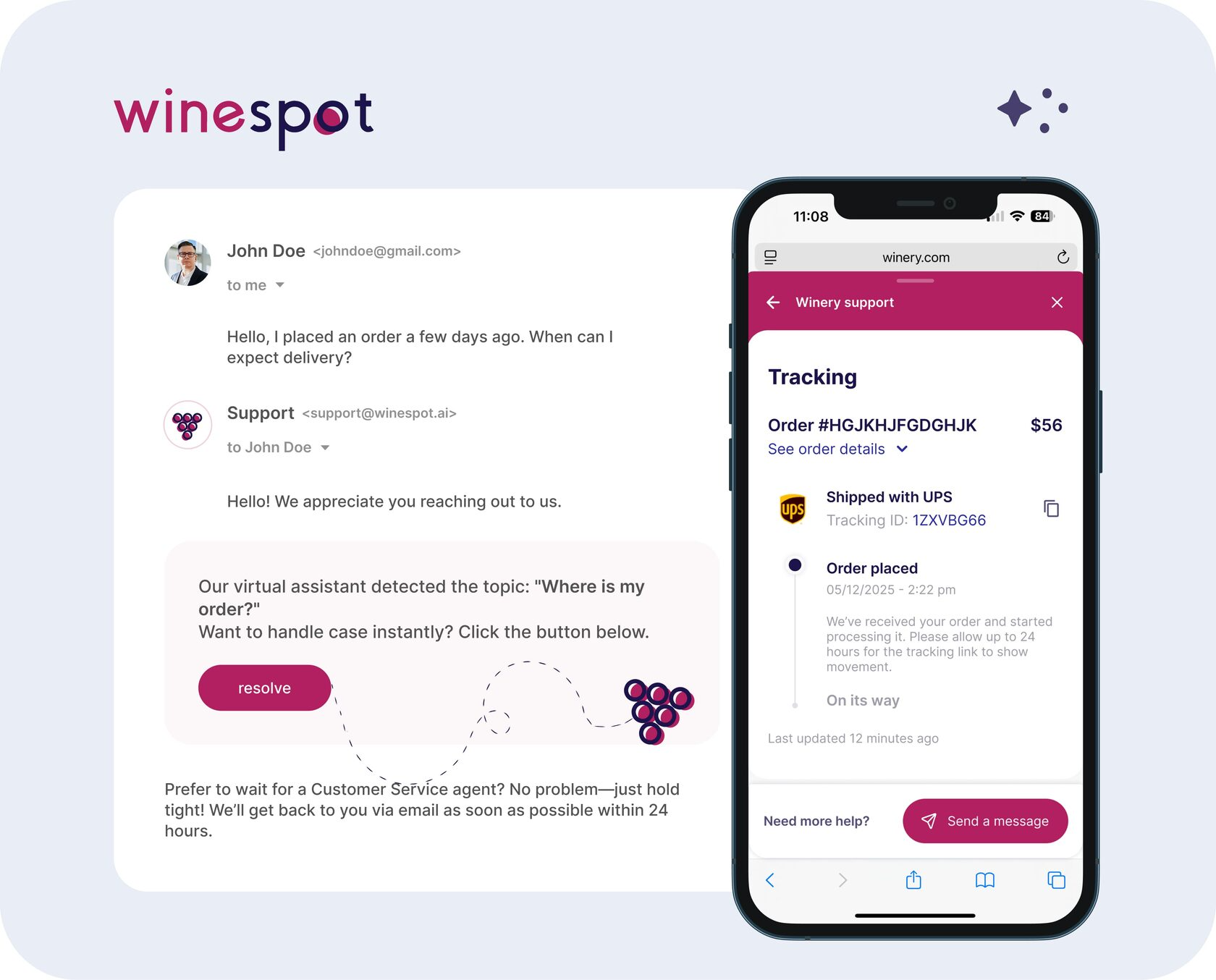
The AI agent recognizes the intent behind the message and sends back a fast, friendly reply. And right in that reply is a “Resolve” button.
When the guest clicks it, they’re taken straight into a chat window — which is right on your website — where WineSpot can walk them through solving the issue.
👉 The truth is, customers don’t want to wait for an email response. Research shows that most people want to fix the issue themselves — they just need a clear, trusted way to do it.
That’s exactly what the “Resolve” button gives them — a direct path to action, with no confusion.
The AI authenticates the customer, then connects securely to your winery systems — like Commerce7 or Corksy — and completes the request. That could be tracking an order, skipping a club box, updating a delivery address, or editing a wine selection.
If the issue can’t be completed automatically, WineSpot escalates it to your team — without losing the context.
🧠What Happens If the AI Can’t Help?
WineSpot is already able to recognize and handle over 60% of incoming customer support requests — and that number keeps growing as the system learns.
But in some cases — like processing a refund — the request needs human approval or falls outside what the AI is allowed to handle.
That’s when WineSpot triggers a fallback to your human support team.
Here’s what happens:
The conversation, detected intent, and relevant customer/order data are routed to your team through the WineSpot dashboard
If enabled, the guest is also invited to continue the conversation via SMS fallback powered by RedChirp
If your winery already uses RedChirp:
Guests can continue the thread using a tool your team already knows
✅ You organically grow your SMS opt-in list, since fallback happens within a compliant and customer-initiated flow.
🎯 Why It Works So Well for Wineries
WineSpot isn’t here to replace your team — it’s here to amplify it.
Think of it like an AI-powered support teammate that takes the first pass at every message, handles the routine stuff instantly, and flags the rest for your review — with full context, no guesswork, and no stress.
That means:
You reply to customers faster
Your staff avoids burnout
And your support team becomes 10x more effective — without needing to grow headcount
AI does the busywork. You stay focused on the moments that matter.
🥂 Built for the Way You Already Work
You don’t need to change how your inbox works or overhaul your tools. WineSpot integrates behind the scenes and takes care of the busywork — while your team stays in control of everything that matters.
If you’d like to see the Email Bot in action, we’d love to show you how it can help.
Book a quick demo or visit WineSpot AI — and let your inbox breathe again.
March 1, 2026
Online Reservation Systems vs. Built-In Booking Features on Winery Websites — What Should You Choose?
In today’s wine industry, tasting room reservations are not just operational tools — they are strategic levers. According to the 2025 SVB State of the Wine Industry Report, tasting room visitation remains one of the most powerful drivers of Wine Club acquisition and the second-largest contributor to direct-to-consumer (DTC) revenue, following wine sales themselves.
Yet, as consumer visitation patterns evolve, how wineries manage reservations — whether through third-party platforms or built-in tools — has become a critical decision. The right choice can impact everything from guest satisfaction and Wine Club conversion to brand control and long-term revenue growth.
Let’s explore the two primary approaches wineries use today:
• External reservation platforms (e.g., Tock)
• Built-in reservation flows on the winery’s own website
External Reservation Systems: Convenience with Constraints
Third-party reservation platforms like Tock, OpenTable, or CellarPass remain popular among wineries, especially those managing high guest volumes or multiple locations. These tools offer standardized user flows and built-in marketing benefits, making them attractive for operational efficiency.
Benefits:
• Quick setup with minimal technical resources
• Handles payments, confirmations, and reminders automatically
• Marketplace visibility (e.g., Tock’s regional winery listings)
• Advanced features like waitlists, seat maps, and tiered experiences
• Simplified Booking for Customers: Aggregators provide a single, convenient platform for guests to discover and book tastings across multiple wineries
Drawbacks:
• Guests are redirected off your website to book
• Limited control over branding and user experience
• Data is often stored within the aggregator’s platform, not your own
• Monthly or per-cover fees can reduce margins
• Dependence on the Platform: Your ability to take bookings relies on the aggregator’s technology and policies
“We use Tock for general tastings because it’s easy to manage. But for club bookings and private events, we need more control and flexibility.”
— DTC Manager, Interview Participant
Built-In Website Booking: More Control, Greater Integration
Many wineries choose to offer reservations directly on their own website, either through built-in tools from their DTC platform (such as Commerce7) or via a custom-designed booking flow. This approach focuses on ownership — of the experience, the data, and the customer relationship.
Benefits:
• Full Control: You maintain complete control over your reservation process, scheduling, and data
• No Commissions: You avoid paying commission fees on reservations
• Direct Customer Relationship: You build a direct relationship with your guests and have access to their information
• Guest Data Ownership: All guest data stays within your winery’s ecosystem
• Seamless guest experience — bookings happen entirely on your own website
Drawbacks:
• Requires setup and coordination with a developer or DTC provider
• May lack marketplace-style discovery features (e.g., being listed alongside other wineries)
• Ongoing maintenance and updates are your responsibility
• Limited Reach: Customers may not discover your winery through your own system if they are not already searching for you directly.
“We like having bookings stay on our site — especially for club members. But we had to work with our developer to get the flow just right.”
— Small Winery Owner
A Third Option: The Hybrid Approach
Thankfully, this isn’t an either/or decision.
Many modern wineries are choosing a hybrid reservation model — combining the discovery benefits of platforms like Tock with the ownership and branding of built-in tools on their website.
This gives you the reach of aggregators and the control of a direct channel, all while centralizing data and supporting long-term Wine Club growth.
The Smart Approach: WineSpot + a Hybrid Reservation Model
At WineSpot, we believe the most effective reservation strategy today is a hybrid model:
• Use external aggregators like Tock, OpenTable, or CellarPass to bring in new visitors and tourists
• Use your own website, powered by your DTC platform, to offer a seamless, branded experience that supports Wine Club growth
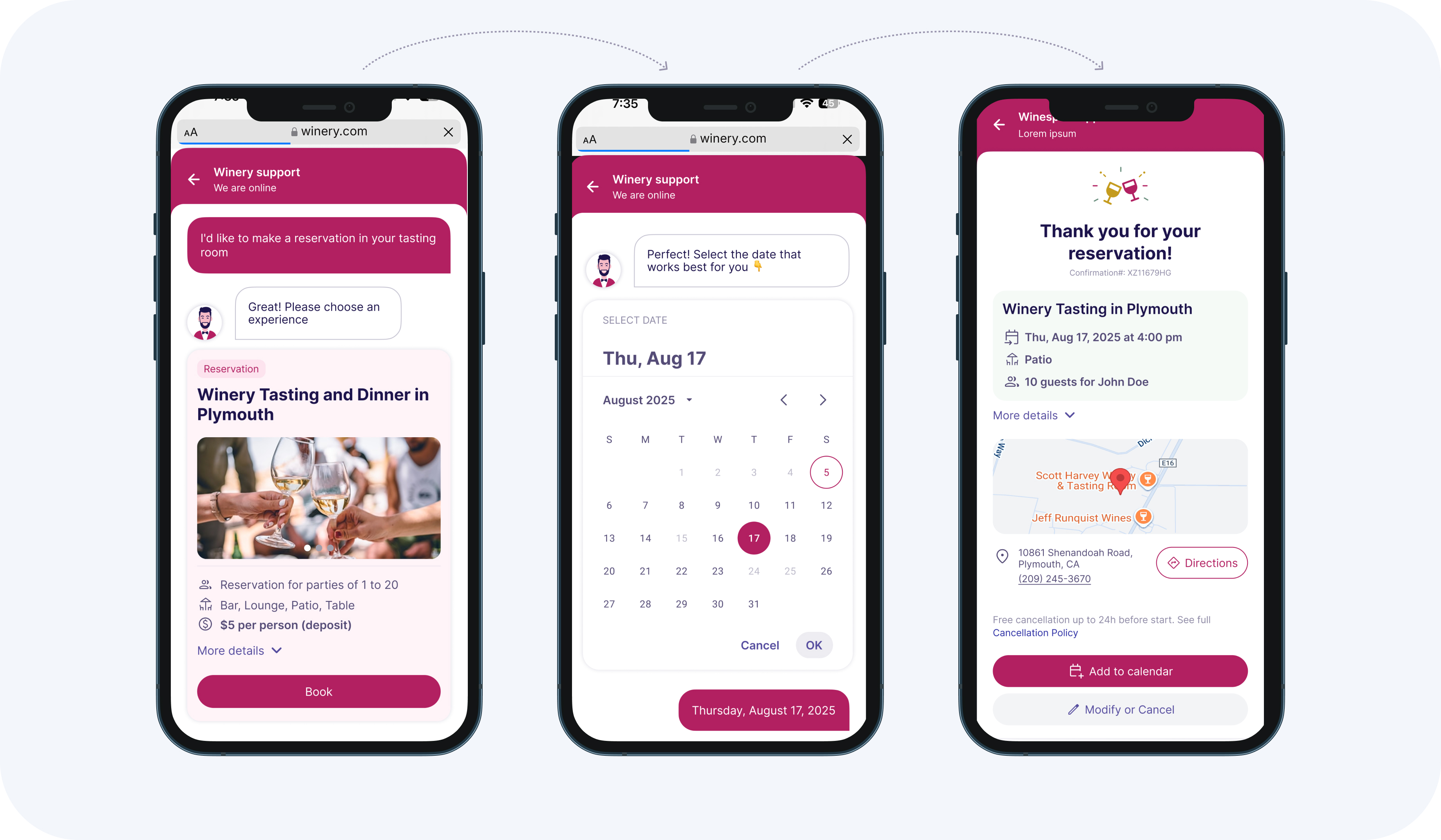
With WineSpot, your website becomes a fully capable reservation channel — not through static forms or redirects, but via an AI-powered conversation.
Guests simply ask to book a tasting, and WineSpot handles the entire flow:
• Checks availability in Commerce7
• Applies rules like membership access or max party size
• Books the reservation and sends confirmation — all within the chat
It’s the convenience guests expect, without sacrificing your brand or customer ownership.
Centralize Guest Data with Commerce7 + Tock
Commerce7 gives wineries the tools to run smart, integrated reservations — with features like:
• Multi-location support
• Flexible reservation types and pricing
• Visual property mapping
• Club-only access
• Custom booking rules
If you’re using Tock, you can still keep all customer data in one place by enabling partial or full integration in Commerce7.
This allows guest contact info — and optionally reservation orders — to sync into your Commerce7 records, so you can manage Wine Club activity, segmentation, and communication without missing a beat.
This means you can use Tock to bring in traffic, but still manage your guest data, club segmentation, and reservation history inside Commerce7.
Final Thought
In a market where every tasting room visit is a Wine Club opportunity, wineries need more than a booking link — they need an integrated, flexible strategy.
A hybrid approach, supported by platforms like Commerce7 and powered by WineSpot, gives your winery the tools to grow smarter:
• Reach new guests through aggregators
• Retain control and guest data through your own site
• Book instantly, through chat, without lifting a finger
No silos. Just a better experience — for you and your customers.
See WineSpot in action — and turn your website into a reservation assistant that works while you pour.
WineSpot AI - CS Platform for Wineries 🇠Press Grapes, not buttons!
March 1, 2026
Wine Club Members Want to Swap Wines — Here’s How to Make It Effortless
Wine club flexibility drives retention — but for many wineries, giving members the freedom to change wines before a shipment often comes at the cost of time, stress, and manual work.
In our recent interviews with DTC managers at small and mid-sized wineries, one recurring challenge stood out:
“I get a ton of those emails — people asking to change wines before their club ships.”
While it sounds simple, the process is often time-sensitive, rule-bound, and surprisingly manual. Let’s break down why these requests are so challenging — and how WineSpot’s new Commerce7-powered workflow makes the entire experience smoother for both staff and members.
The Real Problem: Endless Swap Requests
Wine swap requests typically start arriving right after the pre-shipment email goes out — about two weeks before billing. Customers reply via email, call the tasting room, or send text messages, asking to substitute wines in their upcoming release.
The trouble is that these requests often arrive with little detail. Staff have to look up the account, confirm the membership level and shipment, and double-check whether swaps are even allowed.
As one club manager explained:
“They email and say something like ‘Can I switch the Syrah for the Barbera?’ But they don’t always say what club they’re in, or which shipment they mean. I have to look everything up.”
And even when the request is clear, the manual workflow piles up: log into the system, adjust bottles, save changes, confirm with the guest, and document it in the notes. Multiply that by dozens or hundreds of members, and it’s easy to see why staff feel overwhelmed.
Why It’s So Complicated Behind the Scenes
On the surface, swapping a bottle should be quick. But in reality, it’s governed by strict rules and operational constraints:
• Billing cutoffs — changes usually stop at the billing date.
• Fulfillment deadlines — once shipments are palletized and shrink-wrapped, edits are impossible.
• Inventory limits — only certain wines are eligible, and low-stock items create exceptions.
• Club-specific rules — each club tier may have its own bottle minimums or SKU restrictions.
• Compliance checks — some wines can’t ship to certain states, like sparkling into New Jersey.
As one interviewee shared:
“Once the order is billed and sent to fulfillment, there’s no way to pull it. It’s already palletized and shrink-wrapped.”
For winery staff, each of these variables adds another layer of complexity and another opportunity for error.
Why Customers Avoid the Portal
Many wineries already include a portal link in their pre-shipment email, but most members don’t use it.
“We include the link to update wines in our email, but most people don’t use it. They just write back and ask us to make the changes.”
The issue isn’t lack of communication — it’s the friction of the portal experience.
Why? Because the portal experience creates friction:
• Passwords are a barrier: Most members don’t remember their portal login. Resetting a password or digging through old emails is too much effort for a quick change.
• The process feels clunky: Even after logging in, finding the right place to swap wines isn’t always straightforward. Different club levels, bottle minimums, and SKU rules make the experience confusing.
Instead of self-serving, members default to sending vague requests back to the winery team — creating even more manual work.
How WineSpot Makes It Simple
WineSpot removes the portal barrier by meeting customers where they already are — in email, SMS, or chat.
Here’s how the new flow works:
1. The member clicks a link or “resolve” button in an email, responds to an SMS prompt, or opens the winery’s chat.
2. Quick verification happens inside the chat experience — no password needed, just a simple identity check.
3. WineSpot AI pulls shipment details from Commerce7, validates eligibility, and presents swappable wines in real time.
4. The member makes their selection, and the system updates Commerce7 instantly.
5. If the request isn’t eligible or comes in late, it escalates to staff with full context preserved.
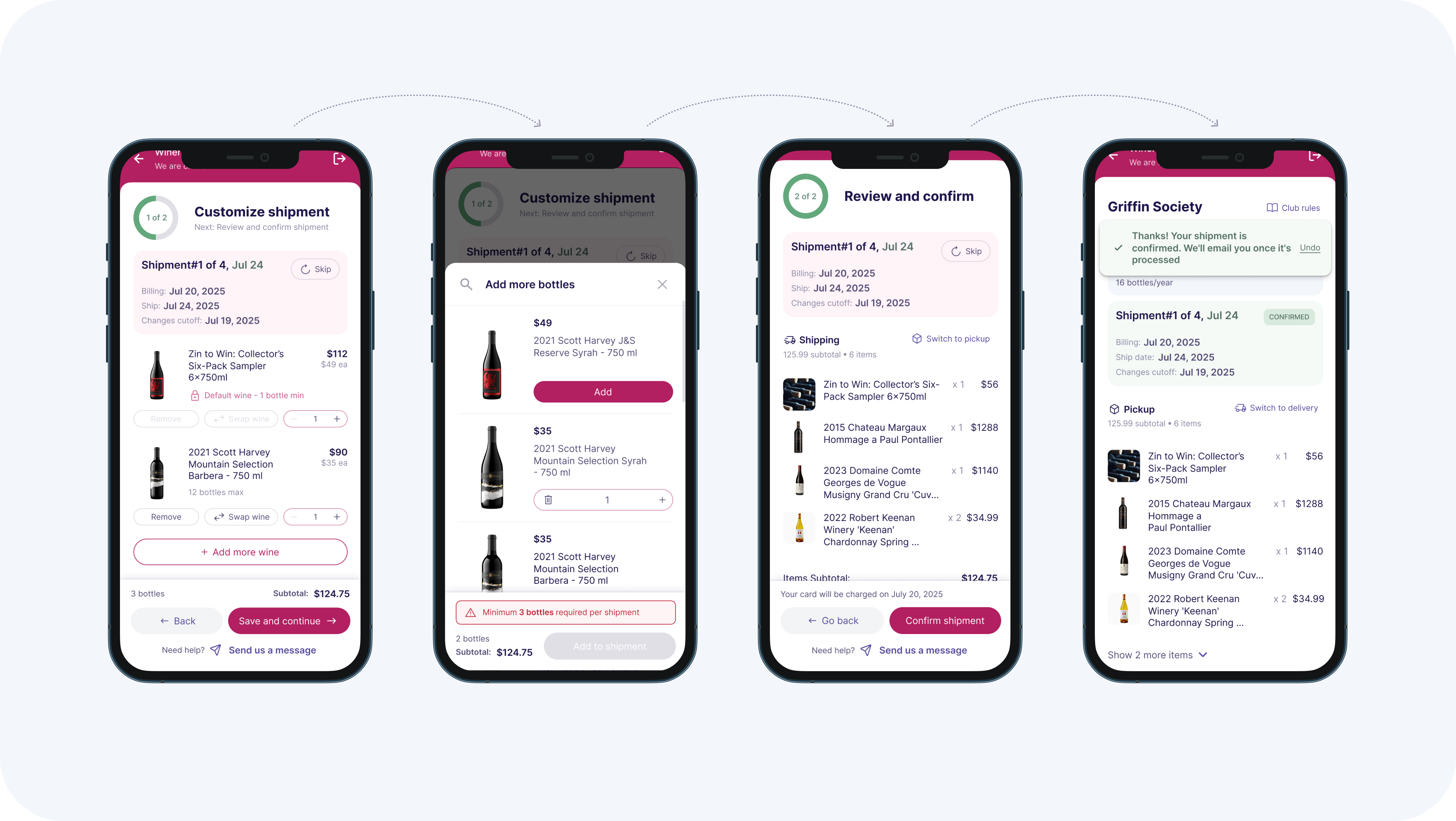
No extra logins. No back-and-forth emails. Just a quick, guided swap that works within winery rules.
Guests can also use a Help Center widget on the winery’s website. It includes quick-action buttons for repetitive inquiries such as Wine Club Management, Track & Manage Orders, or Make a Reservation. From there, they’re guided into the same AI chat-driven experience that resolves requests instantly or escalates when needed.
Built on Real Winery Feedback
This solution wasn’t invented in a vacuum. It was designed hand-in-hand with winery staff who handle thousands of wine club orders each year.
What they asked for was clear:
• A way to reduce the flood of vague, repetitive requests
• Smart validation of wine swap rules and timing
• Clear fallback when AI can’t handle an exception
• Full integration with Commerce7 so nothing falls through the cracks
WineSpot delivers on all four.
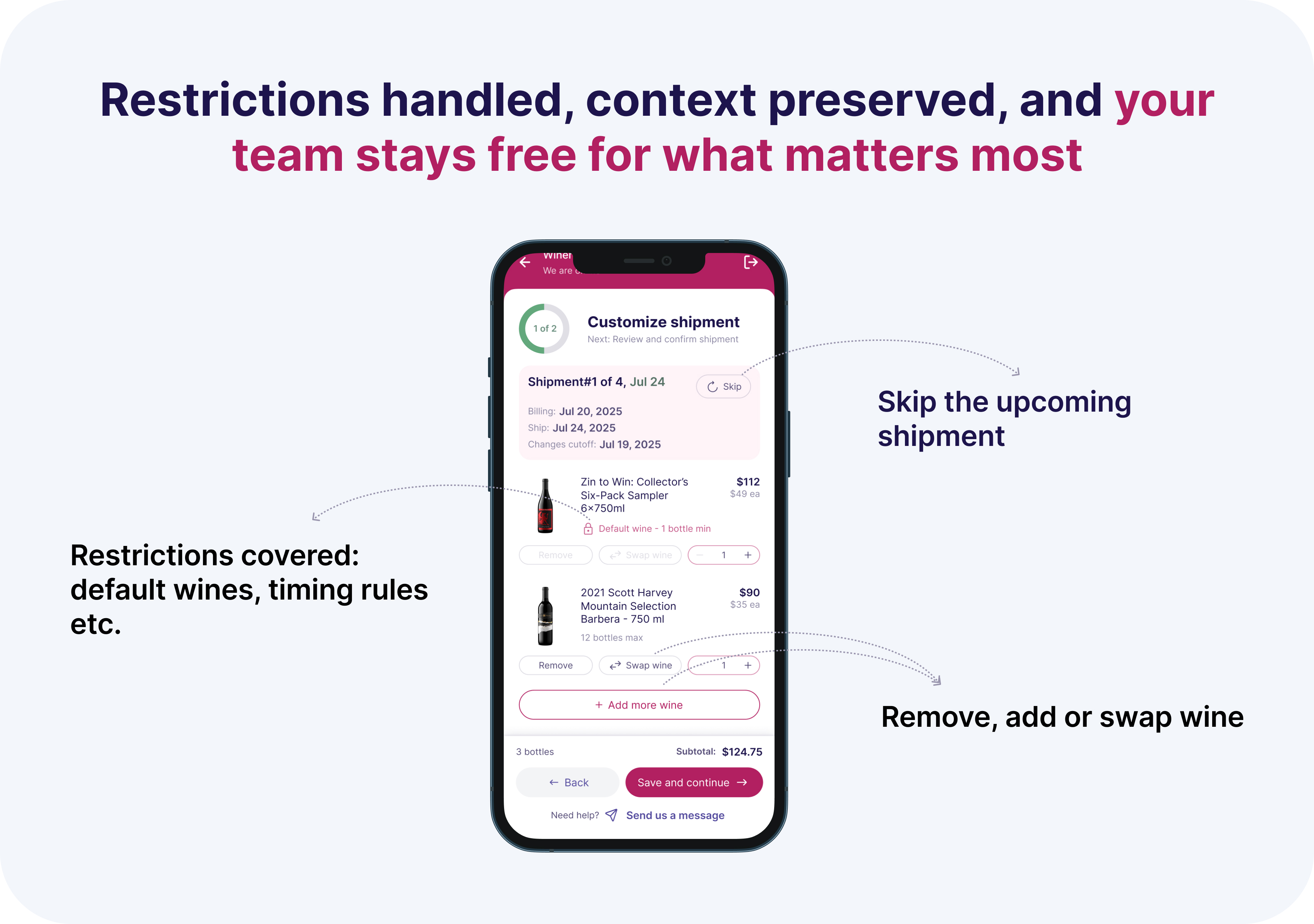
Flexibility Without the Burnout
Wine club personalization shouldn’t come at the expense of your team’s sanity.
With WineSpot’s Commerce7 integration, members get the flexibility they expect — and your team gets the time back to focus on what really matters.
Curious to see it in action?
Book a quick demo and discover how WineSpot can handle wine swaps — and dozens of other repetitive tasks — with zero training and real results.
Originally published on the WineSpot.AI Blog
WineSpot AI - CS Platform for Wineries 🇠Press Grapes, not buttons!
February 25, 2026
WineSpot AI: Filling the Gap in Winery Customer Service Winery marketing teams are in overdrive these days—accelerating efforts to attract younger consumers, growing wine club membership and elevating tasting room and online interactions for prospective visitors and buyers. In the end, effective communication to meet these goals is a must.
Many small and mid-sized wineries have staffing limitations that make providing quality tasting room experiences and handling call-ins while also attending to texts, emails and online orders a daunting challenge.
Evgeny Bazhutov founded WineSpot AI to help wineries fill this gap. “Before launching our automated support app, we spent eight months researching the U.S. winery market to assess automation levels in business processes, customer support structures and the key pain points wineries face. Through over 100 interviews with winery employees and business owners, we found that wineries producing up to 5,000 cases annually rarely have a dedicated support team—or even a single employee assigned to customer service.”
Their research determined that limited staffing meant most webpages can’t offer customers live chat sessions to answer their questions, instead relying on emails and phone calls—what Bazhutov calls “old-fashioned communication channels.” This lack often leads to a response lag, which can be frustrating, especially for the young generation.
Says Bazhutov, “The young generation doesn’t want to wait twenty-four hours for a reply or use texting because of spam. To involve them in the process, you must be able to provide instant answers reliably.”
While some wineries offer chatbots on their website, they are typically older-generation models restricted to giving “baked-in” answers that can’t provide answers to questions outside of those parameters.
WineSpot AI’s ‘AI Agent’ gives wineries a unified system with a Helpbox, an Email Bot and an AI Chatbot. This AI-powered solution connects to customers across communication channels, including email, web interfaces and social media, gathering all customer messages in one easy-to-manage system. The result is a unified omnichannel customer support experience.
Helpbox organizes frequently asked questions into easy-to-navigate tabs, which allows customers to locate answers quickly. “AI Agent currently handles over 60% of customer inquiries without human involvement,” says Bazhutov, and its capacity is expanding. When customers need human assistance, AI Agent collects the details and seamlessly passes the information to the winery’s support team, notifying them via email or SMS.
WineSpot AI’s platform is powered by generative AI. “With natural language processing (NLP), the AI Agent understands and responds in a natural, conversational way,” Bazhutov explains, “It’s flexible rather than strict like older chatbots. Customers don’t need to go through as many questions to get an answer.”
This capability makes it a game-changer. Like a human, it can recognize and accurately answer customers’ questions and follow customized dialogue flows, like proactively promoting wine club memberships, handling concerns or suggesting cross-sells.
AI Agent uses Retrieval-Augmented Generation (RAG), and all responses are based strictly on the winery’s official information and automatically adjust when the winery updates its website.
By leveraging AI-driven automation, Winespot AI helps wineries streamline their customer service process to save time and reduce labor costs. This dual benefit of improving customer experiences and increasing profitability can provide a valuable asset for winery owners.
To learn more, talk to WineSpot AI at the Wine Sales Symposium on May 14 at the Hyatt in Santa Rosa.
February 25, 2026
WineSpot AI: From Manual Replies to Smarter Support â?? Instant Help, Exceptional Customer Experience Wineries are overwhelmed — especially during wine club season, when inboxes skyrocket overnight and the same routine questions flood in:
“Where’s my wine?”
“Can I skip this shipment?”
“How do I update my address?”
Most of these questions are simple — they don’t need a staff member, just a fast and accurate response. That’s exactly what WineSpot AI is built to provide.
It works across every support channel — email, chat on your website, and voicemail — reducing your team’s workload by more than half while giving guests instant answers.
What makes WineSpot especially powerful is how it handles email and voicemail — two of the most time-consuming channels for winery teams.
The Email Bot reads incoming guest messages, understands what the customer is asking, and replies instantly. If it’s a straightforward request — like tracking a shipment — the bot responds automatically with real-time data pulled from your DTC platform and a tracking link. If it’s something that requires options — like swapping wines — it replies with a “Resolve” button that opens an AI-powered chat experience on your website, where the guest can complete the request on their own.
The Voicemail tool works the same way: it transcribes each message, detects the intent, and — when possible — replies automatically via SMS, including a link that lets the guest resolve the issue in chat. If the request needs a human touch, it’s forwarded to your team with full context — so nothing slips through the cracks, and your staff saves time.
From our AI-powered Email Bot to voice and chat flows, everything is designed for the unique workflows of winery DTC teams.
The result?
- Reduced support workload across all channels
- Less burnout
- No more 24-hour replies
- Higher guest satisfaction — at scale
Drowning in emails? Losing hours to voicemails? Come see how WineSpot AI can give your team time back — and your guests the experience they deserve.
Smart support. More hospitality.
Special WIN Expo Offer: 3 Months Free for Commerce7 + RedChirp Wineries
If you run on Commerce7 and RedChirp, you have a chance to try WineSpot AI free for 3 months.
We’re making this offer available to a limited number of wineries.
Come to our WIN Expo Booth 213 and take yours before it’s gone.
Why this combo works so well:
Commerce7 Integration
Actions, not just answers.
- Instantly resolves guest questions using live data from orders, clubs, and shipments
- Supports wine swaps, shipment skips, address changes, reservations, and many more
- Personalized answers, pulled straight from your DTC platform, website, and internal documentation
RedChirp Integration
Not replacing your lovely SMS tool — think of it as a smart extension.
- Automatically routes unresolved requests to your team via SMS — using a tool your staff already knows
- Keeps the conversation going in the same text thread
- Grows your compliant SMS opt-in list — no extra effort
WineSpot AI handles 60–70% of routine support messages — saving your team hours each week, especially during wine club season.
Spots are limited — come grab yours at WIN Expo Booth 213 at the Sonoma County Fairgrounds on Dec. 4, 2025
July 30, 2025
WineSpot x Commerce7 + RedChirp: Automating the Painful Parts of Winery Support
At WineSpot, we set out to solve the customer service challenges that winery teams face every day — especially during wine club season.
â³ Wine swap requests
📦 “Where’s my shipment?” emails
🚫 Last-minute address changes or cancellations
📞 Voicemail overload
These moments create stress for lean teams and often delay service for your best customers. That’s why we started by building deep integrations with two platforms that are already powering the modern DTC winery:
🇠Commerce7: Flexible, Open, Built for Action
Commerce7 is one of the most advanced and winery-friendly platforms in the industry — and we love working with it.
Thanks to its clean API and real-time data access, WineSpot can do more than just reply to questions. It can act — instantly and accurately. From wine club edits to tracking shipments, WineSpot executes tasks directly in your Commerce7 environment, following your rules and preferences.
✅ No ticketing system
✅ No wait times
✅ Just smart automation where it matters most
💬 RedChirp: The Gold Standard for Winery SMS
We’re big fans of RedChirp and the work their team is doing. It’s one of the most convenient and effective ways for wineries to reach customers via SMS.
WineSpot uses RedChirp as a fallback escalation channel: when a customer wants human help, or the AI can’t resolve an issue, we pass the conversation — with full context — directly to your team via SMS.
Already using RedChirp? Perfect — you’ll continue using a tool your team knows and trusts.
Not using it yet? We strongly recommend it. It’s also a powerful solution for SMS marketing, event reminders, and club engagement.
What You Can Automate Today
The following use cases are live or in final testing — available to wineries using Commerce7 + RedChirp:
🷠Change Wines Before a Shipment
Swap requests handled instantly — no emails, no stress
Why it’s important: These spike during club season and directly impact retention.
📦 “Where’s My Shipment?”
Real-time tracking, status updates, and delivery exceptions
Why it’s important: This is the most frequent support question — automation saves hours.ðŸ Change Delivery Address or Date
Updates applied if eligible, fallback to team if not
Why it’s important: Prevents missed deliveries and frustrated members.
⌠Cancel or Skip Club Shipment
Members can cancel or skip via chat, with churn reasons collected
Why it’s important: Helps your team handle emotional requests with grace — or prevent churn altogether.
🾠Damaged or Missing Shipment
Collects photos and issue details, matches order, suggests resolution
Why it’s important: Fast resolution builds trust and saves future sales.📅 Make a Reservation
Guests book tastings via chat — including notes like allergies or accessibility needs — passed to Commerce7
Why it’s important: Many bookings come through website widgets and are still handled manually. This closes the loop.
🤖 Smart Human Fallback via RedChirp SMS
When needed, WineSpot passes the issue (with full context) to your team
Why it’s important: Your team stays in control, but only steps in when truly needed.
5 Free Trial Spots Available (Commerce7 + RedChirp only)
We’re currently testing WineSpot with a group of forward-thinking wineries — and we’re opening 5 more Early Access spots.
If your winery runs on Commerce7 + RedChirp, you’re eligible for:
✅ 3 months of free access
✅ Personal onboarding
✅ Special partner pricing after the trial
👉 Book a demo to reserve your spot https://calendly.com/pbazhutov-winespot/
Let’s build the future of winery customer support — together.
May 12, 2025
Introducing WineSpot: Watch Our WIN Webinar & Meet Us at Wine Sales Symposium🚨 Missed our webinar last week on Wine Industry Network?
No problem — you can still catch the replay and see how WineSpot helps winery teams automate up to 60% of support requests (emails, voicemails, and more):
👉 https://lnkd.in/eFsb9XMm
We’ll also be exhibiting live at the Wine Sales Symposium in Santa Rosa, CA this Wednesday, May 14 — come say hi!
✅ Faster replies
✅ Happier wine club members
✅ Less stress for your team
Let us show you what WineSpot can do.
— Eugene, Pavel & the WineSpot Team
March 17, 2025
License to Win: 5 Advantages of Automated Customer Service in Wineries
License to Win: 5 Key Benefits of Automated Customer Service in Wineries
As technology advances and labor costs rise, businesses across industries are turning to automation—and the wine industry is no exception. While wineries focus on crafting exceptional wines, customer service often becomes a bottleneck, especially during peak seasons like holiday sales or wine club shipments. Our research—based on over 100 interviews with U.S. winery owners and employees—revealed that many small wineries lack dedicated customer support, while larger ones still struggle to handle high volumes of inquiries efficiently.
The result? Delayed responses, overwhelmed staff, and frustrated customers. In many cases, winery employees spend up to four hours a day just prioritizing voicemails and emails, unable to keep up with customer requests in real time. During peak wine club seasons, the volume of inquiries skyrockets, making it nearly impossible to respond within 24 hours.
According to Gartner, AI is projected to handle 80% of customer service interactions by 2029, significantly reducing costs and improving response times. But how does this apply to wineries?
In our latest article, we explore five key advantages of AI-powered customer service in wineries, including:
• A better experience for support agents – Reducing repetitive tasks and allowing staff to focus on high-value interactions.
• Faster response times & increased satisfaction – AI chatbots provide instant, personalized answers.
• Seamless omnichannel communication – Synchronizing chat, email, and social media support.
• Boosting wine club memberships – AI proactively engages visitors and increases sign-ups.
• Ticket deflection & self-service efficiency – Enabling customers to find answers without waiting for human support.
AI-powered automation is more than just an efficiency tool—it enhances customer experience, strengthens winery teams, and increases profitability.
👉 Read the full article to discover how AI can transform your winery’s customer support!
🇠Press Grapes, not buttons!