

March 1, 2026
What the Best Nut Growers Know About Irrigation Timing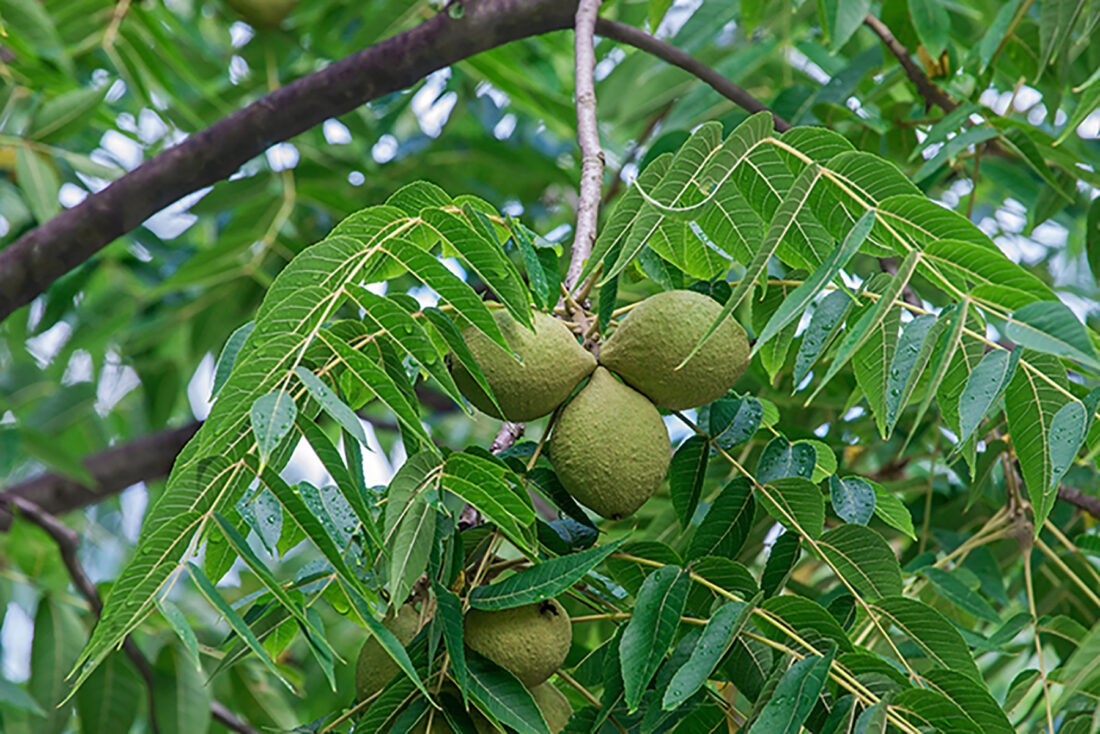
How to get irrigation right at every stage
When it comes to nut crops, timing isn’t just important. It’s everything.
Each stage of the season brings different demands. Miss the window for spring irrigation, or stress the trees too early at hull split, and your yield can take a serious hit. But when you get the timing right? The results speak for themselves.
Below, we break down the four most important irrigation decisions nut growers face, and how Verdi helps you make each one with confidence.
1. Spring: Time your first irrigation perfectly
Getting it wrong by just 1 to 2 weeks can hurt yields for the entire year. With Verdi, you get real-time soil moisture data so you know exactly when the first irrigation must happen—not too early, not too late.
2. Summer: Control frequency and duration with confidence
Throughout the crop season, Verdi helps you automate and adjust irrigation cycles based on real-time soil moisture, maximizing yield potential.No overwatering. No wasted fertilizer. Less disease pressure, even in wet years.
3. Nut fill: Keep trees healthy and nutrients flowing
This is when trees need available soil moisture to push nutrients into growing nuts. Verdi tracks field capacity and onset of stress real-time for your specific soil type, to achieve higher yields and crop size.
4. Hull split: Apply just enough stress to trigger harvest
The key is cutting water just enough to trigger nut opening, without harming the tree. Verdi lets you apply precision stress so you hit the sweet spot for harvest.
Make next season your most precise yet
Verdi automates and verifies irrigation through every stage of nut development—at any scale, and with the most cost-effective platform on the market. Built for large, mid-sized, and small growers alike.
Working with grapes, not nuts?
Many of the same principles—like springtime irrigation timing, minimizing disease pressure, and managing stress near harvest—apply directly to winegrapes. Verdi’s system is crop-agnostic, and we work with vineyard managers across California and the Pacific Northwest.
Whether you’re growing almonds or Zinfandel, Verdi helps you irrigate with more precision, less guesswork, and full confidence from your phone.
Have questions or want to see if Verdi is right for your farm? Book a demo or reach out directly to your regional contact:
- Brian Borges (California) (559) 366-9237 | brian.borges@verdiag.com
- Eugene Kovalenko (Pacific Northwest) (250) 328-2982 | eugene.kovalenko@verdiag.com
- Gill Costa (All other regions) (530) 564-5272 | gill.costa@verdiag.com
March 1, 2026
Say Goodbye to Manual Irrigation – Discover Verdi’s Automation Solutions Verdi’s mission is to make modern irrigation automation accessible to all growers, regardless of vineyard size or type of irrigation system — even manual systems can be automated.
Most automation solutions for irrigation are expensive and tailored toward the upper tier of vineyard operations. Existing systems also fail to address the worsening conditions farmers face, including labor shortages and environmental concerns such as droughts, water scarcity and new water usage monitoring requirements from the government.
Yet, every grower needs to reduce water costs and waste and the time their team spends patrolling the vineyards for valve malfunctions and line breaks, as well as improve the quality and yield of their crop.
As Verdi’s founders, CTO Roman Kozak and CEO Arthur Chen, worked to solve these problems, they realized the solution was to make the latest technology affordable and simple enough for farmers to install themselves.
“Arthur and I have spent the last four years talking with farmers and walking their farms with them,” says Kozak.“We saw how many problems they face and knew we could lighten that load by making automation more attainable and user-friendly.”
The result is the ultra-low power wireless Verdi Block Controller that automates five critical tasks for farmers:
- View soil moisture and environmental data
- Create data-informed schedules
- Control valves and pumps
- Detect leaks and breaks
- Keep an accurate water record
 The Verdi Block Controller is a compact, integrated device with fewer components. It doesn’t require buried wires, large gateway towers, external solar panels or antennas. It lets farmers control and monitor irrigation valves and flow meters quickly and seamlessly from an app on their computer or mobile device.
Some of the largest agricultural producers in the world use Verdi’s solutions, including Gallo, The Wonderful Company and Arterra, Canada’s largest wine company. So, too, do smaller wineries throughout North America, including Quails’ Gate, with 160 acres in the Okanagan Valley, Realm Cellars, with 75 acres in Napa, and Tantalus Vineyards, with 37 acres. It also works with crops other than grapes, from berries to cannabis.
“Verdi gives you the freedom to remotely turn on valves day or night, saving you water and time,” says Nelson Dutra at Arterra Wines. “The system has been super reliable for controlling our irrigation valves.”
Winemaker Matthew Fortuna at 50th Parallel Estate Winery in Lake County, BC, adds, “Before Verdi, I would spend up to four hours a day turning on valves, turning on pumps, ensuring everything was working on our 50-acre vineyard. Now I can remotely plan and execute my irrigations within 15 or 20 minutes, which has really freed me up to do bigger and better things on our site.”
Learn more about how you can implement modern irrigation automation for your farm at Verdi Ag’s WIN Expo booth #200.
March 1, 2026
Verdi’s New Block Controller Is the Easiest and Most Reliable Way to Automate IrrigationBuilding Upon a Strong Foundation
 The Verdi Block Controller is our most popular product for a reason: it makes it easy and affordable for any grower to access labor-saving irrigation automation technology and start
getting results in just one day.
The Verdi Block Controller is a wireless, battery-powered device that brings remote control and monitoring to agricultural irrigation valves and pumps.
Paired with the Verdi Dashboard and wireless soil moisture probes, it unlocks powerful features like irrigation flow verification, text alerts, sensor automation, and set-based scheduling — everything designed to help growers save labor and improve productivity.
Introducing the Next Generation
This major update builds on four years of in-field reliability and grower partnerships with upgrades to make the Block Controller even more dependable, easy to use, and capable:
- Gain complete visibility into your equipment: Confirms your solenoid actually fired and your wire isn’t severed, helping you build trust in technology.
- Connect common flowmeters: Works seamlessly with McCrometer, Seametrics and others for flow verification, water use tracking and SGMA compliance.
- Faster sensor integrations: Faster, cleaner installs for flow, pressure, moisture, and temperature sensors.
- Longer battery life: 12 months on a standard alkaline 9V, or up to 16 months with a lithium 9V.
- Quick non-technical install: Install in under 5 minutes. Connect a solenoid and scan the QR code to add to your Verdi Dashboard map.
Built for Reliability at Scale

Our mission is to make irrigation automation technology easy and affordable for all growers so more farms can benefit from this labor-saving technology.
We built the Block Controller to fill a critical gap in the market: a modern, reliable, wireless irrigation automation system that doesn’t require complex installations, high upfront costs, or specialized training.
It’s capable enough for industrial-scale infrastructure, yet simple enough for smaller operations to adopt quickly and get immediate benefits.
The new Block Controller is a significant improvement in reliability and ease of use, ensuring it can be deployed at scale.
Available Now
The new Block Controller officially launches Monday, May 12th.
Brian Borges (California) (559) 366-9237 | brian.borges@verdiag.com
Eugene Kovalenko (Pacific Northwest) (250) 328-2982 | eugene.kovalenko@verdiag.com
Gill Costa (All other regions) (530) 564-5272 | gill.costa@verdiag.com
The future of irrigation automation has arrived — and it’s never been easier to adopt. We hope you love this new update, and we look forward to sharing more exciting releases soon!
March 1, 2026
Tired of guessing rainfall for your farm? Here’s the fix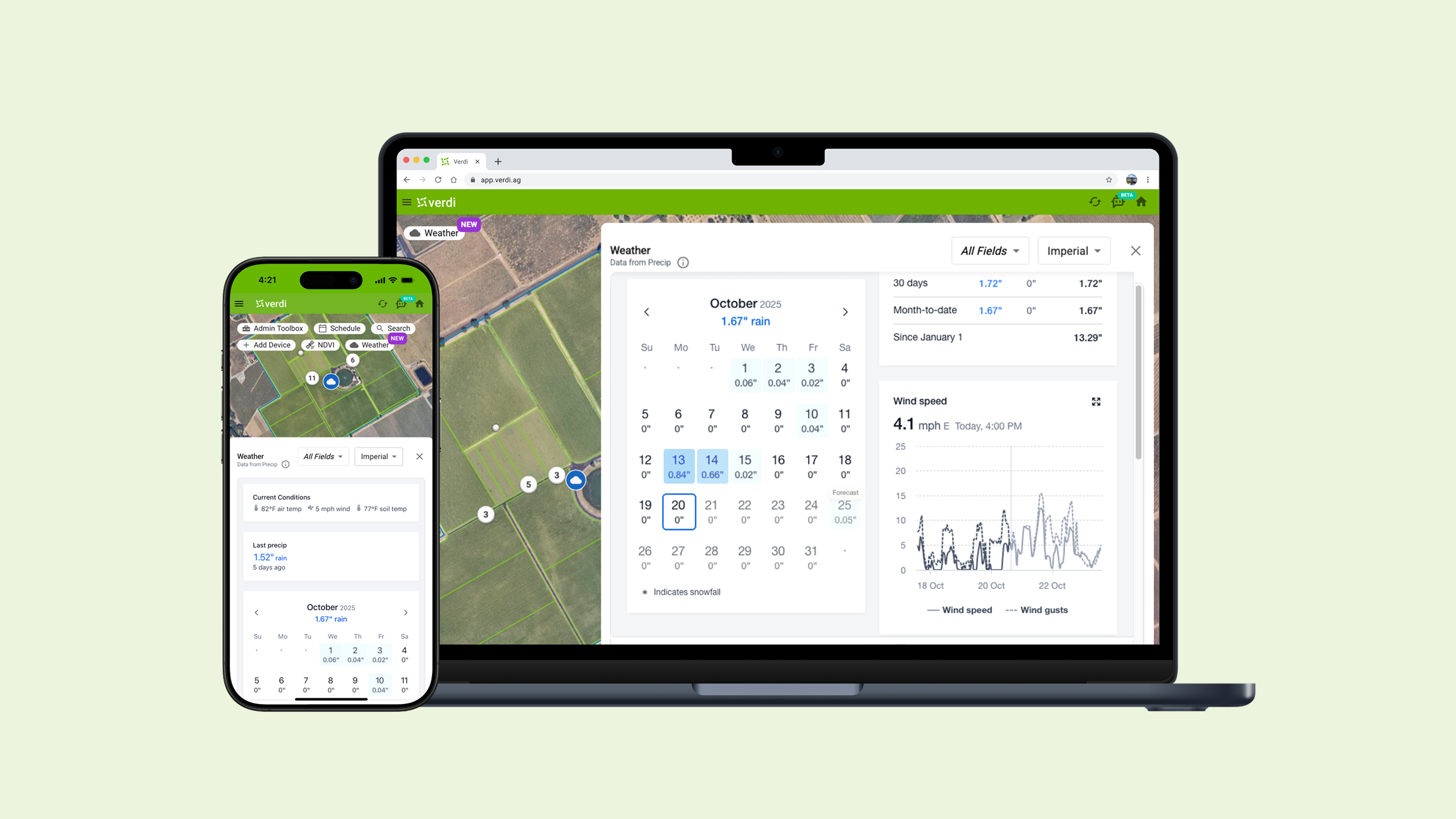
Until now, getting reliable weather and soil data meant installing and maintaining a physical weather station, or relying on generic, imprecise forecasts.
Verdi Weather changes that.
This new feature gives you hyper-local weather data, right inside your Verdi dashboard.
Powered by Precip, it puts actionable insights exactly where growers make irrigation decisions.
Why We Built It
Every week, growers make irrigation decisions that directly affect yield, quality, and costs. But too often, those decisions rely on assumptions, not field-specific data.
“Knowing how much rain fell yesterday, last week, or across the whole season changes everything,” says Nart Barileva, Verdi’s Head of Data. “Precip’s data fills that gap instantly.”
With Verdi Weather, there’s no hardware to buy or maintain. It’s already embedded in your dashboard, and the data is specific to your farm.
What You Can See
When you open the Verdi Dashboard, click the new Weather button to view the latest data for any field or your full operation:
- Current air temperature, wind speed, and (USA only) soil temperature
- Recent rainfall and snowfall totals, plus last significant precipitation event
- Soil temperature and relative soil moisture (USA only)
- 16-day forecasts and historical weather trends
- Hourly and daily precipitation breakdowns
- Cumulative rainfall graphs comparing recent years to each other and to 30-year normals
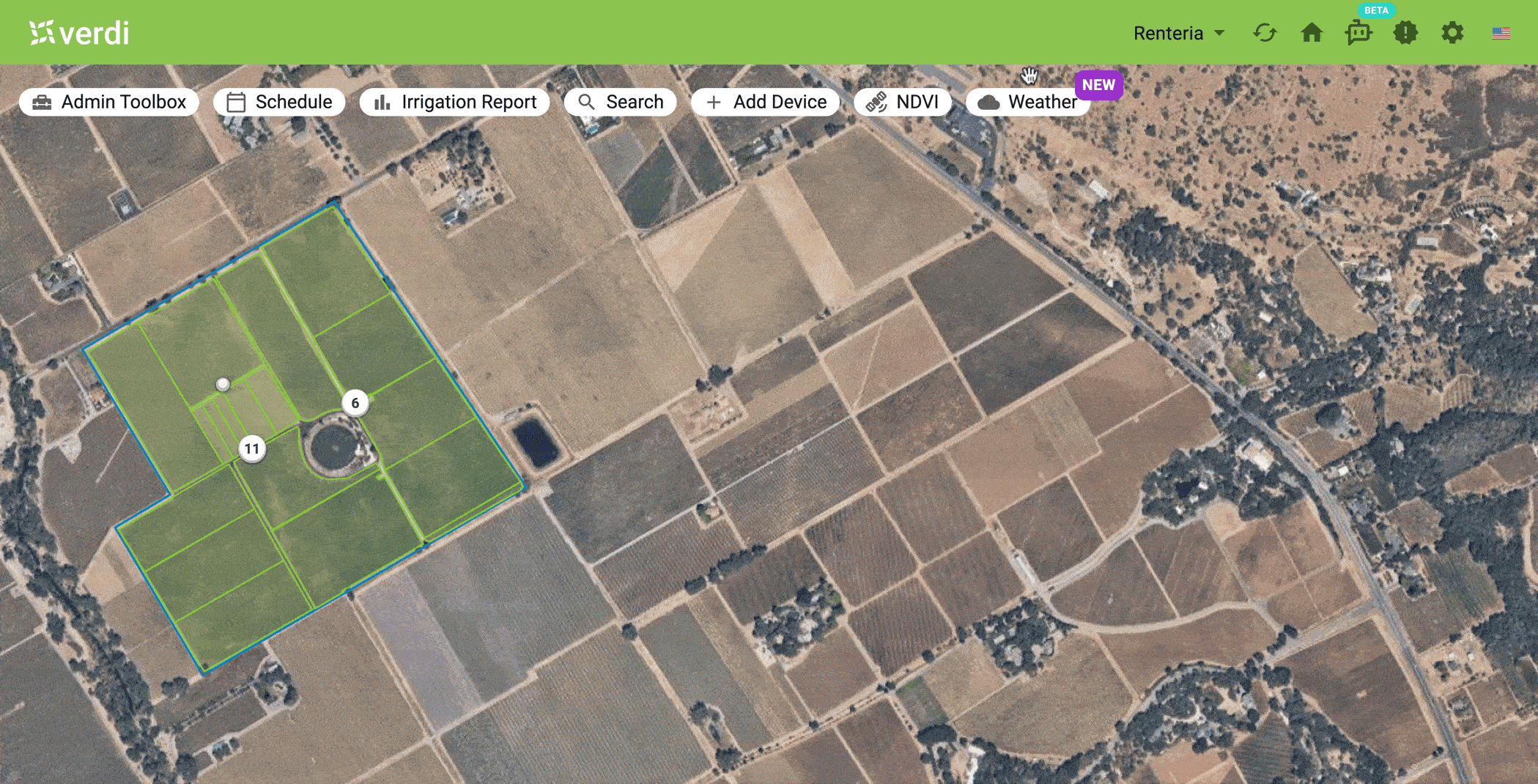
No Station? No Problem.
Weather stations can be expensive to install and maintain, and often require switching between platforms to access the data.
Verdi Weather removes that friction.
“This is some of the most accurate historical precipitation data available anywhere,” says Barileva. “It unlocks powerful decisions for every farm, no matter its setup–especially for growers expanding into new blocks or those without a station.”
Weather-Based Irrigation Works
The science is clear: using weather and soil data to guide irrigation saves water and improves yields. For example:
- Save up to 35% water using weather- or soil-based scheduling without yield loss (Sustainability, 2023)
- Increase yields by 3.4 t/ha with weather-based scheduling for blueberries (HortScience, 2024)
- Boost water productivity by 20–30% using forecast-informed irrigation (Journal of Hydrology, 2024)
When you align irrigation schedules with actual field conditions, you eliminate guesswork and maximize ROI, without adding complexity.
Built for Action, Not Just Insight
Unlike standalone weather apps, Verdi Weather appears directly next to your irrigation scheduler. That means you can check conditions and act on them, without toggling tools or copying data.
“By integrating weather where irrigation decisions are made, we make data actionable,” says Roman Kozak, Verdi’s CTO. “The next step is using this data to automate irrigation intelligently.”
Free for Verdi Users
Verdi Weather is live today for all Verdi users in the Contiguous USA (Lower 48) and Canada.
Soil temperature and moisture data are currently available only in the US, with additional data types and regions coming soon.
No hardware. No additional cost. Just better decisions, on demand.
What's Next
“This is just the beginning,” says Arthur Chen, Verdi’s CEO. “We’re building toward AI-driven irrigation recommendations that help every farm, regardless of size or infrastructure, irrigate like a smart farm.”
Features in development include:
- Humidity and evapotranspiration (ETo) tracking
- Custom weather dashboards tailored to each grower
- Intelligent irrigation suggestions based on rainfall and soil data
See It In Action Today
Log in to the Verdi app and click the Weather button to explore your farm’s live and historical weather data today.
Want a walkthrough? Book a demo today or reach out directly to your regional contact:
- Brian Borges (California) (559) 366-9237 | brian.borges@verdiag.com
- Eugene Kovalenko (Pacific Northwest) (250) 328-2982 | eugene.kovalenko@verdiag.com
- Gill Costa (All other regions) (530) 564-5272 | gill.costa@verdiag.com
February 13, 2026
How Verdi is Bringing Precision Irrigation, Verification, and Time Savings to Raspberry and Blackberry FarmsEvery raspberry and blackberry grower knows the pressure of trying to keep up with irrigation while everything else on the farm demands attention. When water timing influences fruit size, uniformity, and pack-out, even small setbacks can ripple through a season.
Yet despite the importance of getting irrigation right, many farms still rely on long field walks, manual valve checks, and a lot of hope that each set completed as planned.
Automation could relieve much of that strain, but the systems available in the past were often too costly, too complicated, or too disruptive to justify.
Why irrigation still creates daily pressure
Verdi was built around changing that equation. Guided by the mission to make irrigation automation accessible to every farm by retrofitting onto the systems growers already use and trust, the company has focused on developing a practical, affordable approach that fits real-world farms rather than requiring it to bend around technology.
As Arthur Chen, Verdi’s CEO, explains, “Growers were telling us the same thing everywhere we went. They didn’t need a big, complicated system. They needed something that worked with what they already had, something that saved them time without adding more to their plate. That has shaped every decision we make.”
For caneberry growers, this approach means tools designed specifically for the mixed soil types, stretched crews, varied block performance, and unforgiving timing that define raspberry and blackberry production.
As a NARBA industry member, Verdi is committed to supporting the caneberry community with practical, affordable tools that fit real-world farming conditions.
Small Changes Yield Big Results
Across berry farms that have begun using Verdi, a consistent theme is emerging: small changes in how irrigation is managed can create meaningful results in time savings, crop quality, and day-to-day predictability.
As one berry grower, Enrique Hernandez of Reiter Berry Farms, shared, “Verdi helps us monitor what’s happening with moisture in our pots, which is critical given how sensitive our production system is. We don’t focus on a single number. We use the trends to understand how things are drying down and to stay ahead, especially on hot days when losing even a few irrigations can turn into a bigger problem. That visibility helps us respond sooner and avoid crop loss."
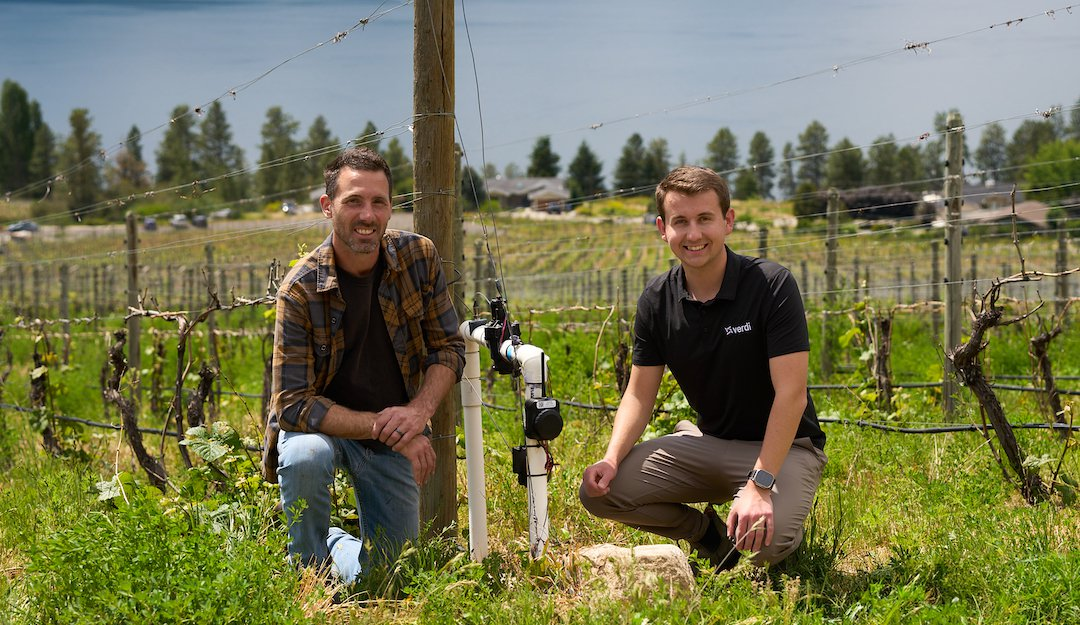
Verdi in the field with customer Matthew Fortuna (left), who reduced daily irrigation management from several hours to about 15-20 minutes.
Why Retrofit Matters for Berry Farms
Instead of requiring trenching, rewiring, or specialized infrastructure, Verdi’s wireless controllers install directly onto the pumps and valves already in use. This lets growers modernize gradually, block by block, without interrupting harvest or reorganizing irrigation layouts. These tools deliver the essential capabilities of traditional automation systems, including remote scheduling, pressure and flow verification, leak detection, and accurate water-use records.
By removing the complexity and high costs that have historically held growers back, farms can achieve comparable results at a fraction of the cost. Many growers are also seeing reductions in both water and labor costs by up to 30%, since fewer field checks, quicker detection of breaks, and more consistent irrigations help prevent waste and unnecessary expense during already tight seasons.
Verdi controller installed directly in a berry field, enabling precise irrigation management at the row level.
What Changes When Irrigation is Verifiable
Growers also point out that raspberries and blackberries are uniquely sensitive to the problems automation helps solve.
Uneven moisture can quickly show up as variation in berry size and firmness. Missed irrigations during heat can result in noticeable crop stress within hours. Once fruit begins sizing rapidly, even small fluctuations in water distribution can affect quality.
Verdi’s real-time verification gives growers immediate confirmation that each irrigation performed as expected, and alerts them the moment a break, leak, or pressure drop occurs. This allows teams to respond quickly and prevent stress before it reaches the crops. This shift from reaction to prevention has helped reduce uncertainty and give growers back hours in their day.
Fine-tuning Irrigation Where it Matters Most
Variability across a field is another challenge familiar to caneberry growers. Many operations manage blocks with different soil textures or canopy densities, or deal with areas of ground that dry out faster than others. Verdi’s row-level visibility and control options help growers fine-tune irrigation where it is needed most. This precision helps growers decide exactly when to start and stop irrigation, reducing nutrient loss from overwatering and minimizing disease pressure, which in turn supports improved yield and crop quality.
Turning Data Into Decision-Making
The system can also integrate with existing soil moisture probes, bringing third-party sensors and localized weather data into a single dashboard where irrigators can view soil and weather information, adjust schedules, and evaluate water use throughout the season. For farms operating multiple properties or training seasonal crews, consolidating this information into a single, easy-to-use platform has proven especially valuable.
Caneberry growers understand better than anyone how critical consistent irrigation is to a successful season. By helping make irrigation reliable, verifiable, and far less labor-intensive, Verdi is giving growers back hours in their day while reducing the stress of uncertainty. That support helps growers redirect their energy to what matters most: their crops, their teams, and the seasons ahead.
February 2, 2026
How to Make AI Earn Its Place on a VineyardMost vineyard teams do not struggle to see the promise of AI. They struggle to see a responsible path to using it. 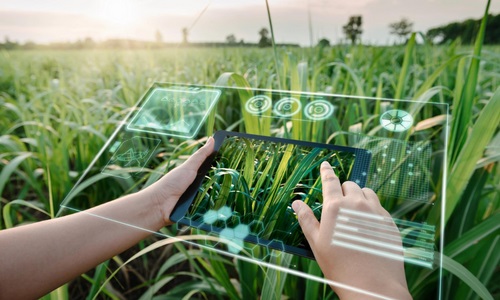
There are no clear standards, few proven playbooks, and almost no shared examples of AI delivering measurable results inside real vineyard operations. The result is hesitation. Not because teams are opposed to technology, but because the risk of adding complexity feels higher than the reward.
This article looks at how one vineyard management team approached AI not as a trend to adopt, but as a constraint to manage. Too much information. Too many variables. Too little human capacity to process them all.
The Question You Should Be Asking First
Rob Whyte leads operations at Renteria Vineyard Management, where scale magnifies every inefficiency.
Across thousands of acres and dozens of properties, teams were already using sensors, labor tracking systems, equipment data, compliance tools, and agronomic models. The problem was not lack of information. It was decision fatigue.
Adding more technology was not going to help. More dashboards would only deepen the bottleneck. What the team needed was a way to handle complexity without increasing cognitive load on managers and supervisors.
Instead of asking, “What AI tools should we buy?” they asked a more useful question:
Where does human decision making break down first?
How the AI Investment Was Made and Justified
The decision to invest in AI did not start with a product demo or a budget line item. It started by identifying work that was essential to the operation but poorly suited for humans to perform manually.
1. Start With the Bottleneck, Not the Technology
The first insight was straightforward. Scheduling, coordination, and administrative work were consuming enormous amounts of attention without improving outcomes.
These tasks required consistency, constraint handling, and repetition. They were areas where humans struggle and machines excel.
AI was positioned as a decision support layer, not as a replacement for agronomic judgment or field expertise.
2. Apply AI Only Where It Has a Clear Advantage
The team deliberately avoided using AI to “think” like a grower.
Instead, they focused on what AI does well:
- Processing hundreds of variables at once
- Optimizing schedules across labor, equipment, property rules, and compliance
- Recalculating plans instantly when conditions change
Fungicide scheduling became a core use case. AI could integrate operator availability, equipment constraints, weather windows, and property specific restrictions faster and more consistently than any human team.
3. Justify the Investment With Obvious, Defensible ROI
Before expanding use, the team quantified the simplest return:
- How many administrative hours per day could be eliminated
- What was the fully loaded cost of that time
Even modest time savings created a clear financial case. Importantly, this justification did not rely on theoretical yield gains or speculative upside. It focused only on work that was already happening every day.
4. Assign Clear Internal Ownership
Rather than relying entirely on vendors, Renteria assigned one internal owner to focus on AI and emerging technology.
This person was not selected for deep technical expertise. They were chosen for curiosity, adaptability, and the ability to learn both farming operations and software systems.
That role became essential in translating between:
- Developers and operational reality
- Technical language and vineyard needs
The result was fewer miscommunications, less wasted development, and faster progress.
5. Build Before You Buy
Instead of expanding their technology stack, the team focused on improving what already existed.
AI was layered into current workflows and tools. It eliminated repetitive coordination work rather than creating new systems that required management.
This approach kept complexity in check while delivering real operational value.
6. Evaluate the Second Order Effects
Beyond direct cost savings, the team paid close attention to outcomes that are harder to measure but far more meaningful:
- Reduced equipment downtime
- Fewer injuries and safety incidents
- Improved crew utilization
- Higher morale and stronger leadership effectiveness
Over time, these effects compounded and reinforced the original decision to invest.
The Core Lesson
AI did not earn its place by being impressive.
It earned its place by being useful.
By removing cognitive load and operational friction, AI allowed experienced vineyard professionals to focus on judgment, leadership, and execution. That is work no system should try to automate, but every good system should protect.
February 2, 2026
The Unexpected Result of Putting AI to Work on Vineyards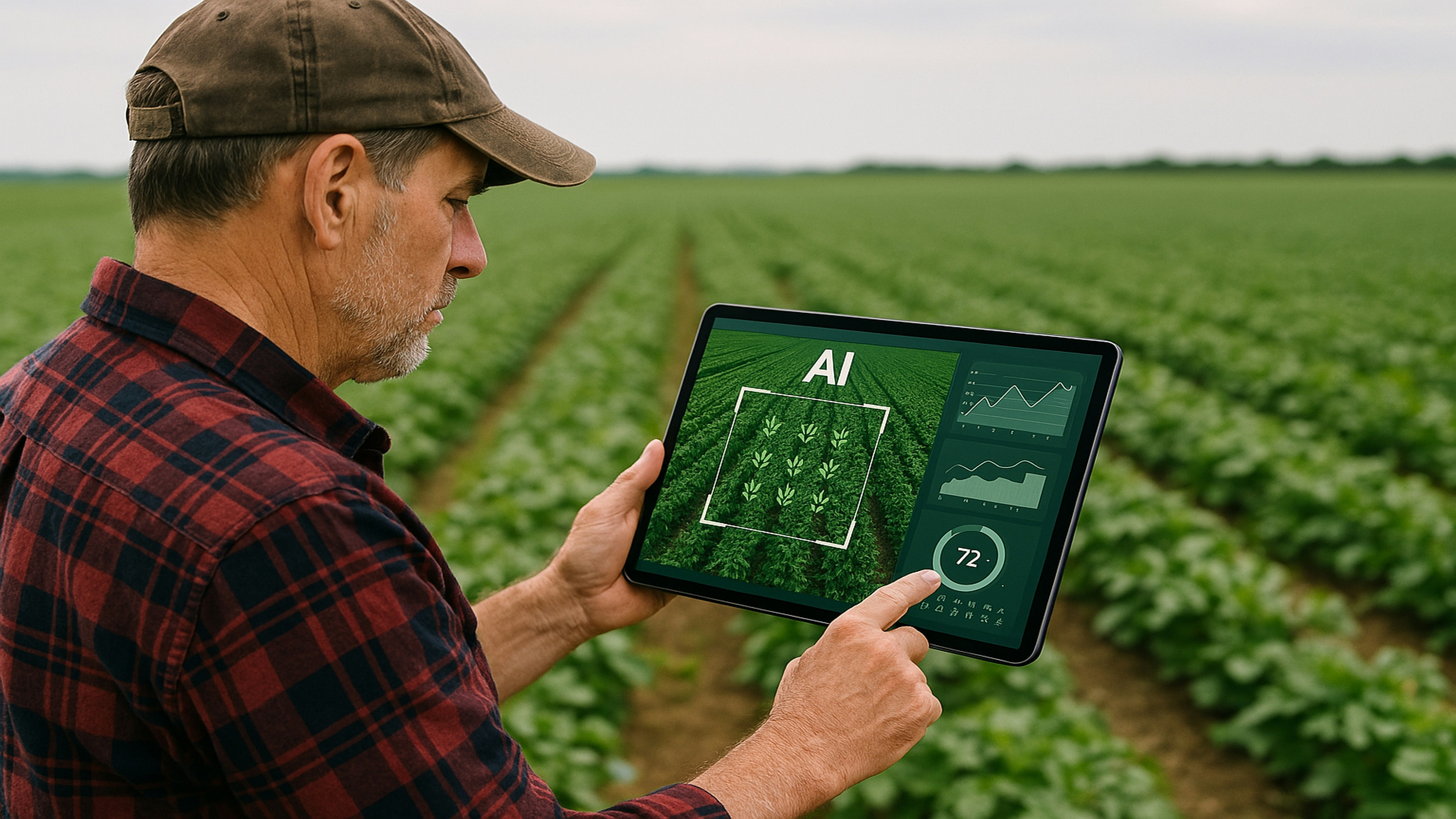
Most conversations about AI in agriculture lead nowhere.
There is plenty of speculation, plenty of marketing, and very little shared understanding of how AI is actually being used inside real vineyard operations. There is no manual, few proven tools, and even fewer examples that go beyond theory.
That is what makes this story different.
Rather than discussing what AI could do someday, this article looks at what happened when a professional vineyard management team, operating at scale and under real economic pressure, put AI to work on the unglamorous parts of their operation: scheduling, coordination, and administrative complexity.
The outcome was not what most people expect.
The biggest gains did not come from automation itself, but from what changed once friction was removed from daily work.
First, You Have to Start With a Real Problem
Rob Whyte described a situation many large vineyard operators recognize immediately: an operation saturated with data but constrained by human capacity.
Sensors, labor systems, equipment logs, spray schedules, and compliance records all existed. Each system was useful on its own, but together they created constant cognitive load. Managers spent their days coordinating people and plans rather than improving outcomes in the field.
Rather than adding more dashboards or reporting layers, the focus shifted to removing friction from daily operations. AI was applied to scheduling, coordination, and administrative work that consumed time without improving decisions.
What followed was not simply efficiency.
The real shift came after the pressure lifted, when managers and supervisors had time and mental space to work differently.
What Happened When Time Came Back
When vineyard operators talk about technology ROI, the conversation usually stops at hours saved.
For Rob Whyte’s team, time savings were only the beginning.
The real value emerged from how that reclaimed time was reinvested across the operation.
1. From Meetings Back to the Field
As scheduling and coordination became automated, equipment managers spent far less time in planning meetings. That time moved back into the field, where early visibility matters most.
Being present more consistently allowed teams to identify issues sooner, reduce execution errors, and prevent small problems from becoming expensive ones.
2. Training Instead of Reacting
With fewer last-minute crises, supervisors had space to focus on training and skill development.
Rather than fixing mistakes after they happened, managers could proactively identify gaps, improve consistency across crews, and reduce equipment misuse. Over time, this translated into fewer repairs, safer operations, and better performance.
3. Leadership, Morale, and Retention
Freed from constant firefighting, managers were able to spend more time doing human work: coaching, motivating, and leading.
The effects were tangible. Productivity increased. Injury-related claims declined. Retention climbed to levels rarely seen in agricultural labor. Crews experienced greater predictability, clarity, and confidence in their schedules.
4. Proactive Instead of Reactive Operations
Perhaps the most meaningful shift was cultural.
With less daily chaos, the organization moved away from reactive decision making. Planning improved. Communication stabilized. Trust increased, both internally and with vineyard owners.
Technology did not make the operation faster. It made it calmer, more deliberate, and more resilient.
Why This Matters for AI in Agriculture
This story highlights a point that often gets missed in AI conversations.
AI does not create value by replacing people or making decisions in isolation. Its real value comes from removing friction so experienced operators can focus on work that actually improves outcomes.
At Verdi, this insight shapes how we think about irrigation AI.
Farms already generate enormous amounts of data. Soil moisture, pressure, flow, weather, and irrigation logs are everywhere. The problem is not data scarcity. The problem is that too much of it demands attention without helping growers act.
Our approach is to build AI that works quietly in the background.
Not more dashboards. Not more alerts for the sake of alerts. But systems that reduce mental overhead, automate the busywork, and support better decisions without demanding constant input.
Building the Infrastructure for Irrigation AI
The future of irrigation AI is not about telling growers what to do. It is about building systems that understand how farms actually operate and adapt accordingly.
That means infrastructure that can:
- Learn from real field conditions, not theoretical models
- Close the loop between sensing, decision making, and execution
- Detect problems early instead of after damage is done
- Support operators when they need help, without adding complexity
This kind of AI only works when it is grounded in real operations and real constraints. It has to respect existing infrastructure, labor realities, and the fact that farming decisions happen quickly, often under pressure.
The work happening today is not about flipping a switch and calling it intelligence. It is about laying the foundation so irrigation systems can become more adaptive, more reliable, and easier to manage over time.
The Real Lesson
Saving time is easy to measure.
Using time well is where the real return lives.
In this case, AI did not replace people or judgment. It removed friction so experienced vineyard teams could focus on leadership, planning, and execution in the field.
That is the unexpected result of putting AI to work on vineyards. And it is the direction irrigation AI needs to go if it is going to matter in the real world.
January 13, 2026
Irrigation Shouldn’t Require Another Walk Through the Vineyard
Vineyard irrigation has a familiar frustration. You can do everything right and still end the day wondering whether each set actually ran the way you intended.
A stuck valve, a pressure issue, a line break, or a simple timing miss can quietly turn into wasted water, uneven blocks, and unnecessary stress. In many vineyards, the only reliable way to catch those problems is still the old way. Drive out, walk the line, and check.
At a time when the wine industry is navigating declining demand and tightening margins, lowering operational costs matters more than ever. Growers are looking for ways to cut labor, reduce water waste, and get more certainty from every dollar invested in the vineyard because the broader wine market continues to face headwinds. Global wine consumption has seen persistent downward pressure in recent years, and many regions are adjusting acreage and operations in response to weaker demand.
Visit Verdi at Unified
Verdi will be exhibiting at the 2026 Unified Wine & Grape Symposium at the SAFE Credit Union Convention Center in Sacramento. Visit Booth A2600 to see how vineyards are adding modern irrigation automation without replacing the system they already use and trust.
A Smarter Path to Irrigation Automation
Traditional irrigation automation solutions can be expensive. Many growers face sticker shock when reviewing proposals that require trenching, hardwiring, and system redesigns. This is especially difficult in a market where keeping costs low is critical to staying competitive.
Verdi approaches automation differently by retrofitting intelligence onto the valves and pumps you already have. Because it leverages existing infrastructure, Verdi systems run at roughly one-tenth the cost of many traditional automation systems, making automation accessible to more vineyards without a heavy upfront investment.
This means you can modernize irrigation while protecting your bottom line and getting more value from your current equipment.
Control, Scheduling, and Knowing What Happened
The real job isn’t collecting more data. The real job is knowing what happened and being able to act quickly.
Verdi gives vineyard teams remote control and schedule-based irrigation, along with real-time verification using live field signals like pressure and flow. When something does not look right, the system can alert you immediately so issues get addressed sooner rather than after vines show stress.
This reduces manual checking, limits surprises, and builds confidence across every block. In a year when many vineyards are tightening belts and seeking operating efficiencies, that confidence translates into fewer wasted labor hours and better water use.
Start Small, Grow with Your Needs
Not every operation wants to automate everything at once, and most do not need to. Verdi is designed for practical adoption. Growers can start with a single block where labor, risk, or variability is highest, prove the workflow, and expand across additional blocks or properties over time. This makes automation approachable both operationally and financially.
And because vineyards vary so much in layout and resource constraints, Verdi offers a 90-day money-back guarantee. If the system isn’t a fit for your operation, you can return it within 90 days. That guarantee removes risk during a time when careful budgeting and certainty of outcomes are top priorities for growers.
See Verdi in Action at Booth A2600
If you are attending Unified, stop by Booth A2600. Our team will walk you through the hardware and dashboard and talk through what retrofit automation could look like in your vineyard, block by block.
Unified Wine & Grape Symposium
January 27–29, 2026
Exhibits: January 28–29
SAFE Credit Union Convention Center, Sacramento, CA
Verdi Booth: A2600
Not attending Unified? Book a demo to get a free consultation with our agronomists today.
December 19, 2025
SGMA Changed the Rules. Here’s How California Vineyards Are Adapting.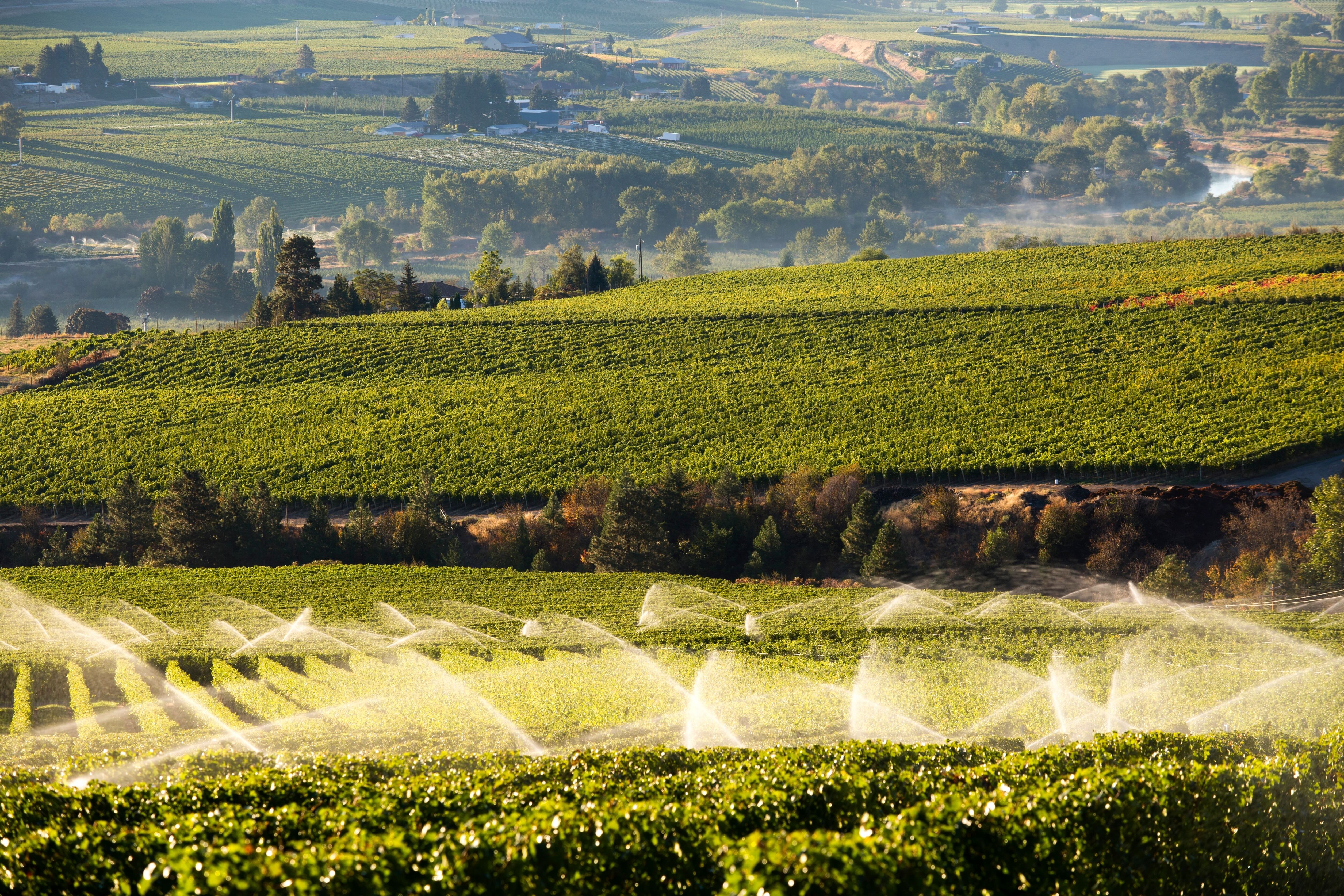
Declining groundwater levels and increasing pressure under the Sustainable Groundwater Management Act are changing how California wine growers think about water. What was once largely an operational concern is now directly tied to long-term viability, regulatory compliance, and sustainability planning.
These issues were front and center during a session at the 2025 WIN Expo, where vineyard operators, hydrologists, and county leaders discussed how groundwater management is evolving and what growers can do to stay ahead. Moderated by Val King, Director of Channel Partnerships at Verdi, the session underscored a clear reality. There is no single solution, but there is a shift toward local control, better data, and practical changes in vineyard management.
SGMA Was Built to Be Local, Not One-Size-Fits-All
SGMA is often misunderstood as a rigid, top-down mandate. In reality, it was designed around California’s variability in geology, climate, and water availability.
Instead of a one-size-fits-all approach, SGMA places responsibility with local Groundwater Sustainability Agencies, which develop plans based on basin conditions. As Marcus Trotta, Principal Hydrologist and SGMA Plan Manager at Sonoma Water, explained, “having a one size fits all, this is how you all have to manage groundwater, was never going to work here in California.”
For growers, the takeaway is straightforward. Participation matters. Local agencies rely on shared data and grower input to build workable plans. If agencies fail to act, the state can step in temporarily, but long-term management always returns to the local level.
SGMA is less about enforcement today and more about forcing better planning before problems become irreversible.
Improving Infiltration Starts in the Vineyard
Policy sets the framework, but many of the most impactful changes happen in the vineyard. Improving infiltration and soil water-holding capacity is one of the most direct ways growers can influence groundwater outcomes.
Building organic matter through compost, cover cropping, and reduced tillage helps soils absorb and store more water. David Gates, Vice President of Vineyard Operations at Ridge Vineyards, highlighted how early-season conditions shape outcomes, noting that “those first rains, if they’re hitting dry soil, they tend to seal the soil,” limiting infiltration later in the season.
That makes winter vineyard floor management critical. Ground cover, straw ahead of early storms, and simple water-slowing features like berms or swales can help keep water on-site longer. Avoiding compaction and bare ground further supports infiltration during recharge periods.
Why Groundwater Risk Is More Complex Than It Looks
Groundwater conditions are rarely uniform, especially in coastal California. Some areas draw down quickly and rebound just as fast. Others decline slowly and recover with difficulty. That variability makes simple answers unrealistic.
As Will Drayton, Director of Technical Viticulture, Sustainability and Research at Treasury Wine Estates, put it, “there really is no silver bullet.” Resilience comes from stacking practical, site-specific actions over time.
Those actions include soil and floor management, slowing and absorbing winter water, and improving surface water systems so less water leaves the basin during high-flow events. Underlying all of it is measurement. Better monitoring helps growers and agencies understand what is working and where adjustments are needed.
What This Means for Wine Growers
Across the panel, a few themes were consistent:
Groundwater management is becoming more local
Winter water is an opportunity when managed well
Vineyard practices directly affect infiltration and recharge
Measurement and shared data are increasingly essential
SGMA is accelerating a shift toward more intentional water management, with growers playing a central role. Groundwater security will be built through informed decisions and steady adaptation, block by block and season by season.
Turning Better Data Into Easier SGMA Reporting
As groundwater management becomes more local and data-driven, growers face a familiar challenge: documenting water use without adding administrative burden.
Measurement is foundational under SGMA. Clear records of how much water was applied, when, and where are becoming increasingly important.
Verdi supports this by creating a live, historical water record at the block level. These records help growers manage irrigation more precisely and make SGMA reporting and local data-sharing easier as requirements evolve.
The goal is not more technology. It is less guesswork, fewer surprises, and clearer documentation that aligns daily irrigation decisions with long-term groundwater sustainability.
Learn How Verdi Supports SGMA Reporting
If you are thinking about how to simplify irrigation management while preparing for evolving SGMA requirements, Verdi can help.
Verdi retrofits onto existing irrigation systems to automate valves and pumps, verify irrigations actually ran, and generate accurate water records by block. Those records support both operational decisions and SGMA reporting, without adding extra steps for your team.
Book a demo to see how Verdi helps growers automate irrigation and maintain clear water records for SGMA reporting.
December 1, 2025
Verdi’s New 1” to 4” Smart Valve Helps Growers Irrigate Precisely, Verify, and ReportIntroducing the Verdi Smart Valve
Precision irrigation depends on one thing: knowing that every irrigation is delivered exactly as planned. For specialty crop growers managing multiple blocks, varied valve sizes, and rising production costs, achieving that level of control and visibility has often been difficult.
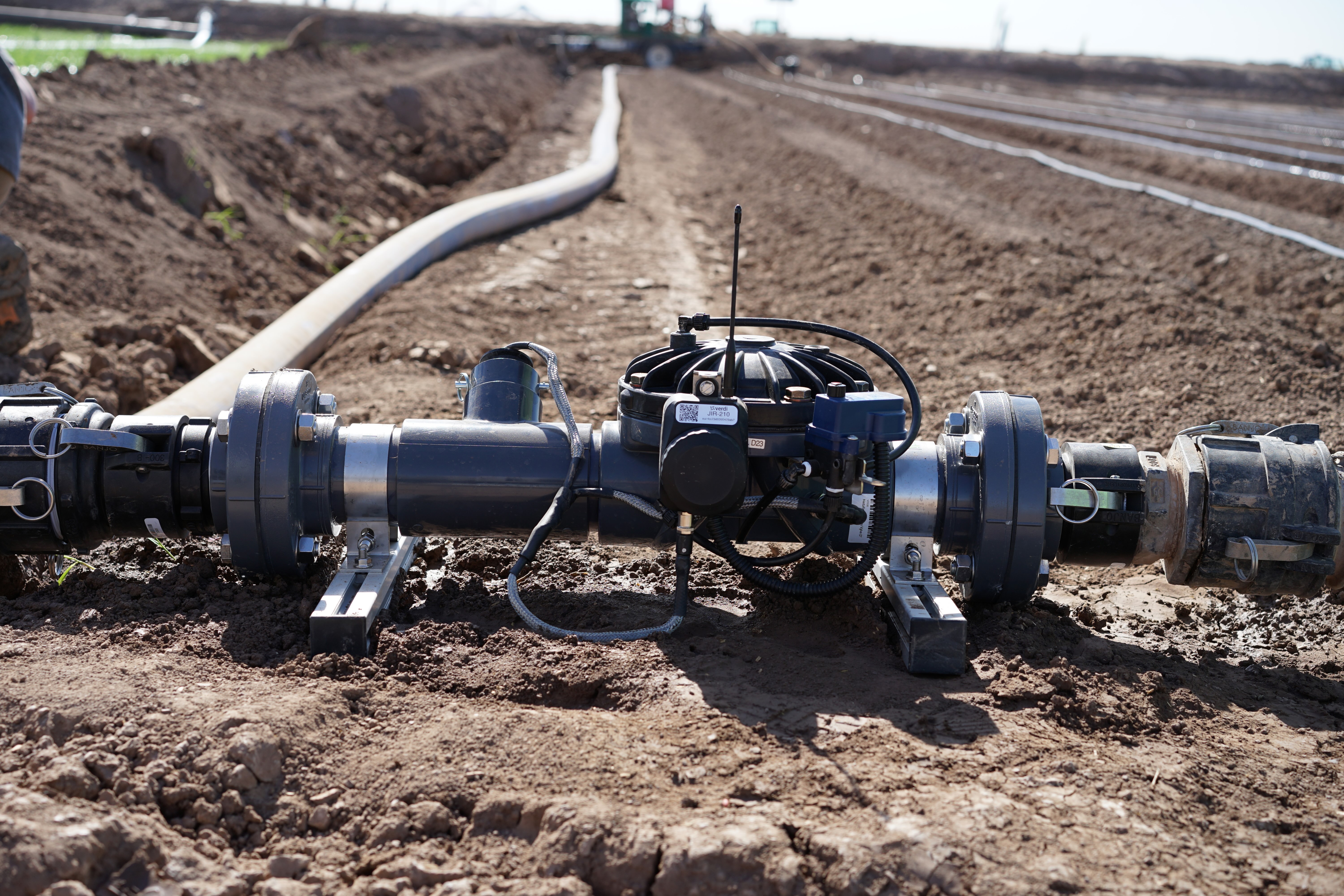
Verdi’s new Smart Valve changes that. Each wireless unit enables remote control, real-time irrigation verification, flow-based scheduling, and water-use reporting, all powered by the Verdi Dashboard. It’s available in a full range of sizes from 1 inch to 4 inches.
Built for Today’s Challenges
Growers across specialty crops, from orchards and vineyards to berries and vegetables, are dealing with rising input costs, labor shortages, and increasing pressure to optimize resources. Many are navigating tighter margins while striving to maintain quality and compliance.
The Smart Valve fills a critical gap in the market for growers who need automation that’s precise, proven, and easy to deploy.
Each unit arrives pre-mounted, pre-wired, and pressure-tested for fast installation, typically in 30 minutes or less using standard tools. There’s no trenching, no field wiring, and no need for specialized labor.
But fast installation is just the beginning.
The Smart Valve gives growers the ability to:
- Control irrigations remotely from any phone or computer
- Verify irrigations in real time using built-in pressure and flow sensing
- Track total water applied for compliance and internal reporting
- Irrigate by volume to deliver precise amounts of water to each block
- Maintain complete irrigation records for audits, water use reporting, and operational visibility
This is automation that saves time in the field and delivers precision at scale.
What’s Inside Every Smart Valve
The Verdi Smart Valve combines everything needed for automation and verification into one ready-to-go unit:
- A Verdi Block Controller for wireless valve control and dashboard integration
- A pilot-actuated solenoid valve, matched to your pipe size:
- 1"–2": Irritrol 200B + DCL solenoid
- 3"–4": Netafim 90 Series + Aquative Plus solenoid
- A Honeywell pressure sensor (±1.0% accuracy, 0–150 psi)
- Optional: FLOMEC ultrasonic flow meter (±2% accuracy, 0.5–537 GPM depending on valve sizing)
- Union, slip, or flange plumbing connections
Each unit arrives pre-mounted, pre-wired, and pressure-tested, so you can install it quickly with basic tools and standard fittings. No specialized labor. No trenching. No multi-hour setup.
Smart Valve vs. Smart Valve Pro
To support different levels of monitoring and control, we offer two configurations:
Smart Valve: Includes Verdi Block Controller + Pressure Sensor
.jpg)
The Verdi Smart Valve provides remote valve control, pressure-based irrigation verification, and full integration with the Verdi Dashboard. It's ideal for upgrading existing pilot-actuated valves or adding essential remote monitoring.
Smart Valve Pro: Includes Verdi Block Controller + Pressure Sensor + Ultrasonic Flow Meter
.jpg)
The Verdi Smart Valve Pro enables water-use tracking, flow + pressure verification, and irrigation by volume using verified flow rates. It's built for growers who want complete visibility and automation across their irrigation network.
Designed for Real-World Farms, Managed From Anywhere
Smart irrigation tools need to work where it counts—in the field, under pressure, and across a wide range of crops and conditions.
That’s why the Verdi Smart Valve is:
- Pre-mounted, pre-tested, and fast to install typically in 30 minutes or less
- Field-serviceable with standard parts from most irrigation suppliers
- Compatible with existing infrastructure no trenching, rewiring, or custom plumbing
- Rugged and reliable for consistent performance season after season
And with built-in remote control, real-time verification, and automated alerts, growers can eliminate manual checks, reduce setup time, and respond to issues faster, all from the Verdi Dashboard.
Available Now
Verdi Smart Valves are available in:
- Pipe sizes: 1", 1.5", 2", 3", and 4"
- Connection types: Union, slip, or flange
- Configurations: Smart (pressure only) or Smart Pro (pressure + flow)
Explore full specs and model options on the Verdi product page.
Smarter Irrigation Built for Every Block
Specialty crop growers need tools that help them irrigate accurately, verify performance, and maintain clear irrigation records across the season. Verdi’s Smart Valve delivers all three across a wider range of valve sizes, crop types, and infrastructure scenarios than any other system available today.
If your goal is to irrigate precisely, verify every run, and ensure full traceability in your irrigation program, all with less time in the field, the Verdi Smart Valve is ready to support your operation.
Want a walkthrough? Book a demo today or reach out directly to your regional contact:
- Brian Borges (California) (559) 366-9237 | brian.borges@verdiag.com
- Eugene Kovalenko (Pacific Northwest) (250) 328-2982 | eugene.kovalenko@verdiag.com
- Gill Costa (All other regions) (530) 564-5272 | gill.costa@verdiag.com
November 12, 2025
Tough Year? Turn Your Irrigation System from Cost Center to Profit Driver with VerdiVineyard owners and grape growers lie awake at night trying to map a path to the future through today’s volatile market. Worries that run through their minds include the overflowing bulk market that is cancelling contracts and lowering grape prices, and the higher pay rates and immigration raids that are compounding an already stressed labor supply.
Two clear steps forward are to lower operational costs and reduce existing staff workload.
Automating irrigation management is a logical way to achieve this, as it reduces labor, water usage and materials costs. But small or mid-sized growers often forego these benefits because the automation price tag outweighs the return on investment. Instead, 95% of growers still choose to continue irrigating manually.

Verdi addresses this ROI concern with affordable irrigation automation technology that growers and their teams can easily install themselves without any training.
What makes Verdi unique is how its smart hardware and easy-to-use software work together to automate irrigation from end to end. At the heart of the system is the combination of wireless Block Controllers and the Verdi Dashboard, giving growers complete control over pumps, valves, sensors, and drip lines with real-time monitoring and action – without having to get in the truck and drive to the vineyard.
Verdi retrofits existing irrigation systems with battery-powered Block Controllers that execute irrigation commands automatically and can be installed in just 5 minutes. Each unit verifies irrigation events, eliminating the need to drive across rows to open or close valves. The system also sends instant alerts to a grower’s phone or computer if a line breaks or a valve fails, allowing them to pinpoint water loss as it happens.
The Verdi precision irrigation automation system saves growers up to 70% on labor and up to 30% on water usage. It can also increase yields by up to 20% and revenue per acre by of 21%.
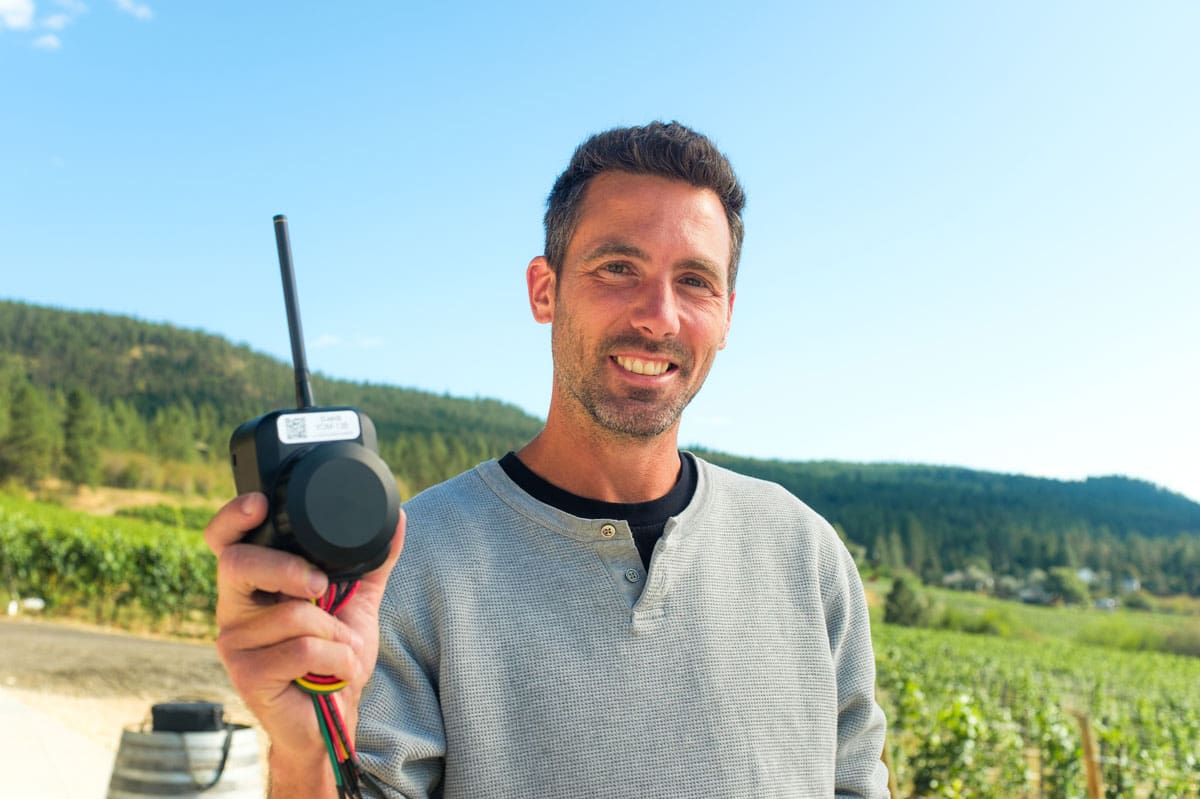
Matthew Fortuna, of 50th Parallel Estate Winery, shares his experience: “Before Verdi, I would spend up to four hours a day turning on valves, turning on pumps, ensuring everything was working on our 50-acre vineyard. Now I can remotely plan and execute my irrigations within 15 or 20 minutes, which has really freed me up to do bigger and better things on our site.”
Because each block controller takes only 5 minutes to install, a 100-acre vineyard can be fully automated in a single morning. Growers can start with 20-50 acres as a test, rent the system by the year for a 30% lower cost or install their whole property with the confidence of a 90-day money-back guarantee.
“Verdi wasn’t built for ideal conditions—we built it for tough years like this,” says Verdi’s co-founder Arthur Chen. “While others focus on complexity and scale, we focused on ROI, scalability and ease of use. Verdi is 1/10th the price of traditional automation and pays off in the first season—keeping farms running lean.”
Learn how to achieve a make-or-break 10–20% cost reduction by visiting Verdi at WIN Expo booth 200 at the Sonoma County Fairgrounds on Dec. 4, 2026.
Exclusive Expo offer: Wine growers who book a demo by December 31, 2025, will receive a free soil moisture probe. All attendees visiting the Verdi booth are eligible.
August 15, 2025
How Top Growers Are Automating Irrigation Without Replacing Their System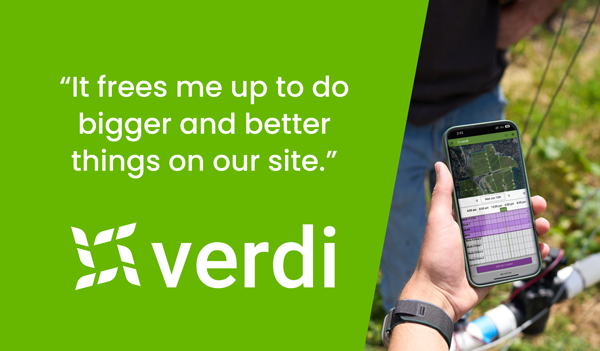
Precision irrigation automation has never been accessible for most viticulturists. Because it’s expensive and complicated, only the largest producers with sizable budgets could afford its benefits – until now.
Since its inception, Verdi has thrown open the door to a high quality, affordable, user-installed irrigation automation system for wine grape growers at all levels of production.
Verdi allows irrigation to be managed on multiple properties manually, remotely, with schedules, and by utilizing farm sensors that notify the system when crops require additional water. It also alerts them when there are problems, so they always know if their watering systems are functioning properly.
“We installed Verdi on a couple of our properties, which historically had been difficult to manage as far as irrigation and immediately I noticed just the labor cost savings overall.”
— Stephanie Adamson, Irrigation Technician, Quails Gate Winery
The Verdi system solves another major pain point for growers - it doesn’t cost very much.
“It’s a wireless, battery-powered, user-installed controller that makes your existing irrigation smart in just 10 minutes,” explains Roman Kozak, Verdi Co-founder and CTO. “No more time-consuming manual checking and middle-of-the-night emergencies. The Verdi Block Controller is easy to use, reliable and super affordable. Our customers start saving time and money the day it’s installed.”
A unique aspect of the Verdi system is that it can be installed on 100 acres or more in just one day without skilled labor. The main component, the Verdi Block Controller, is a wireless controller that brings existing block valves, pumps and sensors online.
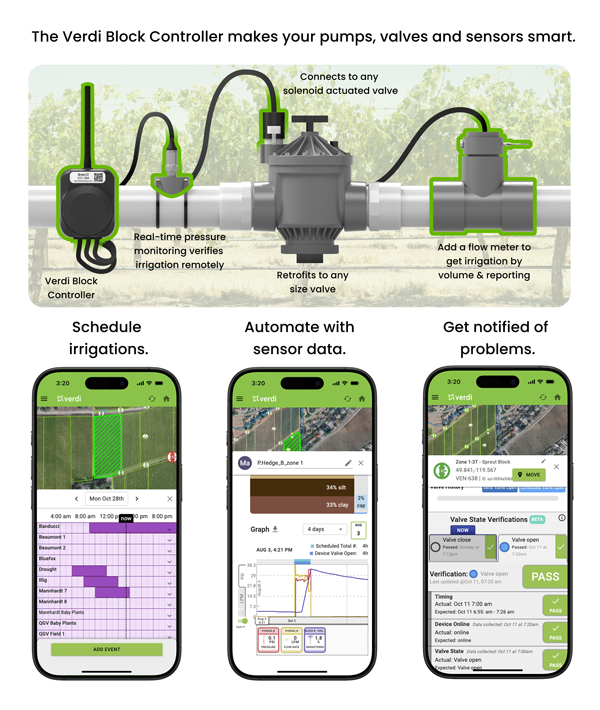
Its design has been proven to work at scale with the world's biggest growers, while attending to the needs of the smallest growers. This means that it installs quickly and easily without any digging, has a years-long battery life, and provides reliable connectivity across long distances and throughout varied, sometimes rugged terrains. It is suitable for submersion, continuous UV exposure and performs even under extreme temperatures. It is a made-for-scale device, providing easy management and maintenance monitoring for thousands of devices in the field.
And all of your farm’s irrigation equipment, all of the data that comes in from sensors, can now be controlled and monitored down to every crop row with sub-block precision from any location, because you can do it all from your phone.
It is no surprise that the Verdi Block Controller has become the company’s most sought-after product. Customers, both large-scale and small, are increasingly impressed by the ways Verdi Ag technology has transformed their practices.
“With previous irrigation systems, we weren't able to really give each vine exactly what it needed. At Tantalus, we have a number of different soil profiles. We have different vines with different needs in terms of water. Verdi allows us to apply more water or less in a very efficient and easy way.”
— Scott Woodie, Vineyard Manager, Tantalus Vineyards
Kozak emphasizes that there are two reasons that Verdi is growing so quickly. They have an ironclad commitment to customer service, and they guarantee customers will be satisfied.
“We recognize that our customers need after-sales support. Every piece of equipment has our phone number and email address listed in both Spanish and English,” Kozak attests. “With Verdi, we’re monitoring your system remotely. If there’s an issue and it’s with our system, we’ll have boots on the ground, we will absolutely be out there to fix it.”
Verdi also guarantees you'll be satisfied with their irrigation automation system, and if you're not, they will take it back. Roman says, “Irrigation automation systems that require digging, or installation of new equipment - they could never make that promise. If you buy the wrong system, or it doesn't work the way you think it will, you're stuck with it. The Verdi system is risk-free. It’s what growers need right now.”
For more information on Verdi, any of its products, or to request a demo, go to: https://www.verdi.ag.
“Previously, we would spend up to four hours a day, turning on valves, turning on pumps, ensuring everything was working. Now, I can remotely plan out and execute my whole day within fifteen or twenty minutes, which frees me up to do bigger and better things on our site.”
— Mathew Fortuna, Winemaker, 50th Parallel Estate Winery
June 4, 2025
Making Irrigation Automation Systems Easy: 4 Stages That Take Farms from Data to Results
Adding automated irrigation to the farm can seem overwhelming. When tasks have always been completed manually (or previous attempts at automation have failed), bringing automation to the table will be uncomfortable and might even feel scary.
Yet, you know that with the increasing costs of labor and other resources, there is a need to do things differently. You want to maximize inputs to achieve the greatest level of efficiency and improve plant health to increase yields.
Automated irrigation can be your ally in doing more with less and advancements in technology have made implementation and day-to-day use easier, more affordable and more robust than ever.
When automation is introduced in a staged approach that works with existing systems, it allows for acceptance, adoption and appreciation before moving on to the next steps. At Verdi, we help growers consider where they are today to determine the stage of automation that makes sense for their operation.
Stage 1: Make data-driven decisions using sensors and trends
An automated irrigation system has a number of components. Each does a specific job to ensure optimal moisture levels and water use. But tracking these measures is essential to optimizing them. Implementing soil moisture sensors and water-tracking tools is often the best place to start when no automation exists.
Growers will benefit from collecting data through monitoring even if they aren’t ready for a full automation package. Soil moisture monitoring and tracking water use can save money and ensure better plant health.
Because farmers don’t have time to be inundated with data that comes from moisture sensors and water monitors – or they have “non-connected sensors” where a person is running out into the field to take readings – connectivity matters when it comes to efficiency.
Said simply - individual readings and data no-one knows how to process won't yield great results. Your sensors need to be connected and you have to be able to be able to easily interpret data so that you can use it.
A provider like Verdi offers tools to automatically collect and interpret the data, then provide quick bites of information that can actually be applied rather than creating a pile of data waiting for a human to analyze it and determine next steps.
Stage 2: Automate your irrigation valves and pumps.
Implementation of automated valve control comes once there is an understanding of what is happening with water in the fields, orchards or vineyards.

Farming decisions can be made from data that comes from field-level information and these decisions include when to turn valves on and off. Valves and other components also need regular inspection. An automated irrigation system should be able to control the valves while also tracking potential damage, blocks or other failures.
This level of automation saves money. There is no longer a need for a person to turn valves on and off or manually inspect lines. It also removes human error, like over-watering because remote control valves ensure irrigation happens when desired and stops when needed.

Stage 3: Unlock data-driven automated irrigation schedules.
Once sensors are sending data autonomously, valves are automated and lines are monitored, farmers can seize the ability to create data-driven irrigation schedules that make use of farmer knowledge and experience while also keeping accurate records. This frees up time and effort spent on day-to-day or moment-by-moment details involved in irrigation.

When irrigation management is turned over to software, the grower still has control over what happens in the field, but now can let go of controlling valves, checking for leaks and gathering data. The farmer’s role changes from basic duties to giving the controlling units specific tasks. Devices like Verdi’s Block Controller and Micro-Block Controller, will follow the instructions the farmer has established.
For example, this may include keeping soil between the calculated Field Capacity Point and the Onset of Stress Point. Or, it may be establishing variable irrigation patterns in different blocks because the grower knows that, for example, their younger plantings, with shallower root systems, need more frequent irrigation than older plantings with deeper roots.
Stage 4: Optimize crop uniformity for increased quality and crop yield
With automated control, farmers can now get even more specific in targeting variability that occurs in vineyards and orchards at levels more finite than by block. With Verdi’s Micro-Block Controller along irrigation lines, blocks can be divided into the zones that need more attention and control. Therefore, a small zone that has struggled can be the target of increases fertigation without wasting resources on the plants that don’t need additional growing support.
Bringing these zones up in quality and yield results in better value for fruit and overall healthier plants. By incorporating variability in irrigation and fertigation, resources are better targeted within the block, plants mature at the same time and costs of management are reduced.
Book a free consultation Verdi team member to find out more about how a staged automated irrigation approach can help.
June 4, 2025
What if Precision Agriculture Technology was Free for Every Farmer?
When farmers evaluate farm technologies, one question looms large: What’s the return on investment (ROI)?
In irrigation monitoring and automation, this question is particularly tricky. The costs of agricultural operations vary widely, and some benefits—like peace of mind during drought years—are tough to quantify in dollars.
Still, the ROI of irrigation automation products is compelling, especially when you break it down into three key savings areas:
- Water resources
- Labor and management costs
- Energy costs
In this article, we explore how Verdi's irrigation technology delivers measurable results, often paying for itself within a year.
How Precision Agriculture Technology Reduces Expenses for Farmers
Energy Costs Are Soaring
The rising cost of energy has become a serious concern for farms:
- Power companies face mounting costs to upgrade infrastructure and mitigate wildfire risks.
- Aquifer depletion means groundwater pumps must work harder, especially with wells averaging 200–400 feet deep.
For orchard growers, pumping groundwater costs about $600 per acre annually, while row crop farmers spend around $400 per acre. Add to that the increasing costs of electricity, and it’s clear that controlling energy expenses is more important than ever.
All of this means that the importance of controlling costs is at an all time high. Please check out the pumping cost estimator from the NRCS and estimate your savings from irrigation monitoring per acre. https://ipat.sc.egov.usda.gov/

Here’s where Verdi’s soil moisture monitoring package shines. By optimizing irrigation schedules and reducing unnecessary water use, farms can see positive ROI in just one season. Even for small farms, Verdi pays for itself on energy savings alone, showcasing the benefits of precision farming.
Water Costs on Farms Are Rising Too
Farmers face dual pressures on water costs: environmental scarcity and policy-driven increases. For example:
- Surface water costs in California range from $80 to $120 per acre, with penalties for exceeding usage thresholds.
- During drought years, open water market prices can spike as high as $1,200 per acre-foot.
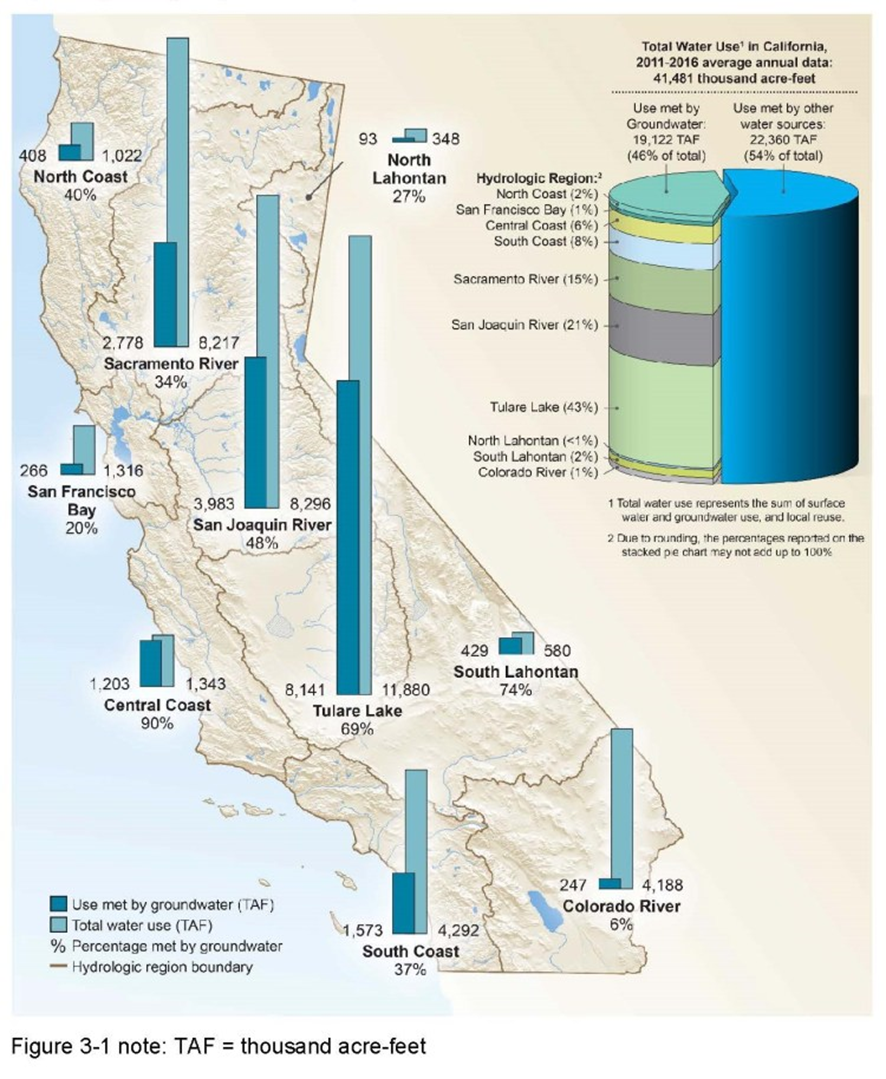
By monitoring soil moisture accurately, farms typically use 30% less water. This savings might seem minor in a normal year, but during droughts, it translates to $240–$360 per acre saved—a game-changer when margins are tight.
Labor Costs Are a Growing Challenge
Labor dynamics are shifting. Younger generations are less interested in farm labor, and stricter immigration policies, combined with minimum wage increases, are driving up costs. For orchard operations, the average labor and ATV transport cost to manage irrigation is $155 per acre per year. ($104/acre/year for labour and $51 /acre/year ATV transport)
By automating irrigation with Verdi, farms reduce labor costs by approximately 70%. For a 50-acre operation, this equates to a $5,425 annual savings, delivering a positive ROI in just 1.5 years.
Beyond Cost Savings: Managing for ROI
Automation doesn’t just save money—it saves time. Most farm managers spend 4–5 hours daily on irrigation tasks. With Verdi, that drops to 15–30 minutes per day. For a manager earning $50,000–$80,000 annually, the time savings alone translate to $25,000–$40,000 in added value.
Add up the savings—energy, water, labor, and management—and a typical 50-acre farm achieves:
- 4.5–6.5X ROI in a normal year
- 6–8.8X ROI in drought years, when water costs spike.
The First Steps of Automation
If you've read this far, you know that Verdi's precision agriculture products pay for themselves and more in a short timeframe. What are the other hesitations you have?
We build Verdi products so that precision agriculture is available to everyone. This means that companies can start small - with Verdi’s wireless soil moisture monitoring package - and get huge benefits. Best of all, installing our equipment is easy and affordable.
Once farmers are comfortable with the main feedback systems that sensor data provides, most farmers choose to automate their pumps and valves, unlocking additional savings while enabling them to achieve even greater ROI through increased yield and quality.
From reducing costs to increasing yields, Verdi doesn’t just pay for itself—it transforms how farms operate.
Whether you manage a few acres or thousands, Verdi delivers ROI you can count on.
June 4, 2025
Verdi Raises $6.5M to Bring Automation to Aging Farm Infrastructure
Verdi’s Block Controller retrofits onto existing infrastructure with no trenching or rewiring required.
Vancouver, Canada – Verdi, the company making irrigation automation accessible to every farm, today announced it has raised $6.5 million CAD ($4.7 million USD) in its latest oversubscribed seed round, bringing total funding to $9.5 million. The round was led by SVG Ventures, with participation from NEC, Ponderosa Ventures (a member of Galvanize Climate Solutions’ platform), Elemental Impact, GenomeBC, One Small Planet, Waterpoint Lane, Dangerous Ventures, VentureUs, Echo River Capital, Cyan Ventures, Jetstream, and Baker Hall
Capital.
The funding follows a breakout year for Verdi, which now powers irrigation automation for some of the world’s largest food and beverage brands on more than 5,000 acres of farmland in North America. Agriculture producers have been drawn to its ability to retrofit to existing infrastructure and deliver immediate results. In 2024 alone, Verdi saved customers over $1M in irrigation labor costs while saving them over 100 million liters of water.
“Our mission is to overcome the traditional adoption barriers that have prevented farmers from scaling irrigation automation, and in turn allow them to increase farm efficiency and resilience,” said Arthur Chen, CEO and Co-founder of Verdi. “This round fuels our ability to scale rapidly and continue delivering impact where it matters most – on the farm.”
Traditionally, automating irrigation required costly and complex infrastructure upgrades, limiting widespread adoption. Verdi’s patented smart devices retrofit intelligence onto existing irrigation infrastructure, eliminating the need for disruptive rollouts. Its technology also enables advanced capabilities such as remote leak detection and row-level irrigation control.
Farms using Verdi have seen up to 90% labor savings, 70% water savings, and 20% yield improvements, while reducing automation costs by an order of magnitude. This accessible approach has fueled Verdi’s growth across the US and Canada, more than doubling its team in the past year to 24 experts in agronomy, hardware, and AI-driven software.
“We invested in Verdi because they’re solving one of agriculture’s biggest challenges – climate resilience – through a solution that is not only innovative but also practical and scalable,” said John Hartnett, CEO of SVG Ventures. “Their ability to integrate with existing farm infrastructure makes their platform a game-changer for growers looking to stay competitive in a changing
world.”
With this new investment, Verdi will continue expanding into new regions, advancing its AI-powered platform, and deepening its relationships with major agribusinesses to drive automation at scale and build a more climate-resilient food system.
 New Verdi dashboard interface allows growers to schedule, monitor, and verify irrigation remotely from any device.
About Verdi
Verdi is making modern automation tools accessible to every farm on the planet. Its patented smart devices retrofit existing farm infrastructure to automate everyday tasks such as irrigation and maintenance, enabling farmers to save labor, reduce inputs, and increase yields. Verdi is trusted by the world’s largest food producers and is helping build the infrastructure for climate-resilient agriculture.
About the SVG Ventures Pioneer Fund
The Pioneer Fund is SVG Ventures’ third fund. The CAD $75 million fund supports global agrifood start-ups developing innovative and sustainable technologies. SVG Ventures | THRIVE is the leading global agrifood investment and innovation platform headquartered in Silicon Valley, and comprised of top agriculture, food & technology corporations, universities, and investors. With a community of over 8,000 startups from over 100
countries, the THRIVE platform invests, accelerates, and creates unparalleled access for entrepreneurs to scale globally to solve the biggest challenges facing the food and agriculture industries. Learn more at thriveagrifood.com.
April 21, 2025
Irrigation Automation That Finally Makes Sense for Wine Grape Growers
Precision irrigation automation has never been accessible for most wine grape growers. Because it’s expensive and complicated, only the largest producers with sizeable budgets could afford its benefits – until now.
Since its inception, Verdi, has thrown open the door to a high quality, affordable, user-installed irrigation automation system for wine grape growers at all levels of production.
Verdi allows irrigation to be managed on multiple properties manually, remotely, with schedules and by having farm sensors tell the system when the crops need more water. It also tells them when there’s problems, so they always know if their watering systems are functioning properly.
“Previously, we would spend up to four hours a day, turning on valves, turning on pumps, ensuring everything was working. Now, I can remotely plan out execute my whole day within fifteen or twenty minutes, which frees me up to do bigger and better things on our site.”
— Mathew Fortuna, Winemaker, 50th Parallel Estate Winery
The Verdi system solves another major pain point for growers - it doesn’t cost very much.
“It’s a wireless, battery powered, user-installed controller that makes your existing irrigation smart in just 10 minutes.” explains Roman Kozak, Verdi Co-founder and CTO. “No more time-consuming manual checking and middle of the night emergencies. The Verdi Block Controller is easy to use, reliable and super affordable. Our customers start saving time and money the day it’s installed.”
A unique aspect of the Verdi system is that it can be installed on 100 acres or more in just one day without skilled labor. The main component, the Verdi Block Controller, is a wireless controller that brings existing block valves, pumps and sensors online.

It’s design has been proven to work at scale with the world's biggest growers, while attending to the needs of smallest growers. This means that it installs quickly and easily without any digging, has a years-long battery life, and provides reliable connectivity across long distances and throughout varied, sometimes rugged terrains. It is suitable for submersion, continuous UV exposure and performs even under extreme temperature. It is a made-for-scale device, providing easy management and maintenance monitoring for thousands of devices in the field.
And all of your farm’s irrigation equipment, all of the data that comes in from sensors, can now be controlled and monitored down to every crop row with sub-block precision from any location, because you can do it all from your phone.
It is no surprise that the Verdi Block Controller has become the company’s most sought-after product. Customers, both large scale and small, are increasingly impressed by the ways Verdi Ag technology has transformed their practices.
“With previous irrigation systems, we weren't able to really give each vine exactly what it needed. At Tantalus we have a number of different soil profiles. We have different vines with different needs in terms of water. Verdi allows us to apply more water or less in a very efficient and easy way.”
— Scott Woodie, Vineyard Manager, Tantalus Vineyards
“We installed Verdi on a couple of our properties, which historically had been difficult to manage as far as irrigation and immediately I noticed just the labor cost savings overall.”
— Stephanie Adamson, Irrigation Technician, Quails Gate Winery
Kozak emphasizes that there’s two reasons that Verdi is growing so quickly. They have an ironclad commitment to customer service and they guarantee customers will be satisfied.
“We recognize that our customers need after sales support. Every piece of equipment has our phone number and email address listed in both Spanish and English,” Kozak attests. “With Verdi, we’re monitoring your system remotely. If there’s an issue and it’s with our system, we’ll have boots on the ground, we will absolutely be out there to fix it.”
Verdi also guarantees you'll be satisfied with their irrigation automation system and if you're not - they’'ll take it back. Roman says “Irrigation automation systems that require digging, or installation of new equipment - they could never make that promise. If you buy the wrong system, or it doesn't work the way you think it will - you're stuck with it. The Verdi system is risk-free, it’s what growers need right now.”
For more information on Verdi, any of its products or to request a demo, go to: www.verdi.ag.
March 31, 2025
Get Your Irrigation Automation Questions Answered Anytime In the world of irrigation automation, information is held hostage by gatekeepers.
When something goes wrong, you need quick answers.
Not being able to get them is frustrating.
Paying for them is even worse.
Part of our core mission is to make irrigation automation easy, so that anyone can use it:
Any farm.
Anywhere.
Any education.
Anyone on the farm.
That’s why remote phone, text, and email support is included with all Verdi products.
But we wanted to take it a step further - and it’s here:
Verdi Docs AI -> Get your questions answered anytime.
âœ”ï¸ 24/7 access - whether it's about scheduling irrigation or troubleshooting a valve issue.
âœ”ï¸ Any Language: Ask your questions in any language, and get responses in your preferred language, breaking down barriers and making information accessible to all.
âœ”ï¸ DIY: With step-by-step instructions and feature explanations, you can handle issues on your own schedule, without having to rely on external help.
 What can you do with it?
âž• Schedule Irrigations: Get step-by-step guidance on setting up your irrigation schedules.
âž• Troubleshoot Issues: Find quick fixes for common problems like non-opening valves.
âž• Monitor Systems: Easily check if your system is online.
âž• Manage Irrigations: Learn how to stop irrigations or calculate field capacity thresholds.
âž• Understand Compatibility: Discover which solenoids work with the Verdi Block Controller.
âž• Explore Features: Get detailed insights into the main features of Verdi.
Does Verdi have the best customer experience in Agtech?
Our customers say we do.
Why don’t you become one and find out ;)
October 30, 2024
Effortless Automation. FinallyJune 17, 2024
The Next Generation of Irrigation Tech Detects Clogged Emitters and Eliminates Crop VariabilityVineyard management has never been easy and crop variability is one persistent issue that has not been resolved.
Having successfully proven the technology for multiple seasons with industry leaders like E&J Gallo, Arterra, and UC Davis, Verdi has distinguished itself as the first and only commercially available solution for variable rate irrigation in vineyards.
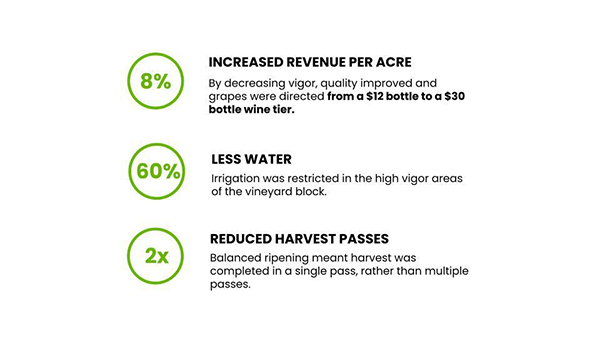
Verdi has demonstrated significant ROI from its cutting-edge solution through higher yield and improved quality by eliminating crop variability due to soil type, elevation, vine maturity, and variety.

According to Roman Kozak, CTO and co-founder of Verdi, the technology his company has developed is able to finetune water and fertilizer applications in a way not previously possible.
“Within an existing irrigation zone, we are able to give more water to the vines that need it and less water to the vines that don’t need as much.”
“We engineered this very low-cost hardware that connects to the drip tubing on every single vineyard row,” Kozak explains. “It allows you to control an monitor as fine of a section as you want. You could get down to every single vine actually receiving a unique amount of water. That’s what’s possible with this technology.”
 Verdi’s variable rate irrigation.
“We make it possible to give different irrigation strategies to vines in the same row,” Kozak confirms. “With other standard technologies, everything has to get the exact same amount of water. But if you have baby vines planted throughout your vineyard, we can give those baby vines a different amount of water than your mature vines.”
The same technology Verdi has developed for eliminating crop variability is also pioneering the way for widespread irrigation automation in vineyards. Verdi is the only company that can detect clogged or missing emitters in addition to fully automating existing valves and pumps. In contrast, automation systems on the market today only focus on automating valves and pumps which saves some labor but workers are still need to check for drip line or emitter leaks and breaks. Furthermore new value is unlocked with the Verdi Software Platform, such as automation based on prediction, using data from sensors on the field and remote imagery.
 Verdi’s row level irrigation automation with drip line break and emitter clog detection.
Since its inception four years ago, Verdi has distinguished itself as the premier, modern-day platform for farm automation with continuous updates and local in-field support.
For more information on Verdi, to request a demo or to join the waitlist, go to: https://www.verdi.ag
Contact Roman at (650) 334-7838 and roman.kozak@verdi.ag
 Verdi's Modern Software Platform
February 22, 2024
Variable Rate Irrigation by Verdi