
For winery owners and vineyard managers, pest control is a constant, and often underestimated, challenge that plays a critical role in maintaining both quality and reputation.
From preventing insect infestations in the cellar to keeping pest birds from nesting in structures or feasting on ripening grapes, protecting your property is a full-time job. And while birds might not seem like a major threat at first glance, their impact on both infrastructure and visitor experience can be significant.
If you’re wondering why it’s important to keep starlings, pigeons, and other pest birds away from your winery and vineyards, read on.
Pest Birds Disrupt the Guest Experience
Wineries often pride themselves on providing a scenic and relaxing environment. But birds congregating around tasting patios, walkways, or event spaces can quickly disrupt the guest experience. Excessive bird droppings, noise, or aggressive behavior can leave a poor impression - and possibly negative reviews - especially during peak visitor seasons.
No one wants to sip a glass of Pinot while dodging a dive-bombing bird.
Birds Can Damage Vineyard Infrastructure
Pest birds are opportunistic and resourceful. They build nests in gutters, signage, equipment sheds, or even under solar panels. Blocked drainage systems can lead to water pooling, creating further pest or maintenance issues.
Their droppings are also acidic, damaging paint, metal, and masonry over time, not to mention making walkways slippery and unsafe. In the vineyard, birds can peck at grapes, reducing yield and leaving bunches susceptible to rot and disease.
Birds Spread Disease
While most winery guests may not think of birds as a health hazard, pest birds are known carriers of bacteria, parasites, and viruses. Accumulated droppings and nesting debris around the property can pose sanitation risks to both people and production equipment if not properly managed.
Aggressive Behavior is a Real Concern
Birds protecting nests near tasting rooms, parking lots, or vineyard paths can become unexpectedly aggressive. Territorial species may dive or swoop at staff or visitors, creating a safety issue - especially if the birds have made your winery their permanent home.
A Humane, Effective Deterrent for Vineyards
Managing pest birds doesn’t need to be a losing battle. Regular maintenance and deterrent strategies are key to keeping bird pressure low, especially during the harvest season.
One effective solution wineries have embraced is the use of Fright Kites—realistic kites that mimic the flight and presence of a peregrine falcon, a natural predator. Suspended from tall poles and activated by even light winds, these kites offer a humane way to protect both property and crop.
To learn more about how to protect your winery and vineyard from pest birds, visit FalconKites.com
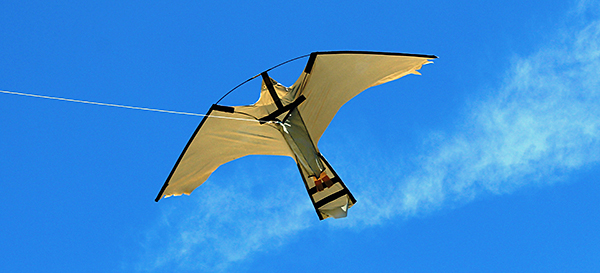
Enhanced Bird Deterrent Technology for Vineyards Takes Flight with New Identity
When the grapes are ripe and the birds are hungry, there’s no better vineyard protection than a sharp-eyed peregrine falcon soaring above the vines. Just a glimpse of this bird of prey sends starlings and other destructive flocks fleeing.
Historically, wineries have installed netting to try to protect their crops, especially their most prized grapes. While effective, netting is also expensive, and installation and removal are labor-intensive. Other safeguards, such as cannons, broadcast distress calls, streamers or stationary decoys, offer fleeting results and can be intrusive.
Ten years ago, Falcon Crop Protection developed an innovative and cost-effective solution: realistic kites that mimic the shape and predatory movements of a peregrine falcon as it soars from a tall fiberglass pole. With just a slight breeze, the kite takes flight and patrols all day, triggering birds’ natural fear responses.
The kites’ success is well-known across the wine industry and in other bird-troubled spaces, from beaches to sports stadiums to fruit farms.
In response to growing demand, co-owner and operations director Justine Davies announces, “We are proud to share our company’s rebranding as Falcon Kites. We’re launching a new website, www.falconkites.com, featuring an upgraded, user-friendly Shopify interface to streamline the purchasing process for our customers. We’re also expanding our distribution by making Fright Kites available at vineyard operator supply stores, like Central Valley in Healdsburg, Napa, and Sonoma.”
In honor of its rebranding, Falcon Kites unveiled a taller, 36-foot expanding pole, allowing the kites to soar to greater heights. Davies also shared a new design feature: a re-engineered spinning top with a ball bearing that turns more smoothly and minimizes entanglements, helping keep the Falcon Kite constantly flying. The Falcon Kite’s movement now appears even more lifelike and threatening to wary winged interlopers.
Many customers start with one or two Falcon Kites as a trial. After seeing the results, they soon return for more. Davies notes, “Two-thirds of our orders over the past five years are from repeat customers. One large winery ordered ten last June, then bought another fourteen over the next two months to protect different vineyard blocks. California’s microclimates ripen grapes - and draw birds - at different times throughout the season.”
Repeat buyers like this speak to the Falcon Kite’s success in deterring these destructive birds. The kites don’t just work their magic on starlings - gulls and Canadian geese also turn tail at the sight. Van Smith of the Lake of the Pines Home Owners Association says, “We recently installed a Falcon Kite on a dock out in our lake, which previously had heavy goose activity and a significant amount of droppings every day. Almost immediately, we noticed a big improvement. Now they’re installed at all of our parks and our main beach. It's made a huge difference in the cleanliness and usability of our public spaces. This is a great product that truly delivers on its promise. We confidently recommend it to anyone dealing with similar issues.”
To keep your vineyards and other properties free from invasive avian flocks, visit Falcon Kites’ new website at www.falconkites.com.
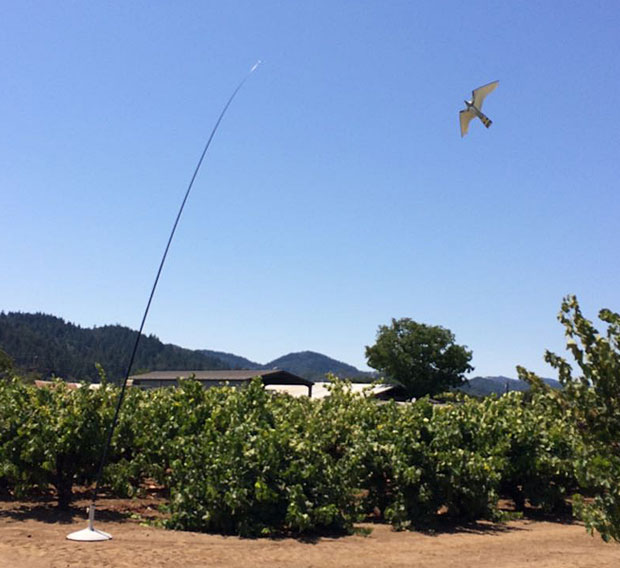
Saini Vineyards is a well-established and well-known family business producing premium quality grapes in Healdsburg. We were introduced to Mike who had serious bird problems in past years and was interested in what the Falcon Replica could do and how it would perform. In 2016 he was not having the typical bird pressure that he had experienced in prior years but nevertheless was willing to test the product.
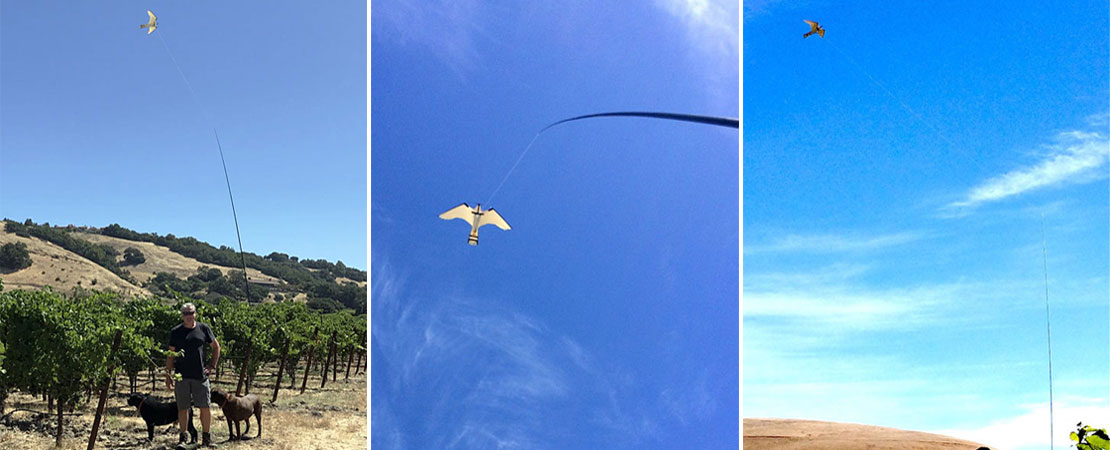
We installed a 22ft Falcon on a portable base (umbrella stand) so it could be moved around to be effective against birds and also to move it out of the way when harvest was in progress. The above photo hows one of the main access roads through the vineyard and the location of the falcon on its base at one of the cross roads. The Falcon easily launched in the winds that are present virtually every day in that location and throughout the remainder of the season did not have to be taken down nor did it suffer any damage.Here are some further photos of the installation.
Notice how in the upper right photo the Falcon has its wings bent upwards which happens as the carbon fiber spars bend in strong winds to give the product a realistic and moving wing appearance just like a real falcon. This 22ft pole had a 16ft flight line so the kite was approximately 35-38ft up in the air. This is easily visible to approaching birds and gives them plenty of advance warning of a predator bird ahead and take evasive action.
The shape of the Falcon closely replicates a real falcon as does it color and movements which are always changing. Typical "scare" repellents like owls and scarecrows etc do not move in a random manner and birds quickly learn that they are nothing to be scared of and continue to invade the vineyard. Not so for the Falcon.
"We did not experience the same bird problems
in 2016 as we had in prior years however we were interested to see just what effect it did have on
those that were present. We moved the Falcon from vineyard to vineyard easily as different varietals
were being picked at different times. At the end of
our testing we can say that the results justified our purchasing the product for use in coming years."
- Mike / Saini Vineyards
Early mornings in Healdsburg can be times of low wind and the unique design of the Falcon incorporates design features of a regular one-plane kite and a box kite, allowing it to rise quickly in light winds, hold position in the air and also dart around sharply as wind gusts change in intensity.
As the end of season approached, Saini moved the Falcon to the fields which were last to ripen before finally taking it down and storing for next year.
One of a vineyard manager's worst early morning sights is walking among their vineyard and finding fruit damaged by birds. To combat this force of nature, growers have traditionally tried expensive and labor-intensive methods of mitigating bird damage in their vineyard. They've used sound-emitting devices, introduced other large birds of prey, placed netting in the fruiting zone and even tried netting the entire canopy, ultimately learning that nothing has truly provided an economic or socially acceptable solution to the problem. Luckily, the industry has been buzzing about a new solution that has shown spectacular results from guarding against bird damage without any netting whatsoever.
Falcon Crop Protection has developed a falcon-shaped kite that is attached to a moveable pole and behaves like a real bird of prey. Their "FrightKite" looks like the real deal and has proven highly effective in fending off birds that would otherwise do damage to valuable crops.
We spoke with Dan Warwick, Winemaker and Vineyard Manager of Paradise Ridge Winery, on the types of issues his vineyard was facing and what made these kites worth the investment.
"Before the kites, we ended up installing netting over the vines which was expensive and labor intensive. It was better than nothing, but some birds were still able to get under the netting and damage the fruit, sometimes getting trapped inside the netting. It's not only about the loss of fruit, we then had to add more labor to go through and drop the bunches that were damaged. When you have fifteen acres of vines and the netting costs anywhere from $1,000+ per acre, you are talking about a major expense. Not only that, but there was an entire process required to make it work. You had to install the netting, which required hiring a crew, then later you'd have another crew lift the same netting to harvest the grapes and then ultimately remove the netting afterwards. It was a hassle and required a lot of labor. Worst of all was that it only helped a little, and still didn't eliminate bird damage 100%.".
"I see not one single grape that has been hit by birds. An added bonus to the other benefits is that they're also bird-friendly, I don't want to kill the birds or have them get trapped in the netting, I just want them to not eat my fruit. The kites are also really kind of amazing to watch. They move just like a real falcon! Seriously though, all positive feedback and no negatives on my end. I'm one happy customer" - Dan Barwick, Paradise Winery
On discussing his decision to give the FrightKites a chance, Dan says, "I had seen the kites at tradeshows and saw a spotlight article touting their effectiveness. I figured I'd give it a shot ? since I'd already tried the netting ? and I was astonished by the results! I had no damaged fruit! It was unbelievable! I ordered some more kites for this year's harvest to put in all my vineyards."
"An added bonus to the other benefits is that they're also bird friendly," he says, "I don't want to kill the birds or have them get trapped in the netting, I just want them to not eat my fruit."
Falcon Crop Protection's FrightKite is an amazing tool that vineyard or winery owners should not hesitate to learn more about to see if they can reduce or eliminate bird damage in their vineyard at a reasonable price, and without harming the environment
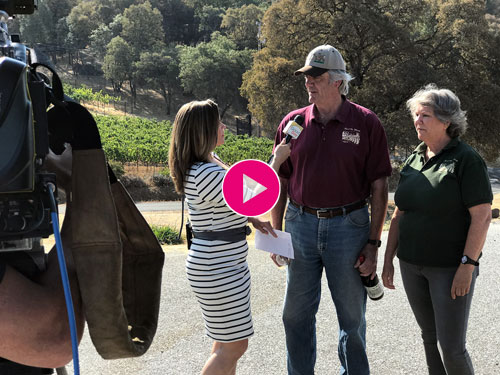
Silent, cost-effective, and eco-friendly, the FrightKite™ is helping vineyard owners protect their crops while increasing yields—one quiet vineyard at a time.
Viewers of Good Morning Sacramento were treated to some footage of the Falcon Crop Protection FrightKite™ in action - although "action" may not be quite the right word. As you'll see from the clip (linked below), a section of grapes nearing harvest at Fawnridge Winery and Vineyards in Auburn, Calif. looked particularly quiet and absolutely idyllic during the report, filmed one Tuesday morning in late August 2018.
But of course, quiet was the whole point - what was missing from the picture were the hundreds of squawking birds that normally flock to the vineyard looking for a free meal of ripening berries.
"We were faced with spreading some nets over the top of the canopy of these vineyards. That's a big job," said Stewart Perry during the news report. Perry, who owns Fawnridge with his wife Stephanie, saw an ad for the Falcon Crop Protection FrightKite™ and was immediately intrigued. With easy setup at a fraction of the cost of installing netting, they had nothing to lose. "I thought, 'Well, I'll give this a try. And here we go."
"Here we go" is right. The cameraman zooms in on a power line above that normally is filled with birds, scouting out their next meal of grapes. With the FrightKite™ flying nearby, the power line was absolutely empty.
During their research, the Perrys found out that the Oakland Coliseum - home of Major League Baseball's Oakland A's - launched two of their own FrightKite™ last year to solve their rampant seagull problem. Viral videos show birds brazenly attacking fans and stealing food right out of their hands. That's now a thing of the past. Not only were the FrightKite™ effective, "Falcon Mcfalconface" became so popular with fans that it has its own Twitter account:https://twitter.com/mcfalconface
"They said that the kites reduced the number of seagulls from a thousand to eight," Stephanie Perry said during the news report.
Stewart and Stephanie Perry are just two of a growing number of vineyard owners who have found out how effective and inexpensive the Falcon Crop Protection FrightKite™ can be. They are silent, portable (so they can be moved from section to section easily), self-launching and self-flying, and totally harmless to the birds for the greenest possible solution to bird control.
With veraison just around the corner, many more vineyard owners are about to find out how the Falcon Crop Protection FrightKite™ can significantly reduce crop damage and increase crop yields. Others are planning to expand - roughly 40% of the FrightKite™ sold today are to vineyards which have already tried them to great success. It pays for itself in the first year with crop yields alone, never mind the labor and materials costs associated with expensive netting.
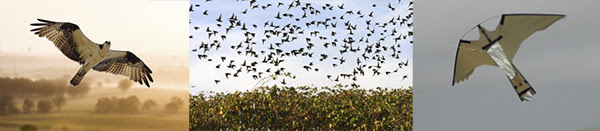
After veraison, as grapes develop their enticing color in the vineyard, the age-old battle between man and nature — in the form of hungry birds — begins. Vintners and farmers have experimented with gas cannons, reflective flash tape, sonic sound systems, drones and netting to scare off their voracious flying opponents. But, the noise of cannons and sonics can irritate neighbors, and drones and netting are labor intensive, making them too expensive to maintain.
Nature often provides the best solution, and in the case of birds raiding vineyards, the natural solution is birds of prey like falcons. Small birds' instinctive fear of their natural predators causes the flock to shift direction, saving the crop from invasion.
After five decades in the bird abatement business, Falcon Crop Protection has an intimate knowledge of bird behavior and has brought this knowledge to wine country after their marketing manager moved to Healdsburg, launching Falcon Crop Protection to help vineyards reduce grape loss from birds. Their invention ― The Falcon Frightkite™ — creates an amazingly authentic profile and flight pattern based on the peregrine falcon, a bird of prey many viticulturists see hunting over their vineyards.
“We’ve had kites up for six or seven years, and we have so many satisfied customers,” says Justine Davies, Marketing Manager for Falcon Crop Protection. “The kites typically last several growing seasons, and we’re now seeing customers returning to make repeat purchases.”
Dave Crockett, Dirt Farmer and Co.
Dave Crockett of Kenwood vineyard services company Dirt Farmer and Co. and Falcons’ first Frightkite customer says, “I have been using Falcon Frightkites in my Cabernet vineyard and at clients’ vineyards for over ten years. They are the most effective bird deterrents I have found, including lasers and various sounds. Not only are the effects visual, but they result in more than 10% greater yields in most areas.”
The kite is a close replica of a falcon. It is two feet long, and its wingspan is 56 inches, wider than a peregrine falcon's 39‒43 inch wingspan and slightly smaller than that of a gyrfalcon's 62 inches. The kite follows the peregrine's v-shaped wing shape and has "feathers" that flutter like a falcon's wingtip feathers when hovering to search for prey or using them for balance and flight control. The falcon kite's head and neck are white, which signals 'danger' to birds even at a long distance, so when they catch a glimpse of the falcon shape in the sky, they also register that white danger sign.
"I have been using Falcon Frightkites for over ten years in my Cabernet vineyard. They are the most effective bird deterrents I have found, including lasers and various sounds and they result in more than 10% greater yields in most areas.”
Robert Salomon attests to the Frightkite's authenticity: "I have been using the Falcon kites in my Viognier vineyard for eight years. I once watched a flock of birds heading directly toward my vineyard, and when they approached the Falcon kite, the flock banked immediately and flew away. The kites have reduced my bird damage problem dramatically. I started with one Falcon kite and have added a second for better coverage. I use them every year."
The Falcon Frightkite hovers like a falcon because the flight line attaches at two places on the wing to pull it away from the bird. This design creates a smooth arc, and the air can flow through it like a box kite, letting it rise in a very light wind. There is another flap sewn into the Frightkite near the tail and together these two design flaps create the Venturi effect that helps the kite raise and do random aerobatics that birds do not adapt to or recognize as a fake.
The vineyard manager for Napa's Blankiet Estate relates a unique experience. "A couple of years ago, our Vineyard Manager took some exciting footage," says Julie Jones, speaking for the estate. "A live falcon came to fight with one of the FrightKite Falcons to protect his territory. It took him a bit to recognize what he was attacking, which speaks well for the kite's lifelike flying patterns."
The 100% handmade, handstitched kites use a proprietary fabric with rip-stop fiber to mitigate against tearing if it gets a hole. The spars creating the falcon shape use a high-strength yet incredibly light material — carbon fiber.
Squire Fridell of GlenLyon Vineyards & Winery and Two Amigos Wines in Glen Ellen puts it: "I LOVE these things, and we'd fly them all year 'cause they are so pretty, but they'd wear out even faster."
Davies, always looking to innovate the Company’s kites, is now at the final stage of field testing a new spinning top with ball bearings to increase maneuverability during wind events.
If you're a satisfied customer and need an update or a grower who needs to prevent grape loss to birds, reach out to Falcon Crop Protection by email or visit the website: falconcropprotection.com.
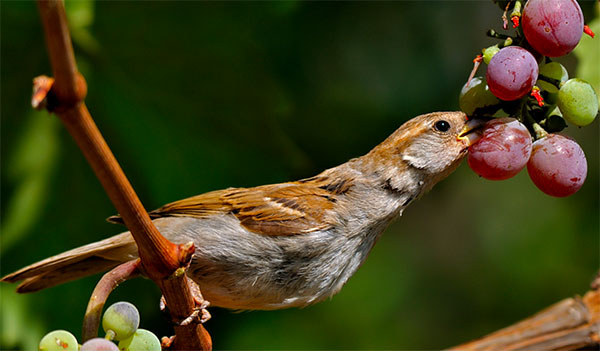
Viticulturists in California's Central and North Coasts predict a delayed harvest this year due to the cold, rainy spring. This postponement poses a potential threat to the grape crop, leaving it vulnerable to challenges from autumn rains, cooler temperatures, and smoke taint from wildfires.
The delay does, however, provide grape growers with more time to prepare for a persistent challenge to wine grapes – bird damage. The critical moment is after bud break and before veraison when vineyards become prime targets for birds searching for food and a place to roost.
"The time to act is when the sugar content begins to rise and attract the birds," asserts Dave Crockett of Kenwood's The Dirt Farmer, vineyard services company. "Once the birds are drawn in, there's nothing you can do to deter them. The key is to prevent them from noticing the ripening grapes in the fields below. With this year's harvest delayed by one to four weeks, there's still time to act."
"Birds always look for areas where they can roost," agrees Roger Snow, a renowned bird control expert. "They prefer elevated spots that provide a clear view of their surroundings and where nothing can creep up on them. You'll often find them perched on power lines, scouting the area. It is crucial to stop the birds before they settle in."
Natural Solution
Snow, the owner of Falcon Crop Protection, has 45 years of extensive experience in commercial bird control, serving clients in 22 countries. His portfolio includes managing the installation of products for such well-known organizations as The Vatican, The Dept. of Defence, Meta, and Google. He has also effectively cleared nuisance birds from aircraft hangers, shopping centers and hotels.
After residing in Marin for two decades, Snow bought a home in Healdsburg. His immersion in the local wine industry exposed him to the challenges grape growers face with birds, which inspired him to develop a solution—the Falcon FrightKiteTM.
His natural approach doesn't introduce chemicals, make loud noises or require a lot of labor to install, a relief given current labor costs and shortages. Instead, the Falcon FrightKiteTM lives up to its name by mimicking the shape and movements of a falcon, gracefully perched atop a flexible fiberglass pole available in 22, 28, and 36-foot lengths. These poles are 5-foot telescoping rods that expand to soar the kite up to 60 feet into the air. Its natural swooping movement is created by attaching it via a ring equipped with a swivel at the pole's end.
"We've been crafting our falcons by hand with premium materials for seven years now," Snow explains. "I enjoy being part of the wine industry and being able to assure growers, "This will work." The problem is that growers often leave solving the problem until too late. It's harder to repel birds once they have eggs in the nests."
Numerous small details ensure the kites are long-lasting. Falcon Crop Protection makes its own poles to ensure they don't get brittle and shatter, uses a proprietary ripstop material that keeps the kites from ripping as the material expands, and forms the falcon shape with carbon-fiber spars that don't snap like wood or bamboo.
"Birds can see that from a long way off," notes Snow. "With just one Falcon, we can reliably protect 1¼ to 1½ acres, and deploying two Falcons expands the coverage to 3-4 acres. With the new 36-foot model, we've achieved up to 10 acres per Falcon because they're flying so high."
Opportunity for Vineyard Management Companies
Crockett installed Falcon FrightKitesTM throughout the 750-acre vineyard at Kunde Ranch. His assessment of their performance speaks volumes: "The kites work better than anything else I have tried in my 15 years in the business. Although nothing is perfect, the kites are as good a commercially-available solution as it gets. Its ability to move like an actual falcon at the end of the pole makes all the difference."
Vineyard owners and management companies can easily install the kites, move them around to achieve optimum coverage, check on them regularly to ensure they're operating properly, and then take them down after harvest and move them to another location, chasing the grapes as they mature.
Falcon FrightKitesTM can be seen flying above numerous vineyards, including neighbors Comstock Wines and Saini Vineyards in Healdsburg's Dry Creek Valley and Parum Leo Winery & Vineyards, which you can see from US Route 101 just south of Petaluma. There's even one that flies between home and third base at the Oakland Coliseum.
Snow reminds vineyard owners that the key to success is to "Get them up early and get them up high!" This year's window is closing, so reach out to Roger at info@falconcropprotection.com or 415-789-5007 today.
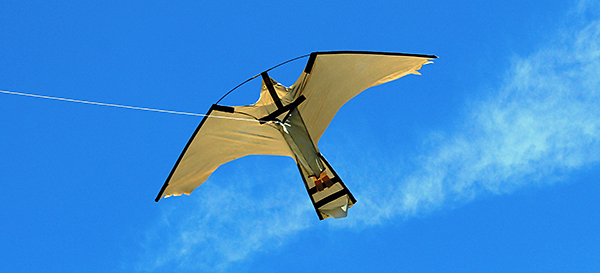
After five years of growing success flying Falcon Frightkites™ over vineyards to ward off destructive birds, Roger Snow, owner of Falcon Crop Protection, is introducing two new models in response to customer demand.
"We LOVE our Falcon FrightKites™," said Kevin and Wendy, owners of Tara Bella Winery, when asked about their success with the Falcon FrightKite™. "Not only are they amazing to see & a great conversation piece, but we also did NOT put up ANY bird netting last year, and we had zero bird damage."
Growers like Kevin and Wendy are increasingly replacing their netting with the Falcon FrightKites™ and satisfied customers are looking to upgrade their falcon solutions. In addition, many first-time East Coast buyers are seeking solutions customized to their needs.
The first new product replaces the 31-foot model, extending the height to 36-foot with a telescoping glass-reinforced flight pole that elevates the Falcon to over 60 feet in the air. This added height makes the Falcon FrightKites™ clearly visible to incoming birds from even greater distances than the popular F28K — for only $36 more. This added height is especially beneficial when hills or tall tree borders block the line of sight for incoming flocks of birds.
The new product uses the standard rubber grommet in the bottom and has a solid black flexipole for vineyard installation. For customers on a budget, it adds height for $100 less than the 42-foot aluminum pole model, although the superior longevity of the aluminum pole makes the 42-foot model the preferred choice.
The proven effectiveness of Falcon FrightKites™ against gulls and geese led Falcon Crop Protection to develop a new kit with a 22-foot pole that fits into rod holders on boats and repels gulls and marine birds. The marine model does not require the rubber grommet or flexipole and instead has an additional 28-inch extension pole tapered at one end to insert into the base of the flight pole. A retaining clip is molded into the flight pole to secure it tightly so it doesn’t lift the assembly out of the rod holder and end up in the sea. The new Marine kit is also effective in vineyards whose owners prefer not to use the Flexipole system.
To purchase or learn more about the new Falcon FrightKites™, go to www.falconcropprotection.com. Be sure to check out the new installation video and installation advice document on the website under “Support.” For questions or to decide which Falcon FrightKite is right for you, contact Roger today at info@falconcropprotection.com or 415-789-5007.
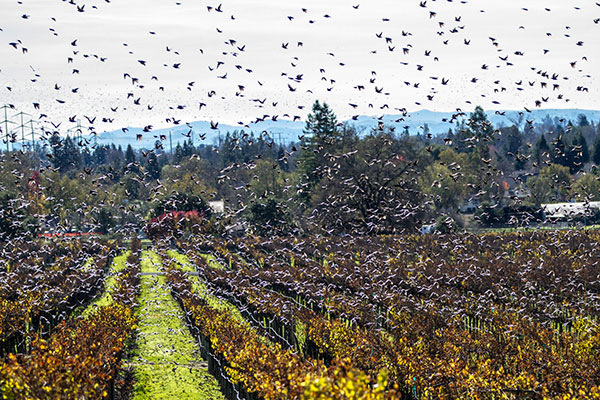
Every year in California alone, vintners and farmers lose millions of dollars to birds feeding on their grapes, seeds, and crops. Veraison is a particularly difficult time for vineyards. Grapes are at their most vulnerable when they are approaching their peak – birds love those juicy berries! To combat this force of nature, growers have traditionally tried expensive and labor-intensive methods of mitigating bird damage in their vineyard. Falcon Crop Protection launched The Falcon Frightkite™ to reduce grape loss due to birds in a more effective, environmentally friendly, and cost-effective way than any other solution, including gas cannons, reflective flash tape, sonic sound systems, and netting.
Falcon Frightkites™ save growers 95-100% of the costly damage caused by finches and other small birds flocking into vineyards during and after veraison to eat grapes just as they ripen. These kites activate small birds’ instinctive fear of their natural predators by simulating a falcon’s shape and movement. When the birds see the Falcon Frightkite™ flying above a vineyard, the entire flock shifts direction to avoid contact with their perceived enemy, providing near-complete protection of the crop. The long-lasting FrightKites™ are incredibly cost-effective compared with netting or other labor-intensive vineyard protection measures and are simple to install. Growers can recover the cost a FrightKite™ many times over in a single season with the grapes saved from bird damage.
It’s estimated that one FrightKite™ will protect a vineyard area of approximately 1.25 acres. Two FrightKites will create a multiplier effect to safeguard three or more acres because birds perceive the area between the two hunting falcons as a “kill zone.” “Put simply, birds don’t want to be watching for hunting falcons in two different directions while they’re pecking at grapes,” Falcon Crop Protection points out. “So the circular area between the two falcons is a no-fly zone, up to a point where there is no gap they can identify as an escape route.”
“We have been growing grapes for 34 years here at GlenLyon. I have tried EVERYTHING (except netting) to keep the birds away from pecking at my clusters including AV Alarms, Reflectors, and Fake owls. I even built 4’ x 6’ x 6’ big bird traps to corral the critters. NOTHING works as well as my three Falcon kites! Thanks for inventing them!” - Squire Fridell of GlenLyon Vineyards & Winery
Falcon Crop Protection can state with confidence that any exclusion method, including netting, has coverage limitations. They say that determining the optimum number of FrightKites™ for complete vineyard protection is best approached on an individual basis, based on vineyard configuration and prevailing wind direction.
“I was sold before I even bought The Falcon Frightkite™,” says customer John Koos in Petaluma. “My neighbors had one for two years, and last year, he harvested 40 tons of grapes without a single bird peck on any of the grapes.” “The benefit of the FrightKite™ is that it gives you acres of proven protection year after year for a fraction of the cost of anything else on the market.” “This is the time to act,” says Falcon Crop Protection. “With grape veraison approaching, winery and vineyard managers still have time to install FrightKitesTM and preserve their grape crop.” Contact one of our partner distributors, Oregon Vineyard Supply Co. at 503-435-2700, or for more information, testimonials from existing customers and orders, go to www.falconcropprotection.com or call 415-789-5007.

Repel Pest Birds from Your Vineyards with Amazing Frightkite™
Have you ever watched a peregrine falcon hunt? It flies high over the vineyard watching for its prey — small birds. When it sights a target, it stoops, tucking curved wings under itself to create an airfoil, and dives at over 200 MPH. The power behind the fastest bird in the world is enough to kill or stun the bird it targeted.
Now think of seeing the falcon from a bird’s point of view, one happily feeding on your sweet juicy grapes. Flocking birds like starlings and blackbirds are the most aggressive avian species in inflicting damage on vineyards. They don’t just take one grape here and there. Instead, they peck here, there and everywhere and keep right on going until they ruin whole bunches. And once the grape meat is exposed, the bees come in and exacerbate the problem.
When a flock of birds see a falcon in the air their first reaction is to evade the threat and create distance between the predator and themselves. Similar to an actual falcon, an entire flock will divert their flight path as soon as they see the Falcon Frightkite™ in order to avoid the perceived threat.
Falcon Crop Protection launched The Falcon Frightkite™ to reduce grape loss due to birds in a more effective, environmentally friendly, and cost-effective way than any other solution, including gas cannons, reflective flash tape, sonic sound systems, and netting.
Bird netting, though highly effective, is manpower-intensive, requiring installation and de-installation for harvest. It is also less eco-friendly, trapping many non-target species like hummingbirds, dragonflies, and seed- and bug-eating songbirds. Gas cannons are noisy and disruptive to neighbors, and birds can ultimately adapt to the noise. Flash tape has limited to zero effectiveness, and sonic systems are relatively ineffective in outdoor fields.
With over a 95% success rate at repulsing birds from open vineyards, the Falcon Frightkite™ is easy to install, simple in design and lasts many years. Relying on prevailing winds for a random flight path and requiring only a 2 MPH wind to launch and keep it moving, it’s always visible to pest birds.
“I was sold before I even bought The Falcon Frightkite™,” says customer John Koos in Petaluma. “My neighbors had one for two years, and last year, he harvested 40 tons of grapes without a single bird peck on any of the grapes.”
The Falcon Frightkite™ is genuinely a “BREEZE TO FLY” and is also visitor-friendly. Sustainability is increasingly vital to consumers, and watching the falcon fly while they’re tasting wine adds a unique conversation piece to their visit.
Winery and vineyard managers are recommended to act now as grape vines begin to form clusters, providing the perfect canopy for birds to make their nests within the vineyards themselves.
For more information, testimonials from existing customers and orders, go to www.falconcropprotection.com or call 415-789-5007.