
Assembly Bill 720 created a new Estate Tasting Event Permit (Type 93) that allows Type 02 wineries to exercise their tasting room privileges at properties they own or control, whether adjacent to the licensed premises or at non-adjacent vineyard sites. While this new privilege offers wineries greater flexibility to host immersive vineyard experiences, it does not override local land use controls. Sonoma County recently issued guidance clarifying how the Type 93 permit may be used on agriculturally zoned vineyard parcels and when additional land use approvals are required.
Sonoma County’s Approach to Vineyard Tastings
Sonoma County has clarified how Type 93 permits may be used on vineyard parcels located within the County’s primary agricultural zoning districts:
- LIA – Land Intensive Agriculture
- LEA – Land Extensive Agriculture
- DA – Diverse Agriculture
The County distinguishes between recreational uses of a vineyard, which may occur without land use approval, and vineyard tastings, which generally require land use approval.
Limited Vineyard Picnicking
According to Sonoma County’s guidance, certain small gatherings associated with a Type 93 permit may be considered recreational use of an agriculturally zoned vineyard parcel. If the activity qualifies as recreational picnicking, it may occur without a land use permit under the County’s zoning code.
To qualify under this interpretation, the activity must meet the following conditions:
- The gathering involves fewer than 20 people.
- The activity occurs no more than one day per month.
- Activities take place during daylight hours only.
- No temporary or permanent structures are used, including tents.
- The event does not involve amplified sound.
When these conditions are satisfied, Sonoma County interprets the activity as a recreational use of agricultural land rather than a visitor-serving winery event.
Activities Requiring Land Use Approval
For vineyard tastings that do not meet the County’s definition of recreational picnicking, the use of a Type 93 permit must be consistent with an existing land use approval.
Relevant approvals may include:
- A use permit for winery or agricultural processing operations,
- A use permit authorizing a tasting room, or
- A temporary special event permit.
Sonoma County also notes that land use permits typically apply to the entire parcel, while an ABC license defines a specific licensed premises within that parcel. As a result, wineries must ensure that both their land use approvals and ABC premises diagrams allow the proposed activity.
State Framework for Estate Tasting Events
The California Department of Alcoholic Beverage Control (ABC) administers the Type 93 permit.
- Annual Permit: Wineries must obtain the Type 93 permit itself at a cost of $210 annually ($200 base fee plus $10 surcharge). Only holders of a Type 02 winegrower license may obtain the permit.
- Individual Event Authorizations: Each tasting event requires a separate authorization from ABC, submitted at least 3 days (but no more than 90 days) in advance, at a cost of $100 per event.
- Annual Cap: Maximum of 36 events per year per licensee.
- Standard Regulations Apply: All tasting room regulations continue to apply, including RBS training requirements.
As ABC guidance emphasizes, however, approval of a Type 93 event authorization does not substitute for compliance with local land use requirements.
Navigating the overlap between ABC event authorizations and Sonoma County’s land use framework requires careful attention to both state and local requirements. Early coordination with County planning staff and legal counsel can help avoid compliance issues and ensure events proceed without disruption.
If you have questions about how AB 720 affects your operation, or
need assistance with permit applications, compliance planning, or navigating
local land use requirements, please contact our office.
Jeremy Little at jlittle@cmprlaw.com
520 Third Street, Suite 500, Santa Rosa, CA 95401
Phone: 707-526-4200
Jessica King at jking@cmprlaw.com
300 Oswego Pointe, Suite 103, Lake Oswego, OR 97034
Phone: 503-658-9925
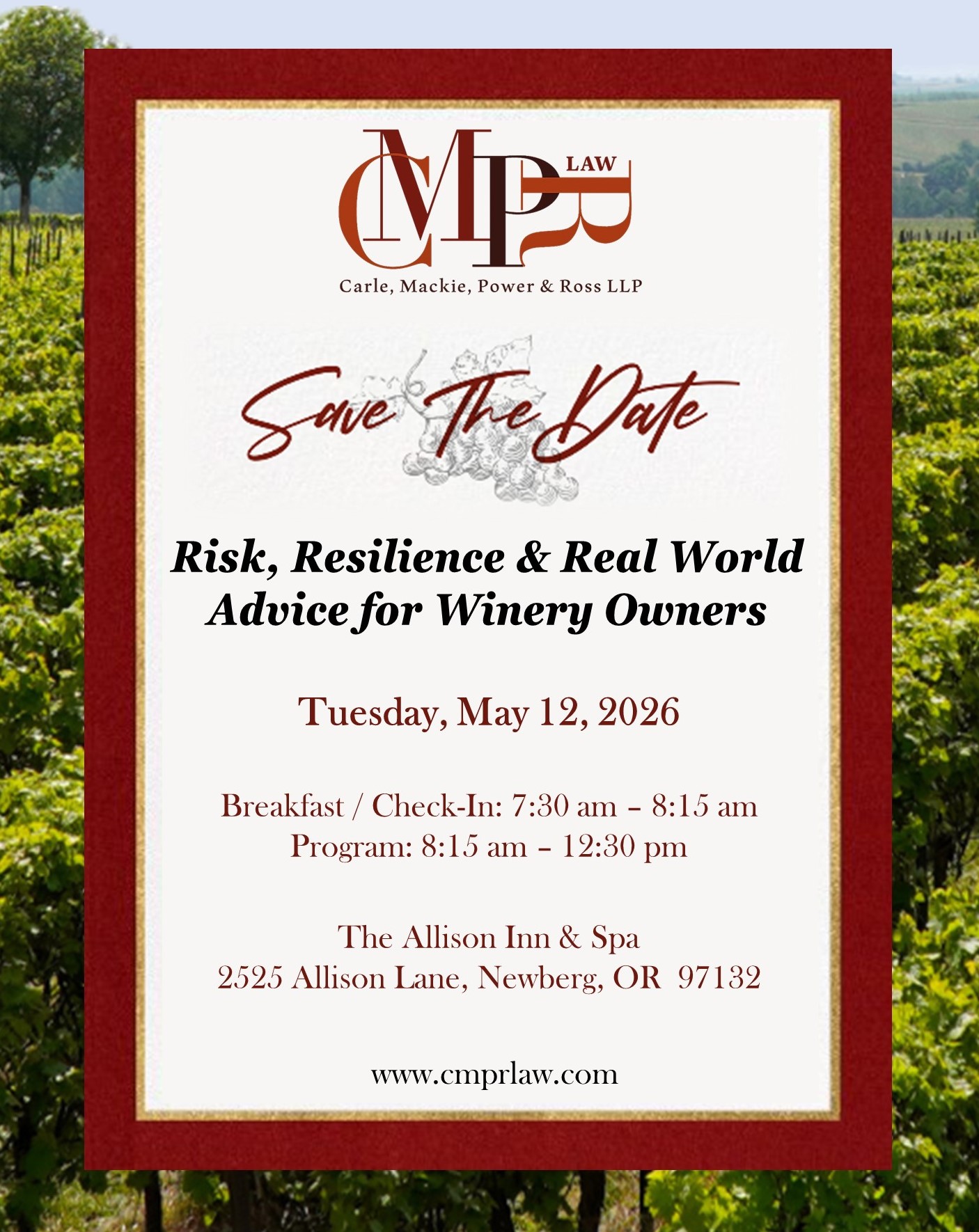
Event Type: Seminar
Location: Newberg, OR
Date: 5/12/2026
Join leading wine industry attorneys, winery owners, and professionals for a focused half-day panel discussion.
Panelists include:
- Arnaud Joubert - Légi Conseils Bourgogne
- Mario Zepponi - BMO
- Howard Bailey - Arch + Beam
- Pete Danko - Portland Business Journal
- Michael (“Mikey”) Etzel - Beaux Frères Winery
- Janie Brooks Heuck - Brooks Winery
- Barbara Gross - Cooper Mountain Vineyards
- David Millman - Domaine Drouhin
- Rusty Field - Domaine Serene
- Adam Campbell - Elk Cove Winery
- JB Rivail - Ponzi Vineyards
What you’ll gain:
- Practical strategies to manage financial and operational risk
- Insights on protecting assets in a shifting market
- Real-world perspectives from industry leaders and advisors
- Actionable steps to strengthen stability and long-term positioning
May 12, 2026
7:30 a.m. - 8:15 a.m. Check-In & Breakfast
8:15 a.m. - 12:30 p.m. Program
The Allision Inn & Spa
2525 Allison Lane
Newberg, OR 97132
It is time to dust off the employee handbook, review your policies and procedures, and make sure they comply with all the new laws, regulations, and interpretations that went into effect during 2025, became effective in late 2025, or January 1, 2026.
Below, we have identified our “top 10” changes. Please keep in mind there were hundreds of laws, regulations, and changes implemented at the local, state, and federal levels throughout 2025. This summary highlights selected changes most likely to impact California employers and is not intended to be exhaustive. So, if you need a handbook/policy review or have any questions, please call us!
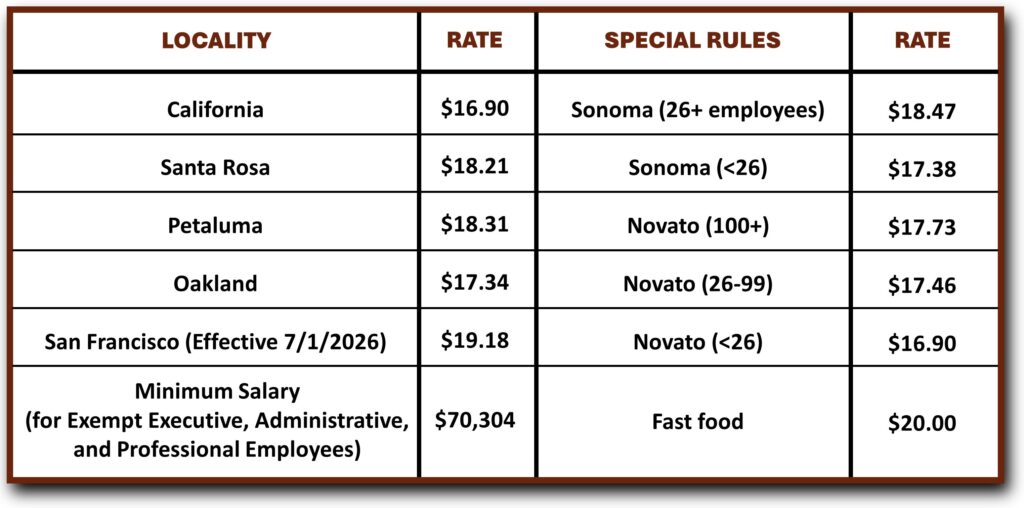
1 – Minimum Wage Update:
Updates happen every year. It’s best to put a calendar reminder in November, to make sure your payroll is ready!
Action: Review your payroll to ensure all employees are being paid the new minimum wage, send written notice of the wage change to affected hourly employees, and be sure your salaried exempt employees are earning at least the minimum salary threshold. This includes remote employees working from home in jurisdictions with higher local minimum wages. Many other cities and counties in California, as well as thirty (30) other states have passed higher minimum wage requirements. Remember that employees should be paid minimum wage based on where they work, whether it be a satellite office or their own home, and that location may have a higher minimum wage than your main worksite.
2 – AI Transparency Law for Employment Decisions:
Automated-Decision Systems (“ADS”) are becoming much more prevalent. They may help to screen applicant resumes, direct job advertisements to targeted groups, or use machine learning to analyze data to rate employee performance. This can also be used in hiring, promotion, discipline, or termination decisions. Effective October 1, 2025, when using AI/ADS, California employers must (1) give notice to employees when it is used, (2) provide accommodations to avoid discrimination, (3) retain all records sufficient to document use, decision-making criteria, and compliance for at least four (4) years. If there is a claim, evidence of proactive anti-bias testing and mitigation efforts will be relevant to avoid unfair impact or unintended bias resulting from the use of ADS.
Action: Review all software systems, as well as all recruiting platforms to determine what is using ADS. Update your employee handbook with information on any ADS you employ, including reference on how to request an accommodation. Research and implement anti-bias analysis/testing to avoid discrimination. Maintain documentation throughout. Failure to comply may increase exposure to discrimination and unfair employment practice claims.
3 – Pay Equity Enforcement Act:
Existing law requires employers to disclose the pay scale for open jobs, and to employees upon request. This bill amends the definition of “pay scale” to mean the “good faith estimate of the salary or hourly wage range that the employer reasonably expects to pay for the position upon hire.” Note that the pay scale includes all reasonably expected wages, bonuses, commissions and fringe benefits (e.g. a company car, employer provided housing, etc.) The bill also expands the statute of limitations from 2 to 3 years for pay equity claims and caps the recovery of unpaid wages at 6 years, consistent with existing wage-and-hour limitations.
Action: Review pay scale disclosures in job descriptions/advertisements to ensure accuracy. If you have not done so already, create a protocol for handling employee requests for information.
4 – Workplace Know Your Rights Disclosures:
Effective February 1, 2026, employers must provide an annual written notice to each current employee that explains (1) workers’ compensation benefits, (2) a summary of employee rights to immigration protections, (3) union organizing and concerted activity, (4) constitutional rights when interacting with law enforcement at the workplace, (5) a list of any other rights identified by the Labor Commissioner and the enforcement agencies responsible for these rights.
No later than March 30, 2026, employees may designate an emergency contact, and employers must, if requested by the employee, notify their designated emergency contact in the event the employee is arrested or detained at work.
Action: The Labor Commissioner has published a template notice for employers to use. Please see the link below and adopt this form into your new-hire packets and ensure it is checked for updates regularly. https://www.dir.ca.gov/dlse/Know-Your-Rights-Notice/Know-Your-Rights-Notice-English.pdf
Of note, the Labor Commissioner already published a template notice for employers to provide relevant employees who are subject to an immigration enforcement action. That can be found at: www.dir.ca.gov/DLSE/LC_90.2_EE_Notice.pdf
5 – Ban on “Stay-or-Pay” Employee Debt Repayment:
This new law prohibits contracts requiring an employee to repay a debt upon termination/resignation. Many traditional sign-on and training repayment agreements will no longer be enforceable as drafted. Exceptions exist for certain agreements, including those involving discretionary bonuses or relocation payments, provided they meet set criteria, including: (1) repayment terms must be in a separate agreement from the primary employment contract; (2) the worker must be advised of the right to consult an attorney and given at least 5 business days to do so before signing; (3) any repayment obligation for early separation must be prorated based on the remaining retention period (up to 2 years) and cannot accrue interest; (4) the worker must have the option to defer receipt of the payment until the end of the retention period without repayment obligation; and (5) repayment may only apply if the employee leaves voluntarily or is terminated for misconduct (as defined by the agreement and consistent with law) – meaning there is no repayment permitted if the employee is laid off.
The new prohibitions will apply to contracts entered on or after January 1, 2026 – and workers who feel aggrieved can file private lawsuits and seek civil penalties for violations. The bill provides penalties for violations at the amount of the greater of the worker’s actual damages or up to $5,000 per worker, injunctive relief, and attorneys’ fees and costs.
Action: Review any policies or practices that may now be prohibited. For any hiring or relocation bonuses, ensure they are documented in accordance with the law.
6 – Expanded Paid Sick and Safe Time: Jury Duty, Victim Leave and Application of Sick Leave:
Existing law permits employees to take time off to attend to certain personal needs associated with being the victim of a qualified act of violence, or assisting a close family member regarding the same (in the latter case, only if the employer has more than 25 employees). Also, existing law protects the right of an employee to take sick leave to attend jury duty. Note that a “Qualified Act of Violence” is very broad, and includes domestic abuse, sexual assault, stalking, acts that cause bodily injury or death, the act of exhibiting, brandishing or using a firearm or other dangerous weapon, acts of violence, or threats of the act of violence to cause physical injury or death, certain violent felonies, certain serious felonies, or felony embezzlement or theft. A victim of a qualified act of violence is anyone who suffers physical, psychological or financial harm as a result of the commission of these acts.
What is new: (i) Employees may use paid sick leave for absences associated with being a victim of a qualified act of violence, (ii) sick leave is also available for jury duty, and appearing in court as a witness under subpoena, (iii) victims now have clear protection from retaliation or discrimination (including discharge) for taking this time off, and (iv) employers must provide notice to employees of these rights, and ensure confidentiality when an employee requests this leave.
Action: Update your sick leave policy to include time off for jury duty, witness duty, and victim leave. Update your qualified acts of violence leave policy to reference the use of sick leave, to ensure confidentiality, and to confirm no employee requesting leave will suffer retaliation. Update your jury duty and witness leave policies similarly. Ensure your workplace posters are updated each year to catch any necessary notices that are required as of January 1st.
7 – SB 617 Change to WARN Act Notice:
In California, employers must provide at least 60 days’ notice to employees if the employer (i) lays off more than 50 employees in 30 days, (ii) relocates a business more than 100 miles, or (iii) closes a qualifying department or location. Certain information must be included in the notice to employees in this circumstance. The new law requires employers to also now include reference to whether the employer will be working with the local workforce development board (regarding helping affected employees find new positions), and to provide information about CalFresh.
Action: If you are considering closing or laying off employees, consult legal counsel to help you determine if you have WARN obligations under state or federal law. WARN triggers can be complex and the requirements for federal and/or state WARN Act compliance are different.
8 – Bias Mitigation Training:
A new law clarifies that an employee’s assessment, testing, admission, or acknowledgment of their own personal bias that was made in good faith and solicited or required as part of a bias mitigation training does not constitute unlawful discrimination. The law is intended to encourage employers to offer such trainings without fear that the process could be mischaracterized. The law does not protect discriminatory conduct or decisions made outside the context of the training.
Action: If you provide bias trainings, remind participants about this protection. Consider whether bias training could be right for your workforce.
9 – Records Relating to Trainings:
Employees have a right to request a copy of their personnel file. This law updates the definition of “personnel file” to include “education or training records.” This includes participation in mandated FEHA training. The law also requires employers who maintain education or training records to ensure the records include the following information: the name of the employee, the name of the training provider, the duration and date of the training, the core competencies of a training course, and the resulting certification or qualification.
Action: If your employees go to a training course that would typically result in a certificate of completion or other confirmation of certain competencies, ensure you document the information required by this new law and that it is saved in your employees’ personnel files. This includes sexual harassment prevention training.
10 – Treble Damages for Unpaid Labor Commissioner Awards:
If an employer is found liable by the Labor Commissioner and fails to pay the judgement, the Labor Commissioner can now add civil penalties if left unpaid for 180 days including: triple penalties, and mandatory attorneys’ fees. The new law also provides broader prosecutorial authority for the Labor Commissioner’s Office to enforce judgments.
Action: Take Labor Commissioner claims very seriously. This forum strongly favors employee claims, whether they have legitimate or complete claims or not. The evidentiary threshold to prove those claims is very low. Although a very informal venue, the awards are just as enforceable as a civil lawsuit. We highly recommend having legal counsel to assist with assessing and handling a Labor Commissioner claim.
The CMPR Employment Law Team is available to provide excellent guidance and defense. Please call us at: (707) 526-4200
Arif Virji – Samantha Pungprakearti – Justin Hein – Sarah Hirschfeld-Sussman
Carle, Mackie, Power & Ross LLP (“CMPR”), a leading U.S. law firm with a strong focus in the wine and spirits industry, is pleased to announce that it has entered into a strategic alliance with Légi Conseils Bourgogne (“Légi Conseils”), a premier French law firm recognized for its deep experience advising wine, spirits and luxury beverage clients in France and across Europe. The alliance became effective on January 1, 2026 and follows the recent opening of CMPR’s offices in Lake Oswego, Oregon and St. Helena, California.
The collaboration establishes a coordinated cross-border platform to jointly market and provide legal services to clients and prospective clients in the wine and spirits sector throughout the United States and Europe. The alliance is designed to enhance the visibility, capabilities, and integrated service offerings of both firms within their respective jurisdictions, while delivering seamless, industry-specific legal support for wine and spirits clients operating internationally.
Under the terms of the alliance, the firms will collaborate on joint marketing initiatives, coordinated client strategies, and regular strategic planning meetings. The alliance will also include a series of joint legal and industry events, including a U.S.-based program in Oregon scheduled for May 2026 and a European program planned for Fall 2026 in Burgundy/Paris.
In addition, the firms will promote the alliance on their respective websites and marketing platforms and will work closely to support clients on a wide range of cross-border legal matters, including:
- Cross-border mergers, acquisitions, and strategic transactions
- Import, export, and international distribution agreements
- Regulatory and compliance matters affecting the wine and spirits industry
- Trademark protection, brand strategy, and intellectual property enforcement
- Market entry planning and expansion strategies
- Client introductions and coordinated legal teams across jurisdictions
Phillip Kalsched, Managing Partner
Cell: (408) 234-3418
pkalsched@cmprlaw.com
520 3rd St., Suite 500
Santa Rosa, CA 95401
Christopher Hermann, Partner
Cell: (971) 895-3686
chermann@cmprlaw.com
300 Oswego Pointe Dr., Suite 103
Lake Oswego, CA 97034 Légi Conseils Contacts:
Arnaud Joubert, Lawyer, Partner
+33 664 966 502
arnaudjoubert@legiconseils.com
21 Avenue Albert Camus • BP 56605
21066 Dijon Cedex • France
Lucie Delaire
+33 662 700 859
luciedelaire@legiconseils.com
21 Avenue Albert Camus • BP 56605
21066 Dijon Cedex • France
Carle, Mackie, Power & Ross is a full-service business law firm with offices in Santa Rosa, California, St. Helena, California and Lake Oswego, Oregon and represents a wide variety of businesses, locally, nationally, and internationally, with specific focus on the wine, food and beverage industries. For more information visit: www.cmprlaw.com.
Légi Conseils is a business law firm based in Dijon, in the heart of Burgundy. The firm has developed recognized expertise in the wine and spirits sector, advising industry players on strategic and operational matters. Légi Conseils regularly assists clients with wealth and business restructurings, vineyard acquisitions and disposals, legal defense and day-to-day counsel for winegrowers, as well as intellectual property protection and enforcement within the sector. For more information, visit www.legiconseils.com.
This announcement is for informational purposes only and does not constitute legal advice or a solicitation of clients in any jurisdiction where such solicitation would be unlawful. The strategic alliance does not create a partnership, joint venture, or integrated law firm, and each firm remains an independent legal entity responsible for its own legal services. Legal services will be provided in accordance with applicable professional responsibility rules and local regulatory requirements in each jurisdiction. Prior results do not guarantee a similar outcome.
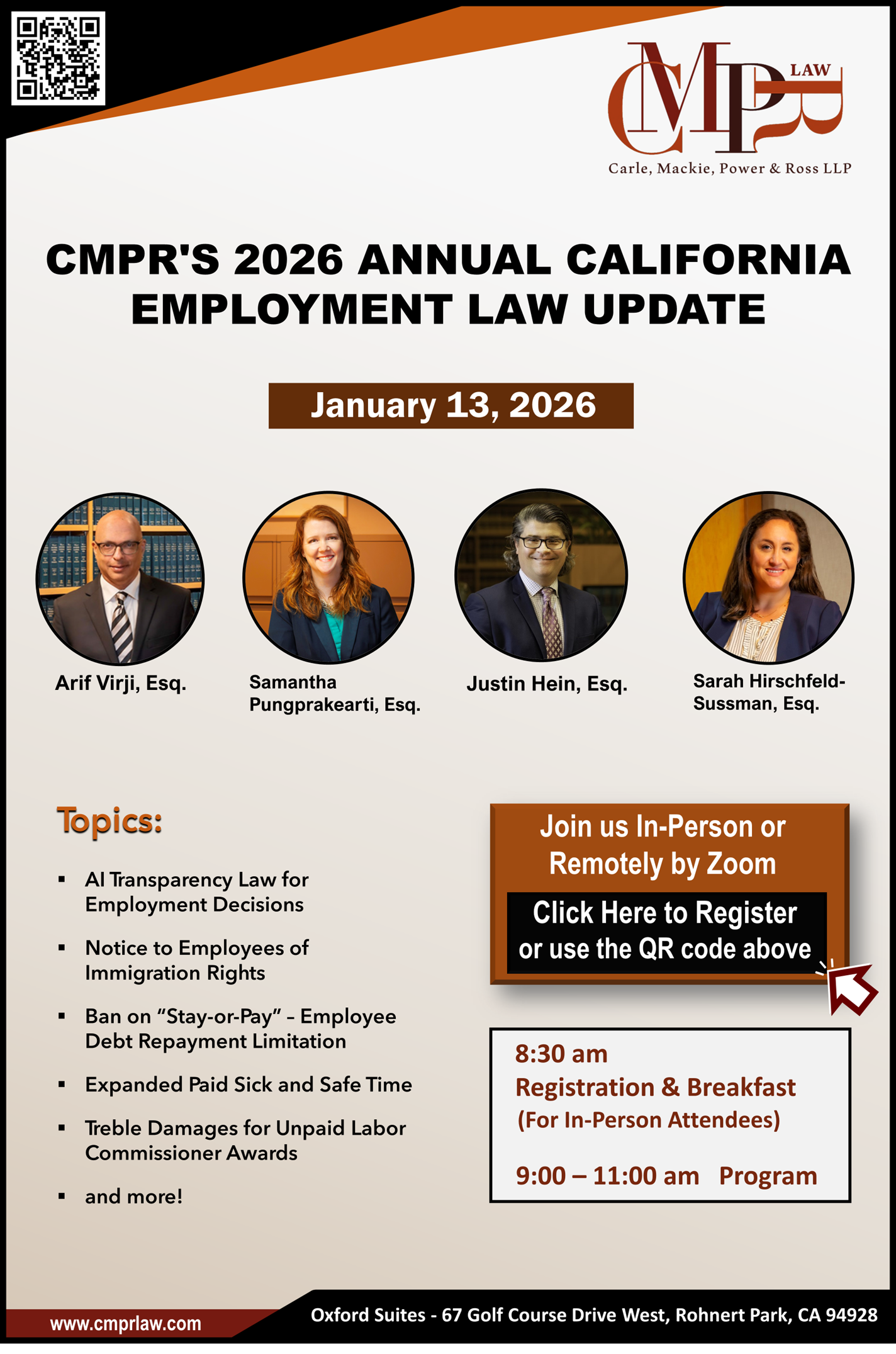
Event Type: Seminar
Location: Rohnert Park, CA + Zoom
Date: 1/13/2026
Join us In-Person or Remotely by Zoom.
Topics:
- AI Transparency Law for Employment Decisions
- Notice to Employees of Immigration Rights
- Ban on "Stay-or-Pay" Employee Debt Repayment Limitation
- Expanded Paid Sick and Safe Time
- Treble Damages for Unpaid Labor Commissioner Awards
- and more!
Schedule
8:30 am Registration & Breakfast (For In-Person Attendees)
9:00 – 11:00 am Program
Oxford Suites - 67 Golf Course Drive West, Rohnert Park, CA 94928

Starting a new business is an exciting venture, and for many entrepreneurs, a catchy brand name for their company or products is the first step toward success. In recent years, companies—especially breweries, wineries, and toy manufacturers—have adopted parody trademarks to garner attention for their products. A clever and humorous parody mark can be an amusing way to stand out, but it also carries significant risks.
A “parody trademark” is a mark that uses an existing brand in a satirical or humorous manner. These marks take recognizable elements from the original and change them with a humorous twist to create a new commercial impression. However, a parody must be perceived by consumers as a critique or joke, rather than as an indication of an affiliation between the businesses. If the parody mark uses a well-known brand’s recognition to sell its own products, it may be deemed infringing by the owner of the pre-existing brand, even when such use is consistent with the law. And this is where the danger lies.
The following are examples of parody marks for beer, some of which were challenged:
Parody Marks and the Law
Parody marks are often vulnerable to claims of infringement and dilution from the owners of the original trademarks. There is a fine line between a legal parody and an invalid one. The legal standards for these cases are based on the Lanham Act and the First Amendment.
- The Lanham Act: This federal statute protects against trademark infringement and dilution.
- Trademark Infringement: This occurs when a mark is likely to cause consumer confusion regarding the source or affiliation of goods.
- Trademark Dilution: This happens when a new trademark weakens the distinctiveness of a famous, pre-existing mark. It can also occur when a new mark harms the famous mark’s reputation, which is called “tarnishment.”
- Unlike infringement, dilution claims do not require proof of consumer confusion.
- The First Amendment: The U.S. Constitution’s First Amendment protects expressive works, which include parodies. However, courts must weigh the right to free expression against the rights of trademark owners in commercial settings.
Notable Cases: A Tale of Two Parodies
Two recent court cases highlight the risks and legal complexities of parody marks:
- Louis Vuitton v. Haute Diggity Dog (2007): In this case, a court ruled that dog toys sold under the name “CHEWY VUITON” were a protected parody. The court found that the parody did not infringe or dilute Louis Vuitton’s trademarks because consumers were unlikely to believe Louis Vuitton made dog toys. The parody was seen as poking fun at the famous French brand in a way that helped reinforce the distinctiveness of the Louis Vuitton brand, rather than tarnishing its reputation.
- Jack Daniel’s v. VIP Products (2023): VIP Products created a dog toy named “Bad Spaniels,” which mimicked the Jack Daniel’s whiskey bottle. Jack Daniel’s sued, and the case eventually went to the U.S. Supreme Court. The Supreme Court ruled that the lower court’s test for expressive works did not apply because the “Bad Spaniels” toy used the parody mark as a source identifier for its product. On remand, a U.S. District Court found that the dog toy diluted the Jack Daniel’s trademark and ordered VIP Products to stop selling it.
The L’Eggo My Eggroll Case: A Cautionary Tale
The pending lawsuit by Kellogg’s against an Ohio food truck called “L’Eggo My Eggroll” further illustrates the inherent danger of using parody marks. The food truck’s name is a clear play on Kellogg’s well-known “L’Eggo My Eggo” slogan, and its branding uses nearly identical yellow and red colors and cursive font. Kellogg’s claims that the food truck is not commenting on or critiquing Eggo waffles, but is simply using a slight variation of the famous slogan and trade dress to sell egg rolls and capitalize on Kellogg’s brand recognition.
Kellogg’s initially offered to pay for the food truck’s rebranding to avoid litigation. However, after the food truck’s owner refused, Kellogg’s filed a lawsuit alleging trademark infringement and dilution. This case underscores that even a seemingly harmless parody can be viewed as infringing, compelling a company to take legal action to protect its brand. Here, the food truck owner could lose everything, and the case serves as a potent reminder that using parody marks is risky and frequently unlawful.
The Importance of Professional Guidance
The potential for litigation, monetary damages, and the destruction of infringing materials makes parody marks a particularly risky choice for a new business or brand. While parody can be a valuable creative tool, their improper use can confuse consumers and/or dilute the distinctiveness of a famous mark. Many parody marks fail to effectively poke fun at, critique, or provide commentary on the pre-existing mark it is parodying.
The “L’Eggo My Eggroll” case illustrates the crucial importance of seeking guidance from experienced trademark attorneys before launching a new brand. Conducting thorough due diligence before branding is essential, particularly when considering a parody. A knowledgeable legal team can help you navigate the complexities of trademark law, ensuring your brand is both creative and legally protected.

Our Santa Rosa office has moved as of September 2, 2025
520 Third Street, Suite 500, Santa Rosa, CA 95401
If you employ full-time staff, seasonal crews, or part-time help in Oregon’s wine industry, there’s a new law that could change how you approach labor planning and workplace disputes—especially during your busiest seasons.
Oregon Senate Bill 916 (SB 916) makes Oregon the first state in the country to offer unemployment insurance (UI) benefits to both public and private sector employees who are engaged in a labor strike.
Why Provide Unemployment Benefits to a Striking Workforce?
Lawmakers behind the bill say it’s about fairness. Their argument is that workers who are lawfully on strike shouldn’t be forced to choose between standing up for better conditions and being able to pay their bills. They point out that most strikes in Oregon don’t last long—about eight or nine weeks on average—and believe a short-term safety net could lead to more productive negotiations.
But not everyone agrees. Many employers, especially in agriculture and manufacturing, worry that offering unemployment during strikes will make work stoppages more common, or longer. That could create real challenges for businesses that rely on precise seasonal timing—like vineyards during harvest. Other opponents, including business organizations, argue that the bill could negatively impact the business climate in Oregon, potentially discouraging investment and job creation.
Other states have passed similar laws—New York, New Jersey, and Washington among them—but Oregon’s is the broadest, especially because it includes public employees and doesn’t have a built-in expiration date.
Signed into Law by the Governor
SB 916 passed the Senate earlier this year, but changes made in the House created some pushback. Lawmakers reached a compromise through a bicameral conference committee, scaling back benefits from a proposed 26 weeks to a maximum of 10. And workers would need to be on strike for two full weeks – one unpaid strike week plus one standard UI waiting week – before benefits kick in.
That revised version passed both chambers and was signed into law by Governor Tina Kotek on June 24, 2025. It is set to go into effect January 1, 2026.
How It Works?
Here’s what the new law will do:
- Striking workers could apply for unemployment after two weeks.
- They could receive up to 10 weeks of benefits.
- Weekly payments would range from $196 to $836, depending on their previous earnings.
- If striking workers later receive back pay as part of a labor settlement, any unemployment benefits paid must be repaid.
- The law would apply to both private and public sector employees.
What This Means for Wineries and Vineyards
This is where things get practical. If your tasting room team, cellar crew, or vineyard workers are covered by this law, it may affect how future labor disputes play out.
For example, if full-time staff walk off the job over wages or working conditions, the availability of unemployment benefits could make a strike more financially manageable. That could extend the duration of a work stoppage.
The same goes for seasonal crews—if they meet Oregon’s wage and hour requirements, they might qualify for UI too. Any worker who worked 500 hours or earned at least $1,000 from an employer in the first four of the most recent five completed calendar quarters1 (“base year”) would be eligible for UI benefits.
Even if you’re not anticipating any labor issues, this bill is worth paying attention to. It may not change your workforce overnight, but it changes the stakes. A harvest-time strike could now be a real possibility, not just a theoretical risk. It also raises the importance of being proactive. This means making sure you have clear policies in place, strong communication channels with your team, and a plan for how to keep operations running if there’s ever a disruption.
What You Can Do Now
If you’re an employer in Oregon’s wine industry, here are a few steps you might want to take:
• Review your employment agreements and collective bargaining obligations (if any).
• Consider how a strike—however unlikely—would affect your operations.
• Think through how you would handle communication, staffing, and production continuity.
• Talk with legal counsel or HR advisors about your options and responsibilities.
Even if SB 916 doesn’t result in immediate changes for your business, it shifts the landscape. A bit of planning now could save a lot of disruption later.
Need Help?
CMPR helps employers stay ahead of legal risks. If you have questions about SB 916 or need help assessing your contracts and practices, contact our Real Estate & Land Use and Employment Law Groups today: Arif Virji, Samantha Pungprakearti, or Justin Hein at 707-526-4200; or Chris Hermann (in Oregon) at 971-895-3686.
Starting January 1, 2026, a new Oregon law will significantly reshape how liability works in private construction projects. Under Senate Bill 426 (SB 426), property owners and general contractors can now be held liable for wage theft committed by subcontractors, even those buried deep in the contracting chain.
Oregon Gov. Tina Kotek signed SB 426 into law on June 9, 2025. It’s a landmark move—and one that raises the stakes for compliance. Here’s what Oregon businesses need to know, and how they can start preparing now.
What’s the Big Change Under SB 426?
If you’re a property owner or GC in Oregon, SB 426 brings a shift in risk you can’t afford to ignore. The law says you are jointly and severally liable for unpaid wages, penalties, and benefits owed by any subcontractor working under your contract—even if you weren’t directly involved and had no knowledge of the issue.
In short, it’s no longer enough to say, “That wasn’t us.”
Who Does It Apply To?
SB 426 targets private, non-union construction projects in Oregon. There are a few exceptions worth noting:
- Owner-occupied residential buildings (up to five units) are exempt.
- Projects covered by a collective bargaining agreement with dispute resolution processes in place don’t fall under the statute.
- Public agencies and lenders in foreclosure situations are also off the hook—unless they’re actively directing the work.
What Triggers Liability?
Here’s how it works:
If a subcontractor fails to pay its workers properly, and one of those workers notifies the property owner or direct contractor by certified mail, the recipient has twenty-one (21) days to fix it.
Upon request, subcontractors must also provide certified payroll records and written affidavits disclosing whether they’ve been subject to any wage claims or judgments in the past five years within ten (10) business days of the request.
If they don’t, the subcontractor is presumed to have committed a wage violation and the worker can sue the owner and/or general contractor directly—for wages, penalties, interest, and legal fees.
Courts can then use this presumption to uphold joint and several liability against Owners and GCs who didn’t take action in the face of noncompliance.
What makes this law even stronger: you can’t contract around it. Any clause in a construction contract that tries to waive this liability is automatically void.
Penalties and Enforcement
The consequences for noncompliance are significant. Workers who prevail in court may recover:
- Unpaid wages and fringe benefits
- Liquidated damages
- Statutory penalties
- Prejudgment interest
- Attorney’s fees and costs
Unlike some labor claims that languish in administrative backlogs, SB 426 gives workers a direct path to court—meaning faster, more public, and more expensive litigation. However, workers also have the option to assign their claims to the Oregon AG to enforce on their behalf.
Workers (or the Oregon AG via claim assignment) have two years from wage due dates to bring suit, and the AG can now step in directly via SB 426.
What This Means in Practice
For businesses, the message is clear: watch your subs carefully.
This law changes the incentives dramatically. It’s not enough to hire a licensed contractor and assume things are handled. Owners and GCs will now need to actively monitor compliance downstream, or risk ending up in court.
The law doesn’t take effect until January 1, 2026, but the smart move is to prepare now.
Here are just a few steps we recommend taking:
- Audit/amend existing subcontractors, subcontractor agreements to ensure compliance. Revise contracts to require certified payroll reports and wage affidavits, subcontractor disclosures of wage-violation history, and regular reporting on payroll and labor practices.
- Vet new subcontractors thoroughly. Ask about past wage claims, check their BOLI record, and confirm they’re insured and licensed.
- Consider requiring payment bonds, especially on larger or higher-risk projects.
- Establish internal review protocols—especially for higher-risk trades or large projects.
- Train your team to spot red flags—workers complaining about late pay, disorganized site conditions, or missing safety postings.
- Be ready for presumption. Courts will presume laborers are employees unless proven otherwise—putting the burden on classification decisions.
- Consult legal counsel about indemnification, insurance, and any other risk transfer strategy that is within SB 426’s new restrictions.
Why SB 426 Matters Now
The intent behind SB 426 is straightforward: close the wage theft loophole that has allowed bad actors to operate behind layers of subcontracting.
But the law also reflects a larger policy trend across the country: labor enforcement is going upstream, holding those who control the money and the project accountable for wage theft—even if the actual employer is a subcontractor two tiers down.
If you’re involved in real estate development, construction, or property management in Oregon, the time to act is now. Don’t wait until January 2026 to get your compliance house in order.
Need Help?
CMPR helps construction businesses, developers, and real estate professionals stay ahead of legal risks. If you have questions about SB 426 or need help assessing your contracts and practices, contact our Real Estate & Land Use and Employment Law Groups today: Arif Virji, Samantha Pungprakearti, or Justin Hein at 707-526-4200; or Chris Hermann at 971-895-3686.
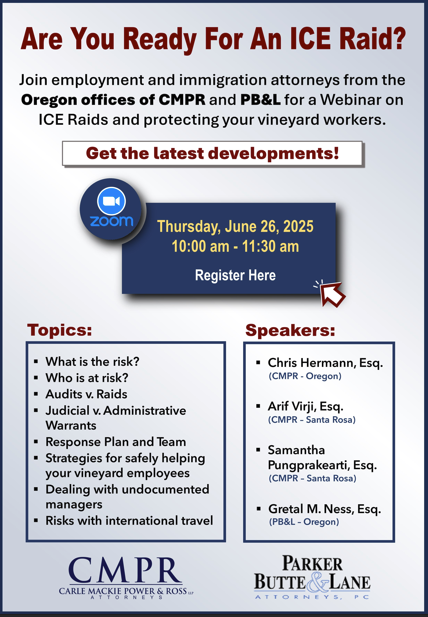
Event Type: Webinar
Date: 6/26/2025
Join employment and immigration attorneys from the Oregon offices of CMPR and PB&L for a Webinar on ICE Raids and protecting your vineyard workers.
Get the latest developments!
Topics:
- What is the risk?
- Who is at risk?
- Audits v. Raids
- Judicial v. Administrative Warrants
- Response Plan and Team
- Strategies for safely helping your vineyard employees
- Dealing with undocumented managers
- Risks with international travel
Thursday, June 26, 2025, 10:00 am - 11:30 am
Speakers:
- Chris Hermann, Esq. (CMPR – Oregon)
- Arif Virji, Esq. (CMPR – Santa Rosa)
- Samantha Pungprakearti, Esq. (CMPR – Santa Rosa)
- Gretal M. Ness, Esq. (PB&L – Oregon)