
Filter Post Type
NewsVideoProductEventLink
Sort:
Most Recent
1–10 of 80

Webinar Recap: Arrive55 and WineDirect Fulfillment: The Next Generation of White Glove Wine Delivery
April 7, 2026
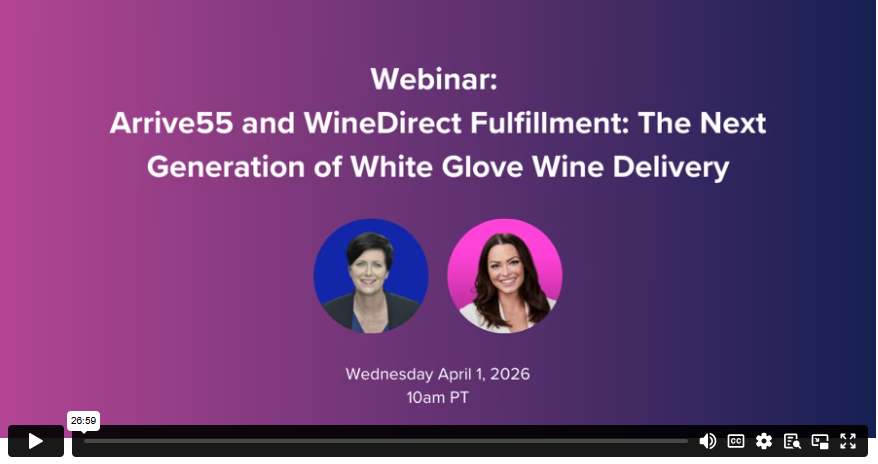
Thank you for joining us for our recent webinar with Alison Galligan and our white‑glove delivery partner, Raini Keyser of Arrive55. We appreciated the opportunity to walk through how wineries can evolve their final‑mile strategy to better protect wine, reduce risk, and deliver a premium customer experience. Here’s a quick recap of what we covered: What true white‑glove delivery looks like: How Arrive55’s temperature‑protected, appointment‑based service ensures wine arrives safely and professionally without relying on traditional carrier networks. Why regional providers matter more than ever: How leaning into regional final‑mile solutions can help wineries navigate shifting carrier conditions and improve reliability in key wine markets. Updated pricing, no fuel surcharges and expanded coverage: An overview of new pricing designed to better meet winery needs, with no fuel surcharges, along with expanded service areas across important wine‑consuming regions. Reducing de
00
Why Wineries Need Influencer Marketing Now Here's a number that should reshape how you think about marketing: 69% of consumers trust influencer recommendations more than information coming directly from a brand That's not a slight edge. That's a fundamental shift in how people decide what to buy. For wineries, this matters more than it does for most industries. Wine is a considered purchase wrapped in uncertainty. Your potential customer is standing in a tasting room or scrolling through an online store, wondering: Will I like this? Is it worth the price? Am I making the right choice? Influencer content answers those questions in ways traditional marketing cannot. When a trusted voice says "I tried this Pinot and it's incredible with grilled salmon," that carries weight. It's a peer recommendation disguised as content. Instagram and TikTok now drive wine discovery among younger audiences, and 87% of Gen Z consumers say they're willing to buy products
00
March 9, 2026
Many vineyard owners may qualify for new federal financial assistance, but an important first deadline is approaching. The US Department of Agriculture has created the Assistance for Specialty Crop Farmers program to provide financial support to growers affected by recent market disruptions. Wine grapes are included as an eligible specialty crop. For grape growers, the most important immediate requirement is acreage reporting. To remain eligible for payments, growers must ensure that their 2025 planted grape acreage is accurately reported with the Farm Service Agency by 5 p.m. Eastern Time on March 13, 2026. Go here for additional information and to file https://www.fsa.usda.gov/resources/programs/farmer-bridge-assistance-fba-program This step is required even if the vineyard has reported acreage in prior years. Payments under the program will be calculated based on reported 2025 planted acres. After acreage is confirmed with FSA, eligible growers will be able to submit
00
March 2, 2026

Fruitful Innovation Can Lead to Tax Benefits Napa has never had the luxury of standing still. This valley adapts. When the weather shifts, growers adjust. When consumer preferences change, winemakers experiment. New rootstock. New clones. Different planting locations. New production techniques. Reinvention here is not a trend. It is how we survive. That is innovation. And in many cases, it is also research. We are not talking about changing a label design or launching a new club tier. We're talking about the real technical questions you wrestle with in the vineyard and the cellar: Can this new grape clone handle higher temperatures? Will adjusting canopy management reduce sunburn without sacrificing ripeness? Can we modify fermentation to improve stability or manage alcohol levels? Is there a way to produce a non-alcohol option that still feels like wine? When you do not know the answer and you run trials to find it, you are eliminating uncertainty. You are experimenting. You are
00
We’re not debating calories or whether that charcuterie board counts as an appetizer or dinner. We're talking about the IRS tightening the rules for deductible meals. Starting January 1, 2026, some winery meals that have historically been deductible will become completely nondeductible. Same harvest crew. Same pizza. Different tax result. Here is what changes and what does not. 1. Harvest Meals on Winery Premises Zero Deduction Beginning in 2026 If you provide meals at the winery so employees can keep working, those meals will no longer be deductible starting in 2026. That includes: Crush pad dinners Bottling day lunches Late night production meals served on site For years these were deductible. Beginning in 2026, they are not. If harvest meals are a routine part of your operations, this is worth budgeting for now. 2. Occasional Overtime Meal Reimbursements Possibly Still 50 Percent Deductible If an employee unexpectedly works late and you reimburse them for dinner, tha
00

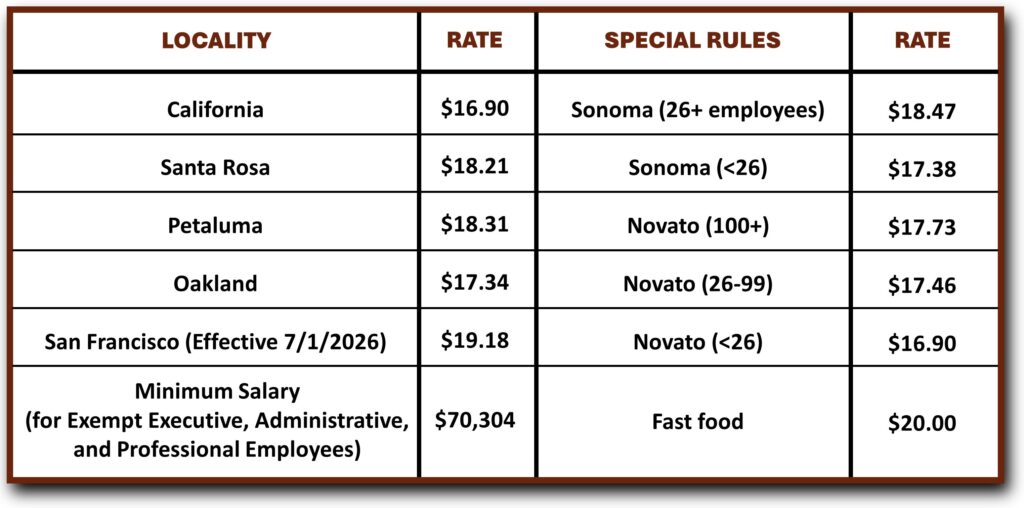
It is time to dust off the employee handbook, review your policies and procedures, and make sure they comply with all the new laws, regulations, and interpretations that went into effect during 2025, became effective in late 2025, or January 1, 2026. Below, we have identified our “top 10” changes. Please keep in mind there were hundreds of laws, regulations, and changes implemented at the local, state, and federal levels throughout 2025. This summary highlights selected changes most likely to impact California employers and is not intended to be exhaustive. So, if you need a handbook/policy review or have any questions, please call us! 1 – Minimum Wage Update: Updates happen every year. It’s best to put a calendar reminder in November, to make sure your payroll is ready! Action: Review your payroll to ensure all employees are being paid the new minimum wage, send written notice of the wage change to affected hourly employees, and be sure your salari
00
January 8, 2026
Alcohol beverage importers may finally get their answer from the United States Supreme Court this week on the validity of the Trump Administration’s tariffs issued pursuant to the International Emergency Economic Powers Act (IEEPA).[1] Recent news reports suggest that the Court’s answer may come as early as this Friday, when the Court is scheduled to issue opinions on pending cases. Based on the questions posed by both liberal and conservative justices during oral argument, many commentators expect the Court to conclude that the president exceeded his authority by invoking IEEPA to issue those tariffs. There are, however, a lot of open questions beyond just the validity of the tariffs. Most importantly, if the Court finds the tariffs are invalid, will importers that have already paid the tariffs be entitled to refunds and what will the process be for getting those refunds. Questions also remain as to whether the case will be remanded to a lower court to determine the
00
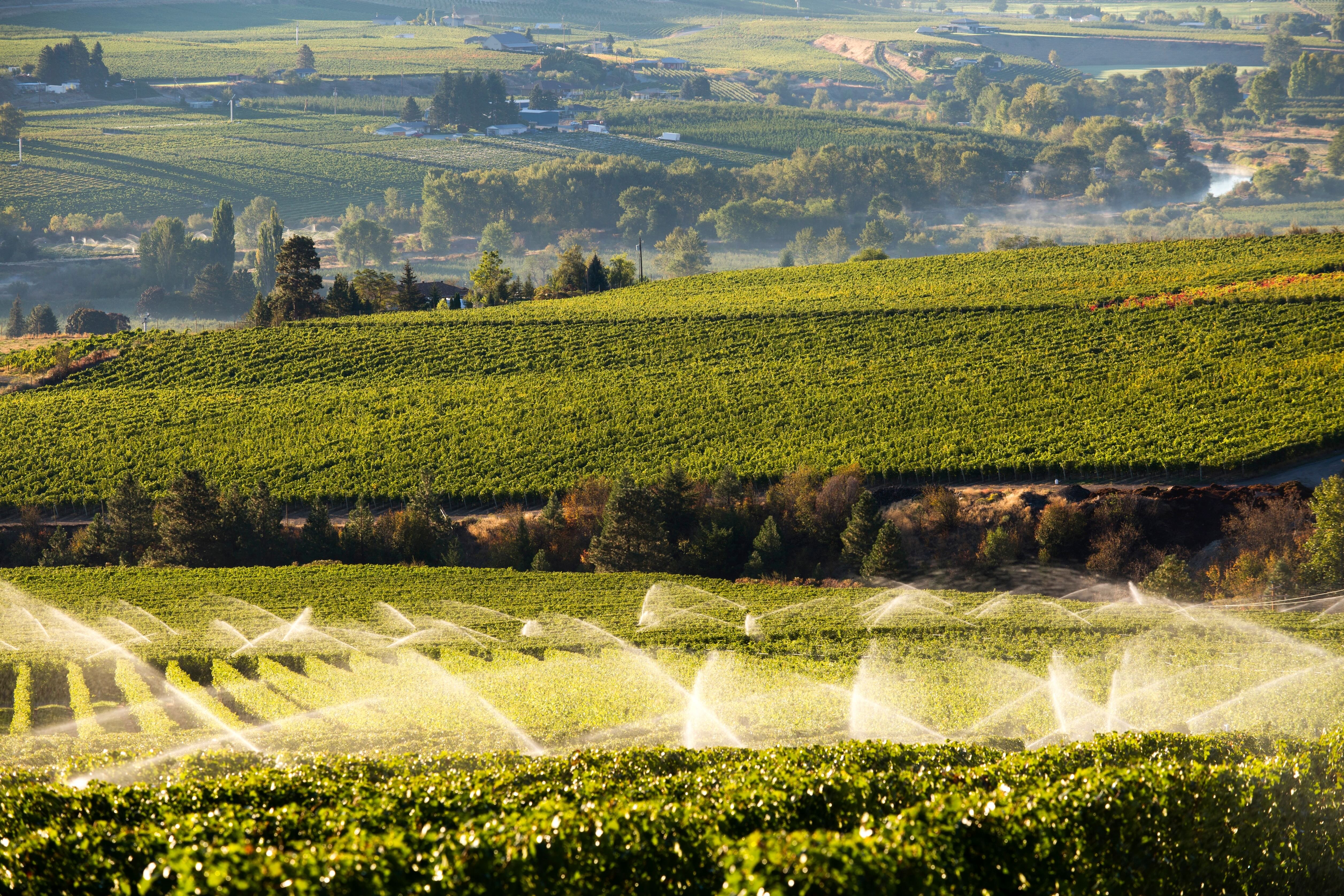
Declining groundwater levels and increasing pressure under the Sustainable Groundwater Management Act are changing how California wine growers think about water. What was once largely an operational concern is now directly tied to long-term viability, regulatory compliance, and sustainability planning. These issues were front and center during a session at the 2025 WIN Expo, where vineyard operators, hydrologists, and county leaders discussed how groundwater management is evolving and what growers can do to stay ahead. Moderated by Val King, Director of Channel Partnerships at Verdi, the session underscored a clear reality. There is no single solution, but there is a shift toward local control, better data, and practical changes in vineyard management. SGMA Was Built to Be Local, Not One-Size-Fits-All Your browser does not support HTML5 video. SGMA is often misunderstood as a rigid, top-down mandate. In reality, it was designed around California’s variability in geology, climate
00

December 17, 2025

A Story of Leadership, Innovation, Hard Work, and Inclusion In an industry dominated by large-scale manufacturers and long-established corporations, National Storage Tank (NST) stands out not only as a leader in engineered water storage systems but also as a certified woman-owned business driving change through innovation, diversity, and community impact. Led by CEO Nicole Oblad, NST has become a powerhouse in the design and delivery of bolted steel, stainless steel, fiberglass, and underground water storage tanks, serving industries ranging from hospitals and data centers to agriculture and manufacturing. Yet, what truly sets NST apart isn’t just the scale of its operations, but the values that fuel its success. Breaking Barriers in a Male-Dominated Industry The water storage and construction industries have traditionally been male-dominated, but NST’s leadership has rewritten that narrative. Under Nicole Oblad’s guidance, NST has become one of
00
November 17, 2025
Wineries are overwhelmed — especially during wine club season, when inboxes skyrocket overnight and the same routine questions flood in: “Where’s my wine?” “Can I skip this shipment?” “How do I update my address?” Most of these questions are simple — they don’t need a staff member, just a fast and accurate response. That’s exactly what WineSpot AI is built to provide. It works across every support channel — email, chat on your website, and voicemail — reducing your team’s workload by more than half while giving guests instant answers. What makes WineSpot especially powerful is how it handles email and voicemail — two of the most time-consuming channels for winery teams. The Email Bot reads incoming guest messages, understands what the customer is asking, and replies instantly. If it’s a straightforward request — like tracking a shipment — the bot responds automatically with real-
00