
Filter Post Type
NewsVideoProductEventLink
Sort:
Most Recent
1–5 of 5

December 1, 2025
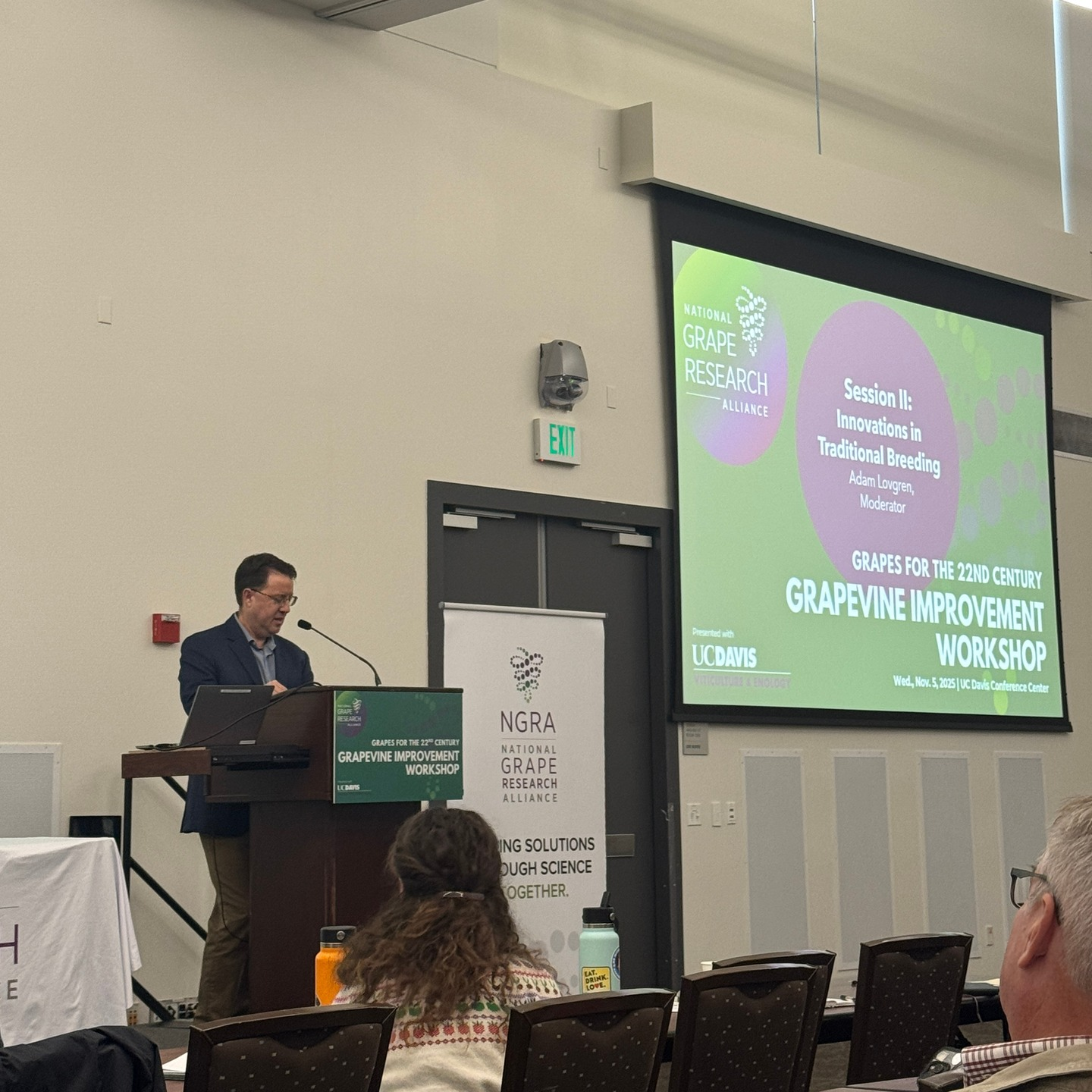
Sunridge Nurseries' VP of Operations, Adam Lovgren, participated on behalf of the California Grape Rootstock Research Foundation as moderator for Session II: Innovations in Traditional Breeding at the recent NGRA/UC Davis Grapevine Improvement Workshop. The session highlighted advancements in climate-resilient rootstocks, improved fruit and cultivar quality, resistance breeding, and the integration of modern genomic and phenomic tools, with presentations from Dr. Luis Diaz-Garcia, Dr. Margaret Worthington, Professor Dr. Oliver Trapp, and Dr. Maddy Oravec. The full conference offered valuable insights into how the future of grapevine breeding and genomics can expand varietal options for growers, helping address evolving challenges in disease and pest resistance, climate impacts, and the development of improved cultivars.
00
May 20, 2024

In the 1880s, Pierce’s disease caused a devastating, total collapse of the Southern California grapevine industry. Today, growers have hope for the future thanks to new varieties. Adam Tolmach, owner of Ojai Vineyard, planted four of these new varieties as a field trial on a plot of land where Pierce's disease wiped out his grapes in 1995. Pierce’s disease is a bacterium spread by insects, typically a sharpshooter. One bite and the vine dies within two to three years. To develop resistant varieties, Andy Walker of the University of California at Davis crossed the European grape Vitis vinifera with Vitis arizonica. 20 years later, commercial growers have access to three red and two white varieties. Listen in to learn how Tolmach’s experiment is a success both in the vineyard and with customers. Plus get tasting notes for the new varieties. LISTEN IN Resources: REGISTER: The Ins & Outs of Developing a New Vineyard Site 89: New
00

Adding biochar as a soil amendment creates an ideal habitat for beneficial microorganisms. Sitos Group CEO and Co-founder Mayo Ryan and PR, Marketing, and Communications Manager Jessica Bronner explain how biochar amendments improve disease resistance, plant health, pest resistance, water retention, and drought mitigation. The team explains three different ways to make biochar and why they have chosen to use the slow pyrolysis method to ultimately produce biochar for different soil types. LISTEN IN Resources: REGISTER: February 16, 2024 Biochar in the Vineyard 56: Conservation Burning and Biochar 106: What? Bury Charcoal in the Vineyard? 167: Use Biochar to Combat Climate Change Burn: Igniting a New Carbon Drawdown Economy to End the Climate Crisis Carbon Removal FAQ Monterey Pacific Inc. New Science Says Biochar is Very Permanent Regeneration Regeneration: Ending the Climate Crisis in One Generation Sitos Group Sitos Group Biochar Page Sitos Group Blog Sitos Group Social
00

March 11, 2021
March 25th Webinar, by Coastal Viticultural Consultants, Inc. Effective Implement for the IPM Toolbox Improve powdery mildew management with spore trapping technology. This technology can identify and quantify powdery mildew spores entering into or within a vineyard, better quantify overall powdery mildew pressure, and identify mildew “hot spots” before visual symptoms and damage occur. As the visual inspection of 1,000 leaves per acre is required to detect powdery mildew on leaves at an incidence level of 1% or lower (Mahaffee, et al. 2014) and Disease Forecasting Models do not reflect actual field conditions, spore trapping is more effective in monitoring and predicting powdery mildew populations and treatment needs. Coastal Viticultural Consultants (CVC) is providing a free informational webinar (via Zoom) that will discuss the practical use and advantages powdery mildew spore trapping offers, and availability to regional data sets. The webinar will also discu
00

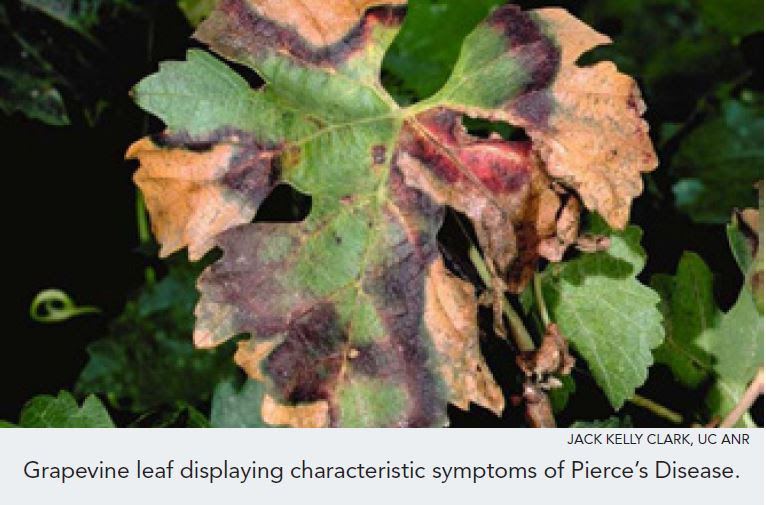
Pierce's Disease has been a scourge of vineyards for well over a century. It was discovered near the end of the 19th century by Newton Pierce, so the disease took on his name after originally being given the name Anaheim Disease (having been discovered in that area’s vineyards well before Disney and all that pavement moved in). Pierce’s Disease (PD) is a nasty disease caused by the bacterium Xylella fastidiosa, which is vectored by several different sharpshooter insects, including blue-green, red-headed and glassy-winged. The bacteria colonize the xylem vascular tissue. The bacterial colonies, along with gums that are exuded by the vine itself, clog the vessels and effectively choke off the vine’s water transport system. The disease is catastrophic in that it cannot usually be surgically removed from the vine and will most often quickly reduce both its fruit production and fruit quality before finishing off the job and killing the vine after a few years.
It is n
00