
Filter Post Type
NewsVideoProductEventLink
Sort:
Most Recent
1–10 of 51


Most conversations about AI in agriculture lead nowhere. There is plenty of speculation, plenty of marketing, and very little shared understanding of how AI is actually being used inside real vineyard operations. There is no manual. No proven tools, and even fewer examples that go beyond theory. That is what makes this story different. Rather than discussing what AI could do someday, this article looks at what happened when a professional vineyard management team, operating at scale and under real economic pressure, put AI to work on the unglamorous parts of their operation: scheduling, coordination, and administrative complexity. The outcome was not what most people would expect. The biggest gains did not come from automation itself, but from what changed once friction was removed from daily work. First, You Have to Start With a Real Problem A vineyard operations leader managing large-scale acreage described a situation many vineyard operators recognize immediately: an operatio
00

April 24, 2026

Afternoon Brief: California’s Wine Grape Acreage Drops in 2025 as Industry Struggles Continues
As the California wine industry currently faces a crisis due to oversupply, weak demand and changing consumer habits, a new report released the U.S. Department of Agriculture’s (USDA) National Agricultural Statistics Service and the California Department of Food and Agriculture (CDFA) shows that grape acreage in the state continued to shrink in 2025...
00

It’s not hard to see the promise of AI on a vineyard: process a ton of information and get meaningful answers quickly. The problem is that no one knows how to get started. There are no clear standards, few proven playbooks, and almost no shared examples of AI delivering measurable results inside real vineyard operations. How can you use AI on your vineyard? Keep reading... This article looks at how one vineyard management team approached AI not as a trend to adopt, but as a constraint to manage. They had too much information, too many variables and far too little human capacity to process them all. This is how they did it. The Question You Should Be Asking First A vineyard operations leader managing large-scale acreage described a situation where scale magnifies every inefficiency. Across thousands of acres and dozens of properties, the team was already using sensors, labor tracking systems, equipment data, compliance tools, and agronomic models. The problem was not lack of infor
00
April 22, 2026

Listen now: Ciatti's Glenn Proctor speaks to Liquid Assets Glenn Proctor, partner at the Ciatti Company, was a guest on Rabobank’s latest Liquid Assets podcast – titled “Will the US wine industry ever recover from the current glut?” – discussing the current and future state of the Californian wine industry with Jeff Bitter of Allied Grape Growers and podcast hosts Stephen Rannekleiv and Bourcard Nesin. Listen Now Glenn set out bulk-wine inventory levels as of the month of March 2026 and the 12 months to March (“it has been extremely high as to where we would usually sit”), delved down into bulk inventory by vintage year (“inventory isn’t going down but some of it is getting older, making it less marketable as you go into the future”), and outlined the tough realities of the current marketplace: “One of the biggest challenges we have: Those who’d be a buyer in a normal market are currently a seller, they’ve got grapes or bulk wine to sell.” With Jeff, Glenn discussed the recently-publi
00
April 15, 2026
Malbec From Home and Abroad
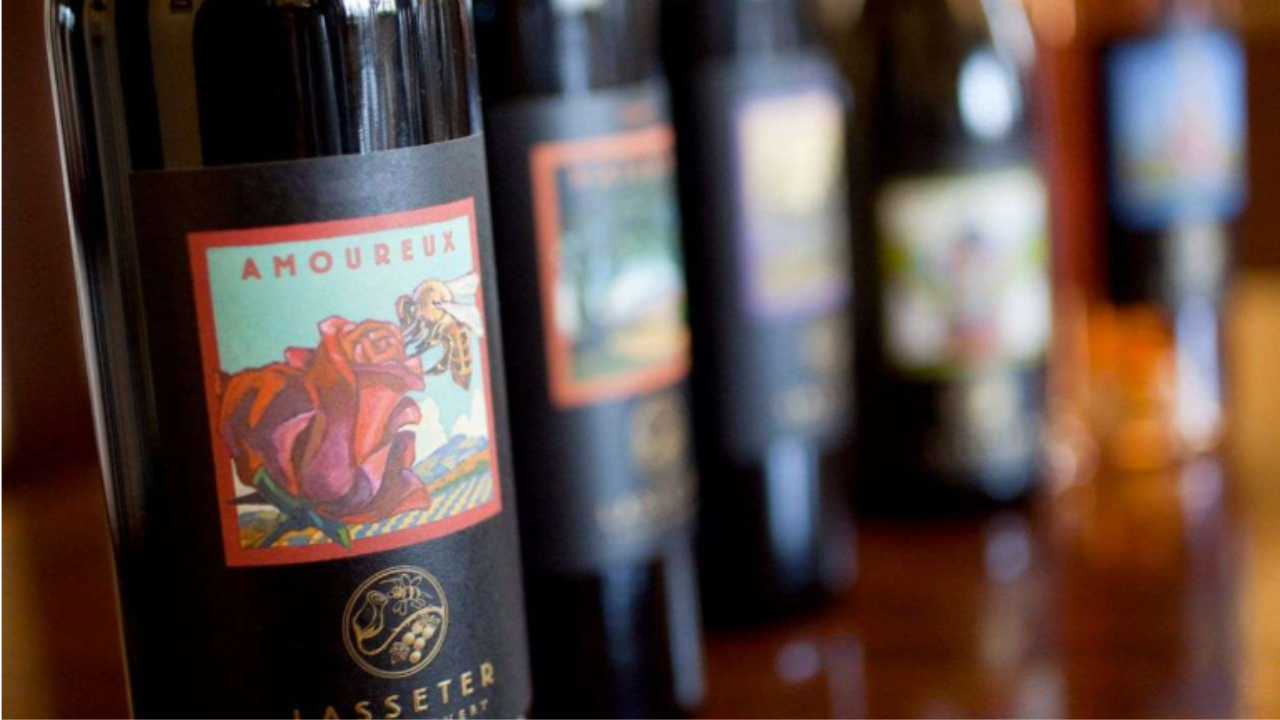
Explore Sonoma County Malbec—an under-the-radar varietal prized for blending and small-lot wines. Discover its history, vineyard acreage, top producers, and global roots, and why this versatile grape shines in Sonoma County for World Malbec Day.
00


Groundwater management fees are no longer just a future issue for California winegrowers. Basins in Napa Valley, Sonoma Valley, and the Santa Ynez/CMA area already have fee structures tied to groundwater management. In the Napa Valley Subbasin, Recovered Water Solutions, a Winesecrets company, can help wineries and growers identify opportunities to annually save over $60 per acre on local groundwater sustainability fees. Planted acreage Potential annual savings 250 acres $15,040 500 acres $30,080 1,000 acres $60,160 On this and related water-cost issues, Recovered Water Solutions works with wineries and processors to better understand water use, identify loss points, and develop practical recovery and reuse strategies that improve cost control, efficiency, and long-term resilience. Call or email Eric@winesecrets.com for more information about our water recovery and resuse services. Or visit recwatersolutions.com. Toll Free: (888)
00


2.62: A Historic Reset by Steve Fredricks The release of the preliminary 2025 California Crush Report confirms an evolutionary shift in the state’s wine landscape. With the total crop recorded at 2.62 million tons, the industry has hit its lowest production level since 1999. This marks the second consecutive small harvest, resulting in a staggering one-million-ton decrease in tons harvested compared to just two years ago. For the consumer market, this translates to roughly 73 million fewer cases available between the 2023 and 2025 vintages, reflecting a deliberate, industry-wide effort to bring wine production back into balance with current demand. The impact of this contraction was felt most acutely in California’s interior regions. While coastal areas saw a 51,000-ton decrease compared to 2024, the interior experienced a much sharper drop of 170,000 tons. This disparity highlights a significant trend: acreage is being removed from production at a higher rate
00
March 16, 2026
The U.S. Department of Agriculture (USDA) is offering up to $1 billion of financial aid to American producers of certain specialty crops, including growers of wine grapes, through its new Assistance for Specialty Crop Farmers (ASCF) program. Per USDA’s recent press release, the goal of the ASCF program is to “help address market disruptions, elevated input costs, persistent inflation, and market losses from foreign competitors engaging in unfair trade practices that impede exports.” USDA’s Farm Service Agency (FSA) is responsible for administering the ASCF program and will issue one-time bridge payments to qualifying farmers. To be eligible for an ASCF payment, specialty crop producers must meet the following requirements: Be actively engaged in farming; Have risk and interest in the eligible planted commodity; and Report 2025 planted acreage to FSA by 5 p.m. ET on March 13, 2026. ASCF payments will be calculated based on reported 2025 planted acres, and commo
00
March 16, 2026
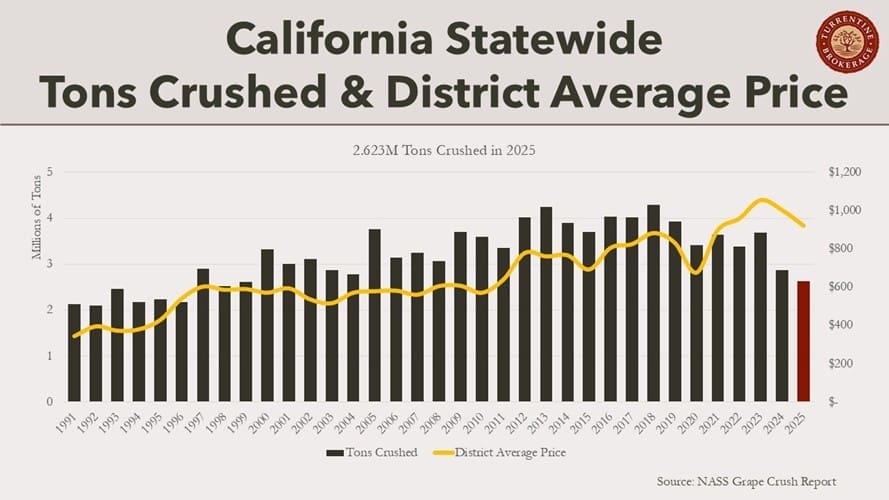
March 13, 2026 (Novato, CA) — Following the release of the Preliminary 2025 California Grape Crush Report, Turrentine Brokerage, the largest California grape and bulk wine brokerage company, has issued a market assessment characterizing the 2025 vintage as one of the most challenging for the wine industry since Prohibition. According to the new state data, the total tons crushed came in at 2.62 million tons, a figure that is above initial projections and well above what was felt by the industry. This statewide volume is 8% below 2024 and 23% below the 5-year average. Total red wine production declined by 9% and white wine production declined by 6%. “The decrease in tons is still very positive news for the industry overall,” said Steve Fredricks, President at Turrentine Brokerage. “The 2025 vintage highlights the industry’s directional shift of declining production and an overall restructure of the industry. 2025 represented continued challenges for grower
00

WHAT: The California Department of Food and Agriculture’s Preliminary Grape Crush Report for 2025 is a barometer for the wine and grape industry, containing prices and tons of wine grapes crushed. The Crush Report provides growers and wineries insight into the inventory position for the California wine business as a whole, and can influence market dynamics for the current bulk wine and grape markets as well as potential impacts at the consumer level. WHEN: CDFA is scheduled to release the Crush Report at 12:00PM PST on Friday, March 13th, 2026.ANALYSIS: A historically small crop coupled with below break-even spot market grape pricing compounds wine industry headwinds. For the second consecutive year, the California Crush Report will reflect a wine industry navigating a significant supply-and-demand imbalance. While actual tons harvested remained historically light across many regions in 2025, the primary driver of market instability is the sustained decline in consumer demand and
00