
Filter Post Type
NewsVideoProductEventLink
Sort:
Most Recent
1–10 of 140
May 6, 2026
Let's jump right in. Here are the Top Takeaways from Last Week’s Tasting Room Data Webinar: Your winery’s WISE Triple Score is ready right now within Enolytics. Even if you aren't already a WISE customer, you benefit from this opportunity. +10% revenue, 27 fewer open days. Big Cork Vineyards eliminated Thursdays and Mondays from their schedule this year — 27 open days gone — and still came in over 10% above last year’s revenue. How? Keep reading to see! 87% improvement in guest account usage. Domaine Drouhin Oregon launched the RedChirp guest check-in QR code on April 10th. By April 27th — just 17 days later — guest account usage had improved by 87% across nearly all associates. 25% of expected crop, 100% of the planning challenge. Big Cork normally brings in 200 tons from their Maryland estate. This year’s frost dropped that to roughly 60 tons — forcing an immediate pivot in distribution strategy, wine club fulfillment, and inventory allocation. We just wrapped one of our most ene
00

2.62: A Historic Reset by Steve Fredricks The release of the preliminary 2025 California Crush Report confirms an evolutionary shift in the state’s wine landscape. With the total crop recorded at 2.62 million tons, the industry has hit its lowest production level since 1999. This marks the second consecutive small harvest, resulting in a staggering one-million-ton decrease in tons harvested compared to just two years ago. For the consumer market, this translates to roughly 73 million fewer cases available between the 2023 and 2025 vintages, reflecting a deliberate, industry-wide effort to bring wine production back into balance with current demand. The impact of this contraction was felt most acutely in California’s interior regions. While coastal areas saw a 51,000-ton decrease compared to 2024, the interior experienced a much sharper drop of 170,000 tons. This disparity highlights a significant trend: acreage is being removed from production at a higher rate
00
March 16, 2026
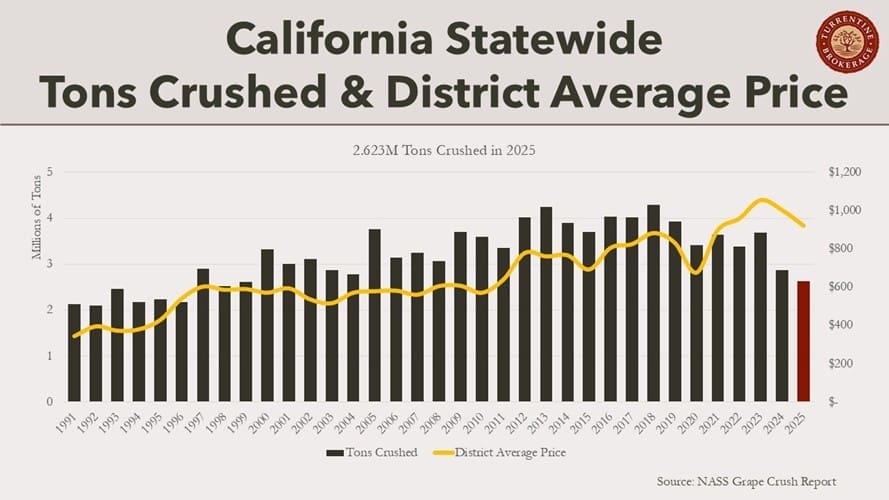
March 13, 2026 (Novato, CA) — Following the release of the Preliminary 2025 California Grape Crush Report, Turrentine Brokerage, the largest California grape and bulk wine brokerage company, has issued a market assessment characterizing the 2025 vintage as one of the most challenging for the wine industry since Prohibition. According to the new state data, the total tons crushed came in at 2.62 million tons, a figure that is above initial projections and well above what was felt by the industry. This statewide volume is 8% below 2024 and 23% below the 5-year average. Total red wine production declined by 9% and white wine production declined by 6%. “The decrease in tons is still very positive news for the industry overall,” said Steve Fredricks, President at Turrentine Brokerage. “The 2025 vintage highlights the industry’s directional shift of declining production and an overall restructure of the industry. 2025 represented continued challenges for grower
00

February 24, 2026

The word “brand” is notoriously difficult to define in marketing. If we were talking about a ranch brand—the kind seared onto livestock to signify ownership—that’s easy to understand. But in marketing, a brand is not a physical thing. It’s a symbolic construct. It’s not the label on the bottle or the winery’s logo or even the product itself. Rather, it’s the entire perception a consumer holds in their mind about your company, your wine, your people, and everything you collectively represent. A brand is a conceptual identity that differentiates you from your competitors. It can be shaped by your name, your origin story, the design of your label, the personalities involved in your winery, your tasting room experience, your packaging, your email tone, your partnerships, or even how you respond to a customer complaint. All these elements come together to form the intangible yet powerful idea of your brand. It is, quite literally, eve
00

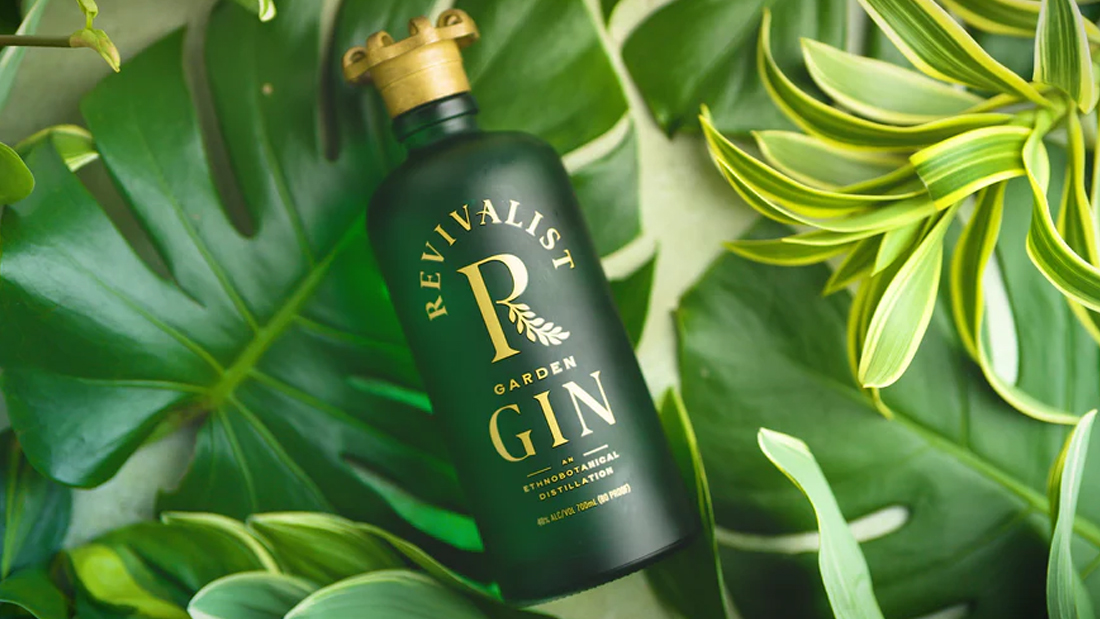
The wine and spirits industry is standing on the precipice of a major design evolution. For years, “premium” was defined by weight, excess, and tradition. For 2026, a new definition of luxury is emerging; one that values intelligence over mass, and tactile storytelling over simple visual appeal. For brand owners and procurement leaders, staying ahead of these glass packaging trends in 2026 is no longer just about aesthetics; it is a matter of strategic survival. From the rise of “quiet luxury” and right-weighted glass to the complex pressures of global supply chains, the packaging decisions made today will define brand resilience tomorrow. In this forecast, we explore how sustainable luxury, ergonomic innovation, and smart supply chain strategies are reshaping the premium landscape, and how Global Package provides the specialized glass solutions needed to help you navigate this future. The State of Glass Packaging for Wine & Spirits At Global Package, we&r
00

February 10, 2026

After 30 years of moving up and to the right, the American wine industry hit a wall. Not a temporary slowdown or a soft patch. A structural shift that requires a fundamentally different marketing playbook. 2025 was the reality check. 2026 is the year wineries either adapt or watch their customer base age out beneath them. The data is now unambiguous: wine sales dropped approximately 6% in 2024, marking the steepest decline in decades according to SipSource industry data. More troubling than the headline number is what's driving it. This isn't a recession blip or a bad vintage. It's a fundamental realignment of who drinks wine, how they buy it, and what they expect from the brands they choose. Here are the five trends reshaping the US wine market and what they mean for your brand's survival. The Demographic Disruption The wine industry built its growth on one generation: Baby Boomers. That generation is now aging out. The Wine Market Council's 2025 U.S. Consumer Ben
00
2025 in review; looking ahead to 2026 This month’s California Report looks back at 2025 on the bulk wine and grape markets and ahead to what we might expect to see in 2026. Bulk inventory charts for a number of 12-month ranges – and updated for January – are included, so too SipSource US wholesaler depletions data that takes in the opening two months of the important OND sales period, and the first packaging bulletin of the year from our friends at Saxco. A Q&A with Ciatti broker Chris Welch, discussing the current wine consumption and bulk market situation, will be published in the coming days. It is fair to say 2025 – like 2023 and 2024 before it – was not an easy year for California’s wine industry, nor was it for the wine industry globally. Evolving consumer preferences as the Baby Boomer generation shrinks, persisting post-pandemic inflationary tailwinds, and economic and political uncertainty, have been eroding sales in most major wine-con
00


NAPA, Calif., (Nov. 26, 2025) – VA Filtration Services’ Scientific Approach, Innovative Solutions from Napa Valley At VA Filtration Services, our mission is to empower winemakers to produce wines of the highest sensory quality. One of the challenges in modern winemaking is managing undesirable levels of pyrazines, particularly methoxypyrazines, which can impart green, herbaceous aromas that mask fruit character and complexity. Winemakers are left with two options: cover up the pyrazine (and potentially other attributes) or remove it through advances in pyrazine remediation practices. The Problem: Pyrazines in Wine Methoxypyrazines are naturally occurring compounds in certain grape varieties, such as Cabernet Sauvignon and Sauvignon Blanc. While subtle concentrations can add a sought-after freshness, excessive amounts lead to pronounced bell pepper and grassy notes, often perceived as faults—especially in premium reds. Often pyrazines present in wine due to enviro
00
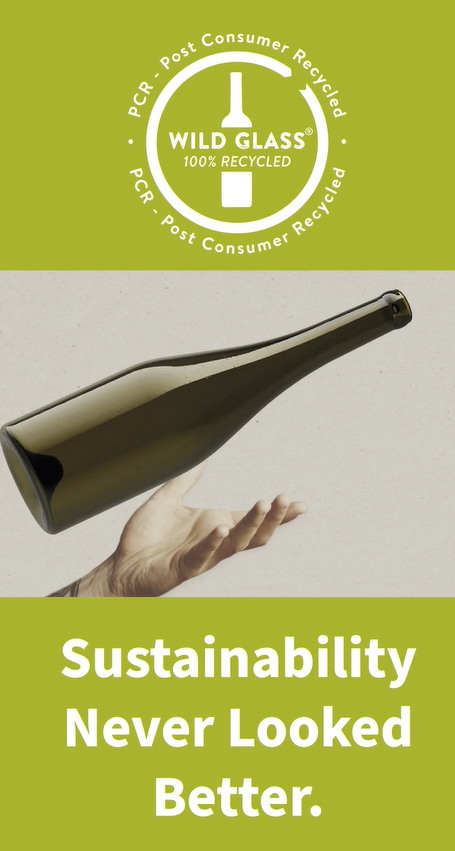
Sustainability has become a core focus across every industry sector lately, but, as lovers of the traditional, the wine and spirit industries are behind the curve on implementing sustainable glass packaging. According to the IWSR, 48% of American alcohol drinkers say that a company’s sustainability or environmental initiatives positively influences their purchasing decisions. Furthermore, according to a report by the global decision intelligence company, Morning Consult, 7 in 10 American adults would consider purchasing from a food and beverage brand that prioritizes sustainability, the highest share across all industries. In the face of ongoing environmental concerns, a growing number of media stories have cited the need for our industry to find a more sustainable package solution. And the call is validated by consumer demands. We are seeing the emergence of a new category of wine consumer: the environmentally-conscious consumer, who is choosing wines and spirits based on the s
00
October 21, 2025

A WINERY GUIDE TO AVAILABLE RESEARCH You know what’s better than spending ten grand on a focus group where Jan from accounting tells you your wine label “feels aggressive”? Doing your homework first. And no, we don’t mean journaling your feelings over a glass of Pinot. We mean secondary research—the overlooked, underloved MVP of marketing insight. While everyone else is out there reinventing the wheel with a clipboard and a budget they don’t actually have, smart marketers are quietly unlocking industry goldmines using data that’s already been collected. It’s like discovering your neighbor’s Wi-Fi is open and they happen to stream all the same shows you like—only more legal. Let’s break down this not-so-secret weapon. THE BOUGIE STUFF: COMMERCIAL SUBSCRIPTION DATA If you’ve got champagne dreams and a caviar budget, welcome to the gated community of NielsenIQ, IRI, Forrester, and Gartner. These firms offer beautif
00