
Filter Post Type
NewsVideoProductEventLink
Sort:
Most Recent
Tagged:Wine Analysis
1–10 of 20

February 11, 2026

Streamline your microbial monitoring with real time actionable data on an easy to use and cost effective benchtop platform. Alternative to costly PCR, single species auto-counters, and labor intensive microbial plating Get microbial counting results in minutes instead of days to help reduct QA hold times Maintain quality and consistency with microbial monitoring throughout your product’s lifeComplete bottle sterility testing in minutes instead of days Troubleshoot and prevent sanitation hot spots Check barreled wine for Brettanomyces contamination Operating the CyFlow RI-300 requires neither microbiology expertise nor flow cytometry experience See Popular Test Kits & Learn More www.GusmerWine.com
00


Strike a New Path The SFD Filling Device, when used with high-precision measuring instruments such as CarboQC or CboxQC by Anton Paar, allows for the quick and reliable determination of dissolved COâ‚‚, dissolved oxygen, and other gases in sparkling wine and wine. Additionally, it calculates the package pressure based on total dissolved gases, providing a comprehensive analysis of the sample. Simple and Straightforward Designed for ease of use, the SFD Filling Device pierces the cork of a sparkling wine bottle using a manually operated threaded tube. Once the cork is fully penetrated, the sample tube is lowered into the bottle, and the sample is transferred via pressurized air or nitrogen—without exposing the liquid to the atmosphere. A tight seal between the piercing head and the bottle’s cork ensures that no COâ‚‚ escapes during the process, preserving the sample’s integrity for precise measurement. The device can accommodate various bottle sizes, from small formats
00


In the ever-evolving wine industry, uncertainty and risk are constants, exacerbated by unpredictable growing and harvest conditions. However, your business doesn't have to navigate these challenges blindly. Why not leverage a simple, proven solution to mitigate risk and enhance your winemaking process? Learn how FOSS analyzers like the OenoFoss™ 2 can revolutionize your operations, providing you with the insights you need just in time for the next harvest. Our experienced representatives are eager to demo how FOSS wine analyzers can provide instant data on crucial metrics such as alcohol and malic acid levels, and much more, throughout your winemaking journey. Learn More
00


L‑Malic acid is a cornerstone in the art and science of winemaking. As one of the primary organic acids in grapes—alongside tartaric—it profoundly influences taste, freshness, stability, and microbial health throughout fermentation. Measuring L‑Malic acid aids in determining grape ripeness at harvest and in tracking malolactic fermentation, where it’s enzymatically converted to softer lactic acid—reducing sharpness while enhancing mouthfeel, complexity, and microbial stability. Precise testing ensures malolactic fermentation proceeds as intended, avoiding off‑flavors and unwanted fermentations post‑bottling. In short, L‑Malic acid testing is essential for crafting balanced, stable, and flavorful wines. For crucial detection below 0.1 g/L, consider using the rAPID-T System from Astoria-Pacific. The rAPID-T allows the operator to monitor a variety of specific tests vs panelized data. This affordable workhorse will become an invaluable tool in your laboratory.
00

The Astoria2 for Free and Total Sulfite analysis is a workhorse for laboratories with high sample loads. Unlike other instruments, the Astoria2 does not use carcinogenetic reagents for the sulfite methods. It uses easy-to-use software on WIN10 or WIN11 and runs at up to 120 tests per hour. Please note that the Astoria2 is designed for labs with lots of samples, so make sure to do appropriate cost analysis prior to purchase. We are happy to assist you with this endeavor.
00
February 3, 2025
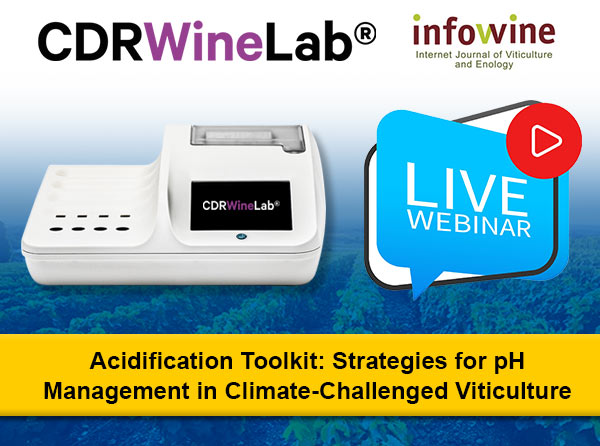
Join us for this complimentary technical webinar on Acidification Toolkit: Strategies for pH Management in Climate-Challenged Viticulture. Thursday, Feb 20, 2025 9:00 AM - 10:00 AM PSTIn an era where climate change is fundamentally altering wine composition, managing pH and acidity has become a critical challenge for modern winemaking. The increasing occurrence of high pH wines with elevated alcohol content not only compromises sensory qualities but also poses significant stability risks. This technical webinar provides a comprehensive analysis of acidification approaches, from traditional chemical interventions to innovative biological solutions. We will explore: The chemical acidification techniques Physical methods including ion exchange technologies Biological acidification processes Harvest timing strategies Blending protocols Speaker: Professor Antonio Morata, University of Madrid (Spain) Got a question about the webinar, email us at gusmerwine@gusmerenterprises.com www.G
00
November 21, 2024

Come by Astoria-Pacific's Booth # 623 at the WIN EXPO DEC 5, 2024. We want to discuss the idea of bringing real science back to Free Sulfite analysis in wine. Oh, yes, we also offer systems for other crucial tests.
00
Is your lab ready for the coming year? Are you using the best instrumentation for your wine analyses? To learn more, visit Astoria-Pacific, booth number 623, at the WIN Expo on Dec 5, 2024!
00
Will you be attending the ASEV Symposium in Portland this year? If so, please pop by our display. If not but know someone who is, have them stop by. Astoria-Pacific offers the rAPID-T for your common tests like Acetic Acid, Malic, Glucose+Fructose, etc. We also have a new system for Free Sulfite that will be introduced later this year.
00
CUSTOMER SUCCESS STORY “The CDR WineLab Junior has expanded our winery’s in-house analysis capabilities. It is an excellent option for copper analysis and a tool we use constantly for wine bottling preparation and quality control. The equipment is easy to use, easy to maintain, and easy to replenish consumables due to the constant communication and support that Gusmer provides its customers." Victoria Mayer – J. Lohr Winery Lab Supervisor Paso Robles, CA CDR ANALYSIS ON WINE AND MUST • Alcohol by Volume • Acetic acid (volatile acidity) • Fermentable Sugars • Total Acidity • L-Lactic Acid • L-Malic Acid • Free sulfur dioxide • Total sulfur dioxide • Yeast Assimilable Nitrogen (YAN) • Galacturonic Acid • Calcium • C
00