
Filter Post Type
NewsVideoProductEventLink
Sort:
Most Recent
1–10 of 12
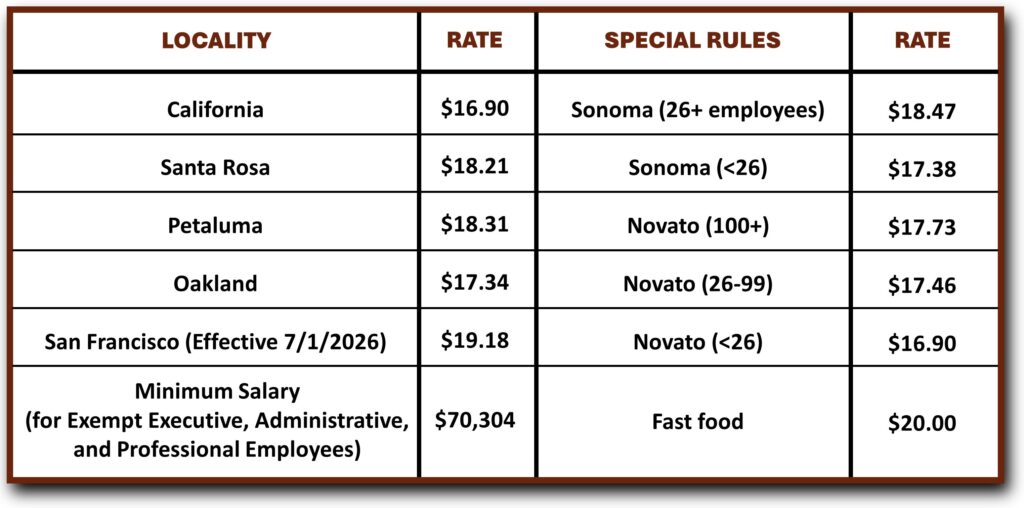
It is time to dust off the employee handbook, review your policies and procedures, and make sure they comply with all the new laws, regulations, and interpretations that went into effect during 2025, became effective in late 2025, or January 1, 2026. Below, we have identified our “top 10” changes. Please keep in mind there were hundreds of laws, regulations, and changes implemented at the local, state, and federal levels throughout 2025. This summary highlights selected changes most likely to impact California employers and is not intended to be exhaustive. So, if you need a handbook/policy review or have any questions, please call us! 1 – Minimum Wage Update: Updates happen every year. It’s best to put a calendar reminder in November, to make sure your payroll is ready! Action: Review your payroll to ensure all employees are being paid the new minimum wage, send written notice of the wage change to affected hourly employees, and be sure your salari
00
February 2, 2026
We are writing to provide information regarding two significant California labor law requirements under the Workplace Know Your Rights Act (SB 294). Our team is available to assist you in administering these new requirements to ensure your organization meets state standards. Mandatory Workplace Rights Notice (Effective Feb 1, 2026) As of February 1, 2026, California law requires employers to provide a stand-alone "Know Your Rights" notice to all current employees. This notice covers fundamental rights, including workers’ compensation, immigration-related protections, and labor organizing rights. Distribution Information: The notice should be provided via your standard communication channel (e.g., email or hand delivery) so that it is received within one business day. Official Templates: The Labor Commissioner has provided model notices for this purpose: English Notice | Spanish Notice Potential Penalties: Failure to provide this notice may subject an employer to
00
August 22, 2025
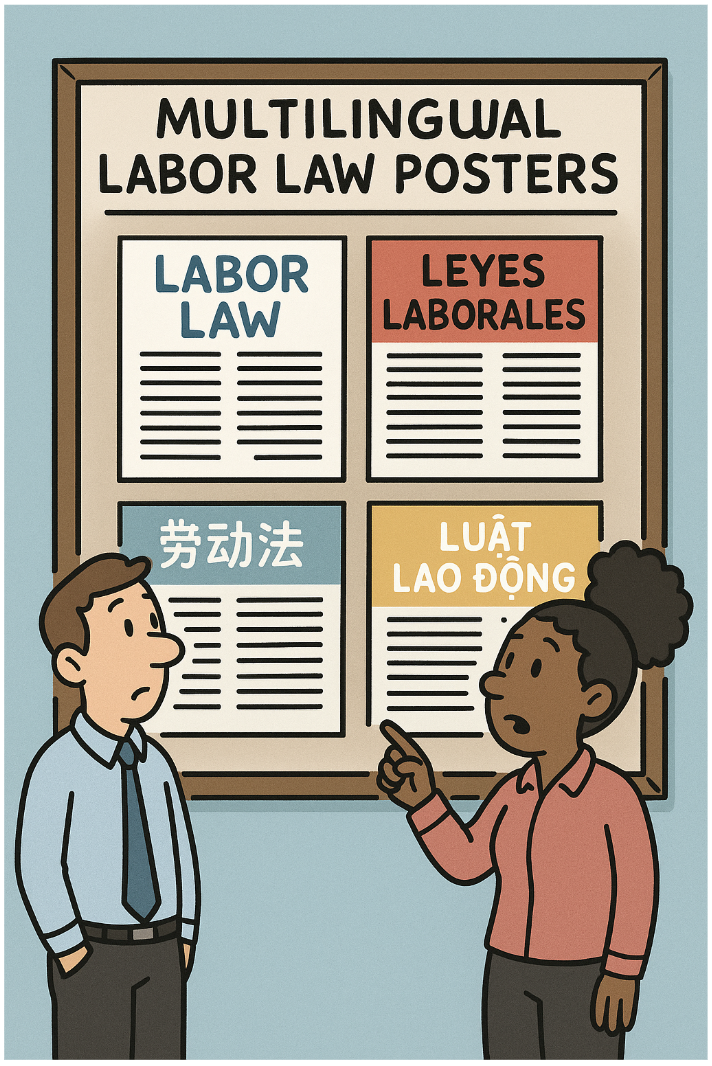
One often overlooked aspect is the language in which mandatory posters are displayed. California, known for its diverse population, has specific requirements to ensure that all employees have access to workplace information. Federal Language Requirements for Workplace Posters The U.S. Department of Labor (DOL) recognizes the importance of communicating with employees in their native languages: Family and Medical Leave Act (FMLA): Employers must provide notices in a language their workforce understands if a significant portion of employees are not literate in English. Migrant and Seasonal Agricultural Worker Protection Act (MSPA): Posters must be available in languages commonly spoken by migrant workers who are not fluent in English. Executive Order 13496: Federal contractors and subcontractors must post notices in languages spoken by employees who are not proficient in English. Translations are available through the DOL upon request. Immigration and Nationality Act (INA): Employers mu
00
Event Type: Seminar
Location: The Oxford Suites - Sonoma County, 67 Golf Course Drive West, Rohnert Park, CA 94928
Date: 4/29/2025
Join employment and immigration attorneys at CMPR and FBCL for a discussion on preparing for and responding to ICE raids. Topics Audits vs. Raids Judicial vs. Administrative Warrants Written Response Plan Response Team Training I-9 Compliance Constitutional Rights Enhanced Documentation Avoiding Discrimination Claims Speakers Arif Virji, Esq. Samantha Pungprakearti, Esq. Justin Hein, Esq. Julia D. Marquez, Esq Lucy F. Lee, Esq. Tuesday, April 29, 2025, 11am-12:30 10:30 a.m. - Registration for In-Person Attendees 11:00 a.m. - Program Lunch included, no cost Join us in-person or remotely by Zoom Register Here
00

March 24, 2025
Watch this comprehensive session on how to secure your labor force and best to remain compliant with federal immigration laws in the Trump era. We will discuss nonimmigrant as well as immigrant visa options for your employees as well as how to best avoid a DHS audit of your HR files.
00
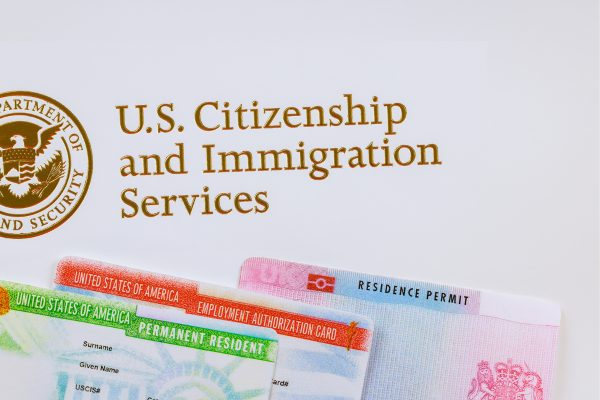
There is a lot of talk and a lot of questions right now about the new administration’s policies and statements on immigration. ICE (Immigration & Customs Enforcement) is the Federal enforcement agency that focuses on immigrant status. They have recently been assisted by the FBI, DHS and other law enforcement agencies when they conduct “raids” to locate and detain suspected offenders. California employers face additional legal requirements due to state laws passed between 2017 and 2021. Employers must, for example, notify employees within 72 hours of receiving an audit notice. Employers are also prohibited from voluntarily allowing ICE to enter non-public areas unless the agent shows an appropriate warrant that authorizes access. Employers and employees are legitimately concerned about their rights and responsibilities. In this article, we will attempt to address some of these concerns. There are two different occasions when an employer might be required to interac
00
February 24, 2025

GROWING FORWARD: Navigating Workforce Challenges Insights on Migrant Labor and Immigration Compliance Understanding how to secure a stable workforce while remaining compliant with federal laws has never been more critical. As immigration policies continue to evolve and enforcement intensifies, agricultural employers are facing urgent questions about labor security, compliance, and the risk of workforce shortages. Many employers are wondering: What visa options are available to legally hire and retain workers? How can I avoid costly compliance mistakes and DHS audits? What are my rights during an ICE site visit? How do I ensure my employment verification processes are secure? Join us for a comprehensive session on how to secure your labor force and best to remain compliant with federal immigration laws in the Trump era. We will discuss nonimmigrant as well as immigrant visa options for your employees as well as how to best avoid a DHS audit of your HR files. Session Panel: Ally B
00

Event Type: Conference
Location: Online
Date: 3/12/2025
Session 1: Navigating Workforce Challenges: Insights on Migrant Labor and Immigration Compliance Broadcast Date: March 12th, 2024 – 10:00 am (PT) The Trump administration’s stringent immigration policies pose a significant challenge for agricultural employers. Initiatives aimed at mass deportations of undocumented immigrants can lead to labor shortages in sectors like agriculture that are heavily reliant on immigrant labor. In California, heightened immigration enforcement has already caused a substantial decrease in field workers reporting for duty, with reports indicating that up to 75% of workers did not show up following intensified raids. These policies may exacerbate existing labor shortages and threaten the timely harvesting of crops and disrupt farming operations. Join us for a comprehensive session on how to secure your labor force and best to remain compliant with federal immigration laws in the Trump era. We will discuss nonimmigrant as well as immigrant visa op
00
February 4, 2025
In the event of potential heightened immigration enforcement, businesses must be informed so that they can be prepared. CMPR put together a brief guide for all businesses on what it can do now in advance of any immigration action. Please click here to read more. In short, the following are the key action steps all businesses should take: Key Steps to Take Now: I-9 Compliance: Ensure that all employee records are accurate and complete. Conduct an internal audit to identify any errors or missing documentation. Designate a Response Team: Appoint a point person to handle any ICE interactions. Train staff on legal rights and responsibilities. Prepare for a Raid: Know what to do if ICE arrives. Understand the difference between judicial and administrative warrants, and limit access to only those areas or records authorized by a judicial warrant. Prepare for the PR Fallout: Have a plan in place in case ICE decides to publicize its interaction with your business. Ensure Quality Partners: If yo
00

The deadline to switch to the new 08/01/23 edition of Form I-9 is fast approaching. Recently, the US Citizenship and Immigration Services (USCIS) published a revised version of Form I-9, Employment Eligibility Verification with several key changes to reflect the end of temporary COVID-19 flexibilities. Starting on November 1, 2023, this new edition will be the only version of Form I-9 that will be accepted by the federal government. What happens if you use the old Form I-9? From November 1st onward, employers who fail to use the new 08/01/23 edition of Form I-9 may be subject to all applicable penalties under Section 274A of the INA, 8 U.S.C. 1324a, as enforced by Immigration and Customs Enforcement (ICE). How to switch to the new Form I-9 You can download the new edition of Form I-9 on the USCIS website, in addition to learning more about the revisions that have been made. If you’re still using paper for your Onboarding process, contact us to streamline and improve you
00