
March 1, 2026
All About the Pace, 'Bout the Pace, No Trembles...





HOW TO DELIVER A GREAT SPEACH 
WISE #220 | Mastering Public Speaking
with Lynda Spillane, April 20 & 21
We invite you to spend two incredible days with Lynda Spillane and become an excellent presenter. Learn what you’re doing to turn people off ... and what you need to do to turn them back ON. Learn why you don’t get the attention you should when you speak.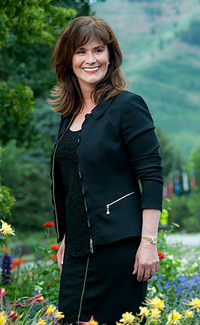 WHO IS LYNDA SPILLANE?
- Lynda is the world's most sought after public speaking coach & speechwriter
- She has coached some of the most influential people in the world ... from royalty to presidents to CEOS
- She has unleashed executives' public speaking potential for 35 years
- See her full C.V. here
WHY TAKE THIS CLASS?
BECAUSE YOU WILL LEARN ...
- Techiques that work on any audience
- Effective persuasion and argument skills
- Secrets to tapping into your audiences’ emotions
- The art of impromptu remarks
- How to effectively start and finish a great speech
- And much, much more!
Register Today (your audience will thank you). 
March 1, 2026
WISE Offers Classes in Arroyo Grande, CASign up for Upcoming WISE Management Classes in Arroyo Grande | View in Browser


WISE COMING TO THE CENTRAL COAST
WISE ACADEMY HEADED TO ARROYO GRANDE
We are excited to share that WISE Academy is headed to Arroyo Grande for the first time, to offer two of our most popular Management Level classes! QUESTIONS? 877-740-WISE (9473)
UPCOMING CALENDAR – ARROYO GRANDE
COMING MARCH 2015
BOTH CLASSES TO BE HELD AT TALLEY VINEYARDS
3031 Lopez Dr, Arroyo Grande, CA 93420
March 9, 10 & 12 - WISE #211 | Tasting Room Management â–º
This 3-day course focuses on the strategic needs of tasting room managers. Topics include team management, retail and merchandising fundamentals, and sales best practices and measurement techniques. Tasting room professionals will enhance their skills in the following areas:
• Hiring, training, managing and firing staff
• Motivating, measuring, and rewarding behaviors
• Leadership and communication skills
• Selling and merchandising
• Planning, budgeting, and goal setting
LEARN MORE â–º
March 11 - WISE #205 | DTC Metrics Intensive â–º
This one-day overview is designed to help attendees better understand the metrics required to manage the various DTC channels (tasting room, wine club, online, phone sales, direct sales, events, etc.). We use real-life experiences to explain the DTC channels and their connection to ROI. DTC professionals will learn about:
• Customer and relationship management
• Data insights
• Dashboards and reporting
• Tasting room, wine club, and online metrics
• Understanding the big picture
LEARN MORE â–º
UPCOMING CALENDAR – NAPA
FEBRUARY 2015
Feb 18, 25 & Mar 4 - WISE #211 | Tasting Room Management â–º
Feb 19 - WISE #205 | DTC Metrics Intensive â–º
Feb 26, Mar 5 & 12 - WISE #213 | Wine Club Management â–º
MARCH 2015
Mar 3 & 10 - WISE #212 | Events Management â–º
Mar 11, 18 & 25 - WISE #201 | Management Core Course â–º
Email Newsletter • Terms of Use • Privacy Policy • Contact
©2015 WISE Academy, Napa, California | 877-740-WISE (9473)
March 1, 2026
Top 5 Ways to Upsell & Increase AOV (Average Order Value)
It’s always important to make the most of every single guest walking through our tasting room door. While most wineries are hiring friendly staff with strong service hearts, sales skills continue to be an area of opportunity for our industry. Many people worry that selling wine is too pushy, but the reality is, it’s an extension of great hospitality. Here are some key ideas to increase AOV.
1. WISE Triple Score
The goal for successful Direct-to-Consumer wineries is to have both high customer satisfaction as well as 3 out of 3 on the WISE Triple Score on every visit. The Triple Score measures if the server: (1) Asked for the sale (Industry Average*: 73%), (2) Effectively presented the wine club (Industry Average*: 38%) and (3) Attempted to capture the contact data (Industry Average*: 18%). (*Based on 2022 averages across 500+ mystery shops.)
Helpful sales shouldn’t feel pushy. It helps to remember that our guests are interested in buying our wine, joining our club, and appreciate an invitation to stay in touch, that’s why they are visiting our winery. Our job in the tasting room is to help them figure out which wines (& club) are the best fit for them. We must get our team comfortable asking for the sale with every taster. If our team is asking for the sale (yay!), the next step is to get rid of the passive or limited asks. We typically don’t have a wine called ‘Anything’ so let’s ask for specific wines we know our guests are enjoying and try to sell bottles (or better yet, cases), rather than a bottle. If they are struggling to ask for the sale, these next few tips can make it easier.
2. Use benefits
Use features and benefits as a natural, helpful sales technique. A feature is what something is. It’s a factual statement about a product or service. A benefit is what something does. Benefits answer the question: “What’s in it for the customer?” Features alone don’t usually close the sale. Benefits appeal to the customer’s emotions, which makes the sale, since people buy with emotions and justify with logic.
Our job when hosting guests is to ask a lot of questions to better understand their interests and then match those interests to what we have available in our portfolio and our wine club. For example: Foodie? Our club has amazing recipes that pair with our wines. Local? We have many fun events showcasing our wines. Love this wine? It’s a winery exclusive so no one can have access to this wine unless you buy directly from the winery. If we can find ways to match their interests with the right benefits, it makes for an easier, more organic, and effective sell.
3. Plant Sales Seeds
Leverage the benefits and plant sales seeds throughout the experience – it is much more effective than just listing them at the end. By dropping seeds along the way, we are encouraging the guests, right from the beginning, with reasons that they should be thinking about what they want to buy or join, rather than putting them on the spot at the last minute.
Warm them up by making suggestions, dropping hints, and noticing buying signals throughout the experience. As we pour wine, we can suggest what foods to pair it with. Mention that it’s a club exclusive or club favorite to entice them to sign up. Talk about the great deals sent by email so that they want to sign up for the list. Planting these gentle seeds for our visitors allows for an easier and more natural ask towards the end of the tasting and is a non-pushy way to increase sales.
4. Notice Buying Signals
We’ve conducted thousands of tasting room mystery shops and found that clear cues often go completely unnoticed by tasting room staff. These tell-tale signs might be verbal, but more likely (70% of the time, in fact), they are non-verbal. Obvious verbal signals may include making ‘yum’ noises while tasting, asking about prices, saying “I love this wine,” etc. Non-verbal signs may include lingering over the price list, licking lips, reading a tasting description, and tapping with finger, etc. Noticing these buying signals is the first step to increasing sales.
Train staff to know what the buying signals are. The best way to do this is to send staff out mystery shopping. Have them make their own obvious buying signals, then see what is noticed.
5. Leverage Programing
Help the team use what programing is already in place for more effective, organic sales. Consider some of these programs and how to leverage them:
- If they purchase xx number of bottles, do you waive the tasting fee? If so, have the team plant that idea in the beginning of the experience as ‘housekeeping’. As a result, guests will start thinking about WHAT they’re going to buy, not IF.
- The same rules apply to the club. If they sign up today, do they get a discount? Tasting fee waived? If so, bring up the club as early as possible. Let them know that club signups and wine purchases lead to benefits to them!
- If you have bottle carriers (2, 4 or 6 bottle bags or case boxes, have the staff remark to the guests that there are ‘holes’ in the bag that they may want to fill, or that there are room for more friends to fill the bags/shippers. Early in the tasting you can get a feel for their purchase allowance by asking, “I noticed you like that wine. I have an empty case box here – would you like me to start filling it now?”
- Challenge the staff to remember the guests’ favorite wines/have them make notations on the price list or order form and see if they can help the guests remember all the wines they liked so that they can pick which ones they want to take home. Feel free to set aside the wines they like along the way – this will make checkout quick and easy, which your guest will appreciate
- Further, consider having labels, stickers, or other collateral to help guests remember which wines they liked. It’s easier to make the sale that way. Or leave a bottle on the table so the guest can see the wines that they tried and liked.
- The feature of a shipping promotion could be a benefit for anyone visiting from out of town. If you have shipping specials like flat rate shipping at 6 bottles, or one penny shipping with a case, make sure there is collateral for guests and the staff to plant the suggestions of getting wine home easily.
- If guests are flying home, ask which airline to plant suggestions for the ‘excuse’ to purchase more. Alaska ships a case of wine for free. Southwest ships two bags for free. There could be an opportunity to upsell some merchandise too if you have anything “shipping” or “packaging” in the shop.
By simply aiming for 100% on the WISE Triple Score, along with implementing these helpful sales techniques, we can grow sales and guest satisfaction exponentially. Every effort counts.
https://wineindustrysaleseducation.com/upsell-increase-aov-average-order-value/
March 1, 2026
WISE #115 DTC Metrics Professional - New & Improved
DTC METRICS | UPCOMING CALENDAR
One of our essential core classes has been updated & retooled ... and is better than ever!
WISE #115 DTC Metrics Professional
Wednesday, April 22
Let's face it - managing, understanding and acting on the myriad of metrics in the direct to consumer world can be daunting!
This Level I Certification Course focuses on the fundamental metrics required to run a successful, multi-channel DTC wine organization, including the basics of customer relationship management (CRM). Students will learn how to create dashboards for DTC channels and how to identify the opportunities and challenges they uncover. In just one day, we'll cover:
- Understanding Your Customer Relationship Management System
- Tasting Room & Wine Club Metrics Dashboards
- Website & Email Analytics & Dashboards
- Phone & Social Media Metrics
- Customer Segmentation
Click Here to learn if this is the right class for youâ–º
Ready to sign up? Click here to register nowâ–º
UPCOMING CALENDAR - NAPA, CA
APRIL 2015
Apr 17, 24 & 28 - WISE #201 | Management Core Course â–º
Apr 20 & 21 - WISE #220 | Mastering Public Speaking â–º
Apr 22 - WISE #115 | DTC Metrics Professional â–º
Apr 28 - WISE #203 | Demystifying Financials â–º
MAY 2015
May 14 - WISE #205 | DTC Metrics Intensive â–º
JUNE 2015
June 2, 3 & 9 - WISE #111 | Tasting Room Professional â–º
UPCOMING CALENDAR –PROSSER, WA
JUNE 2015
June 8, 9 & 11 - WISE #111 | Tasting Room Professional â–º
June 10 - WISE #205 | DTC Metrics Intensive â–º
Email Newsletter • Terms of Use • Privacy Policy • Contact
©2015 WISE Academy, Napa, California | 877-740-WISE (9473)
March 1, 2026
WISE Idea - Urgent Versus ImportantIt’s a typical busy morning. You arrive at your winery to find that the dishwasher is broken, you have a large group arriving at 11am, and the key team member you had scheduled to host them just called in sick. Budgets are due in two weeks and you had been planning to spend the day working on them. Do you now need to put this important work on the back burner? Make it this year’s resolution to focus on the important things.
In the 1960s, Charles Hummel published a little booklet called Tyranny of the Urgent, and it quickly became a business classic. (Hummel’s concepts became the foundation of works like Stephen Covey’s Seven Habits of Highly Effective People.) Hummel noticed that there’s a natural tension between the urgent and the important — and far too often, the urgent wins. In business, this means that crises often take priority over things like strategy, planning, process improvement, and team building. The urgent, though less important, is prioritized, and the important is put on the back burner.
The challenge we all face is that “Urgent" items often masquerades as “Important." But there’s a simple litmus test to help identify the truly important: Ask yourself if the activity will make a significant and lasting positive impact on the business. Identifying and working on the "Important" stuff requires focus and concentration. As managers, this is where we want to be spending the majority of our time.
Below is a sample matrix that separates urgent from important and the tasks that belong in each quadrant:

What will it take for us to spend more time in Quadrant 1 (Important but not Urgent)? Our goal should be to greatly reduce and almost eliminate our time spent in Quadrant 3 (Urgent but not Important) activities. We need to delegate more of our Quadrant 2 (Important and Urgent) activities which may seem scary, but is the sign of a true leader.
Schedule Big Rocks
When something is important, we need to prioritize it. Every day we manage urgency and importance simultaneously. Important projects require time and mental discipline to complete.
Managers tend to get stuck in the urgent, while leaders factor in time to take care of the important things. Covey’s Seven Habits calls this making room and time for the “Big Rocks.”
.jpg "Big Rocks") In this image, if the Big Rocks are our quadrant 1 activities – our important stuff – and the sand is all the other stuff that takes up our time and the glass jar is all the time we have available, then how can we ever find time to get to these big rocks? Put the big rocks in the jar first and then fill in the sand around them.
In this image, if the Big Rocks are our quadrant 1 activities – our important stuff – and the sand is all the other stuff that takes up our time and the glass jar is all the time we have available, then how can we ever find time to get to these big rocks? Put the big rocks in the jar first and then fill in the sand around them.
This is the secret of successful leaders. It is also the difference between managers and leaders and we need to be both. There is no way we can effectively juggle both important and urgent on our own. To do this, we need great staff, great processes, training of systems and real discipline to move from the urgent to the important. Time spent in Quadrant 1 is not a luxury, it is a necessity for every successful manager.
Time Management Best Practices
This sounds good, but realistically, how are we going to make it happen? Here are some best practices:
Prioritize. Be ruthless, and stick to it! Make a list of the five most important things you need to do to positively impact your business. These are our Quadrant 1 activities. The most important use of this list is that it provides clarity about what is NOT on the list.
Act. With urgent problems and conflicts, act immediately. If we dwell on them and don’t act we will just be distracted. Bias towards action here is critical.
Delegate. Entrust your team, especially with urgent items. Don’t hoard them. Be ruthless about Quadrant 3. Push yourself to delegate more in Quadrant 2. Get your ego out of the way. Urgent does not necessarily mean complex.
Take Control. Literally make an appointment with yourself. Set aside time – especially early and late – for focusing on the ‘important.’ Block off time on your calendar, when your office door will be shut or you go offsite. The gift of time is not something that your boss is ever going to give you; it is a discipline you have to create for yourself. Your success depends on it.
Successful managers are great delegators – not abdicators, but real delegators. Successful leaders take it a step further and are constantly working themselves out of a job. For some this may be counter intuitive, but decreasing organizational dependence on you as a manger actually makes you more – not less – indispensable to your employer.
So delegate that broken dishwasher problem to a staff member, get your next most experienced team member to host that large group, close your door and get to work on those budgets! Why not make your resolution to spend time on the important – not urgent – things?
March 1, 2026
Time to Refill Your ‘Hospitality Well!’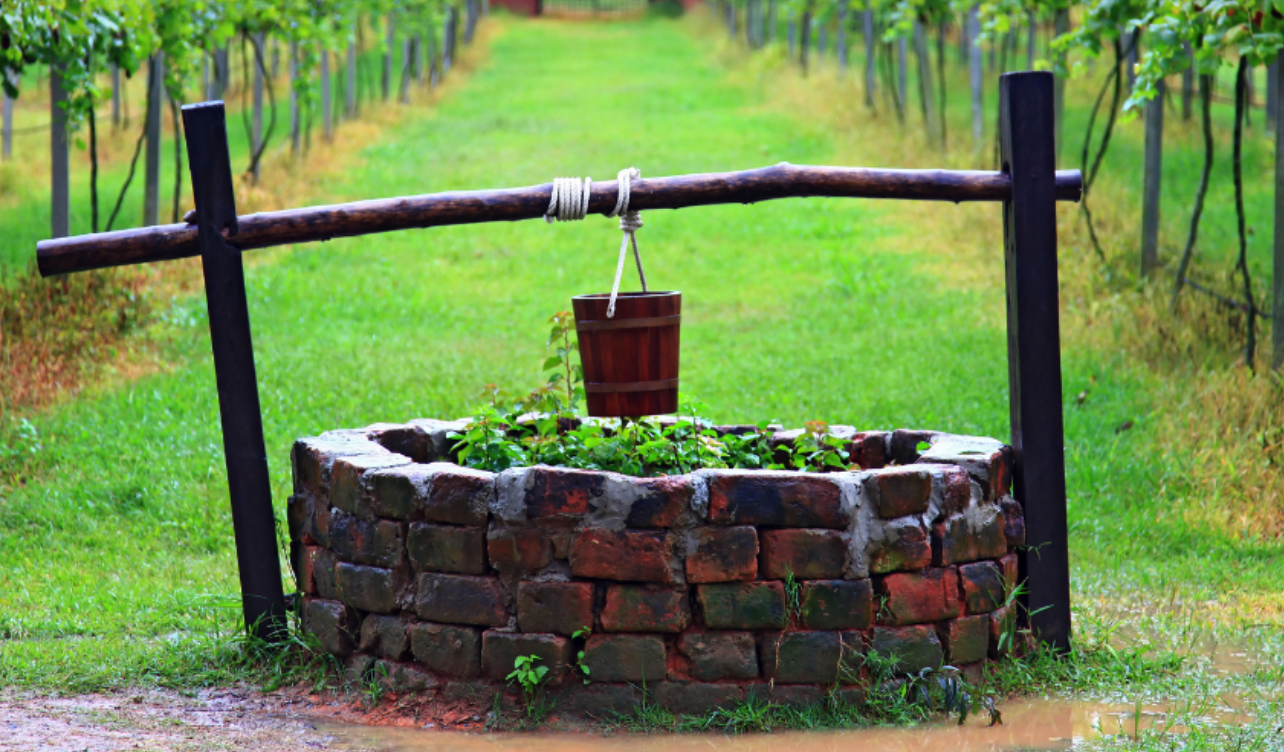
The West Coast has been enjoying all this rain – well over 150% of normal by some accounts. In true WISE fashion, there is a lesson to be learned as we typed this to the sounds of the storm outside.
A common question on the news reports has been “Will all this rain eliminate the West Coast droughts?” and the answer has two parts. First, yes, surface level reservoirs are refilling (albeit a bit too quickly). Local water tables and wells are absorbing some of the deluge. However, there is a deeper issue, and one that resonates. Are the deeper aquifers being recharged and refilled?
What does rain have to do with leadership? The analogy is clear. Are we refilling our own “hospitality wells” – which is to say “Are we taking this slower time of year to refill our own hospitality heart”? It goes even deeper, to our own company aquifer that runs far deeper. Are we as an organization taking the time to absorb all that is being offered, so we can weather the harder, drier months? Don’t let this opportunity pass you by and drain out to the ocean, take time to absorb as much as you can, refill your surface wells and deeper aquifers.
Even at WISE, everyone on our team takes the time to recharge the surface level wells when it rains, and when it pours, we take the time to recharge at a deeper level. At the surface level , looking for those times to exercise, go out and be served a great meal, splurge on a spa treatment, or put on a comedy night with friends is key. We don’t waste a drop of this precious rain.
To recharge our deep company aquifer far beneath the surface, we take time to meet annually and review our hits and misses, our SWOT (strength, weakness, opportunity, threat) Analysis, and our goals for the coming year and beyond. We eat great meals and enjoy more than a few bottles of excellent wine together. We pause for executive education and development by reading and dissecting Harvard Business School case studies, listening to and discussing pod casts, and watching some of our favorite speakers. It is something we look forward to doing with our colleagues and sets our year up for success.
We also take this time to travel and experience luxury hospitality all over the world. In the coming year, members of WISE will be heading to Europe, Bora Bora, Asia, and Argentina. Even though we may be on “vacation”, our minds absorb and collect interesting materials for our winery partner clients. And perhaps most importantly, we refill our hospitality wells and savor those memories so we have the fresh, cool water necessary to get through the drier months.
So, how are you taking advantage of this deluge to refill your hospitality well? Is your company leadership refilling the aquifers, so you and your team are prepared for those months of energy drought? How can we help? We have umbrellas, water tanks, and drills standing by to assist at all levels of leadership.
March 1, 2026
A Missing Piece – Collaborative Action to Increase Qualified Tasting Room Traffic
For years WISE has been collecting data on a variety of key best practices for the tasting room through our Mystery Shopping program. We’ve compiled the data from over 450 shops in 2022 and one thing that continues to come up as an opportunity for the industry as a whole is capturing the Referral Source. It breaks our heart to see that only 56% of the industry attempted to find out what brought the guests into their tasting room because we know that effective referral source data collection brings in revenue! How is that? Well, if we notice that certain people or businesses are sending in great guests, we can leverage that. With a little positive reinforcement, these “gatekeeper” relationships can really increase our DTC revenue.
What is a Gatekeeper?
WISE defines the term gatekeeper as a person or business who could potentially refer qualified customers (aka guests who will purchase wine or join a wine club). This might include hotel concierges, limo drivers, restaurant waitstaff or host/hostess, etc. It could also include neighboring wineries or specific people in the industry. Successful wineries have formal gatekeeper relations programs & it pays off to treat them as strategic partners.
The Payoff
One of our winery partners in Napa recently told us about their relationship with 10 strategically picked, local hotels. The hotels were given “free tasting” coupons for their winery to give out to their guests. The guests who are coming to redeem these cards are “not always, but often A++ shoppers. One out of four is a whole-case buyer.” The lesson here is that even if people are coming in for something free, it doesn’t mean they won’t buy (we hear that all too often from staff). We need to make sure our staff are attempting to sell in a brand-appropriate way. It could also be a value-add and not something free – like an upgraded experience, a cheese plate, etc.
Another winery partner in Walla Walla says the local tour companies bring in about 75% of their revenue. In 2021, this was nearly $413,000 in revenue!
How do we find our Gatekeepers?
When our guests enter the tasting room, a common icebreaker is: “Have you been here before?” or “How did you hear about us?” This is a great start to the conversation and building rapport, but if we tweak the question to find out what brings the guest in today & better yet, who sent them, we can do so much more with the information gathered in the response. Our team should be aware that a huge part of their job on the floor is to build rapport with their guests, which, when done intentionally, will help us discover:
- Where they heard about us
- Wine touring publications, Social Media Groups, & websites they use
- Other wineries they visit
- Where they stay, dine, shop when visiting
- Other activities they engage in when visiting
“Who can we thank for your visit today?” is a question that provides valuable insight into who our gatekeepers are. Referral source awareness can increase our Key Performance Indicators (KPIs) tremendously. Building this awareness with our team is the first step. To take it up a notch, we must put a system in place to measure our results so that we know if we are achieving our goals to justify continuing the program.
Best Practices for Gaining Referrals
Here are five WISE best practices for building relationships with key gatekeepers:
- Create a target list of partners who are, or could be, key influencers – both current and aspirational partners.
- Formally decide on the top 10 to 25 accounts to focus on first
- Set up categories and assign source key codes for tracking. Make sure the whole team knows/can access these codes
- Have the team ask for referral sources at every table (and/or make it part of your reservation process) and track partner referral performance in detail
- Develop a special, unique offer that is easy for our partners to sell and/or foster relationships with our Gatekeepers
Once we realize who is sending us the best customers, we want them to keep doing it! It’s important to foster relationships with these key influencers and not waste time/energy/resources on those who are not sending qualified traffic. Some ideas to incorporate into our Gatekeeper Programs include:
- sending thank you notes
- hosting a Key Influencers industry party
- VIP tastings for key referrers
- unique offers for guests and/or tastings at hotels & B&Bs
- trainings at local restaurants
- offer a relaxing place, a non-alcoholic beverage, or free WIFI for limo drivers to hang out while waiting for their groups
- If all else fails, an occasional “thank you” bottle placed in the hand of a great gatekeeper is always appreciated.
In other words, treat them like a VIP when they visit us and consider setting up experiences or surprise & delight opportunities unique to them & their guests. Another idea, especially for business owners – reciprocate the referral!
While this is an important part of each tasting room host’s job responsibilities, some wineries are paying an incentive to staff to capture this key referral information – it’s that important!
If we don’t have a formal Gatekeeper Relations Program in place yet, there’s no time like the present to start one. For now, let’s get our team asking and formally collecting referral sources. Then in the slower months, we can refine our program, make sure we are meeting all the WISE Best Practices listed above, and work on fostering relationships with those key gatekeepers. Investing time and energy into our gatekeepers will pay off.
March 1, 2026
Phone Sales Isn’t DeadAs anyone who has watched Glengarry Glen Ross knows, sales is all about the premium leads. Where do those leads come from, and what are they used for? Another lesson from Glengarry Glen Ross, ABC…Always Be Closing: “Prospects don’t walk on the lot lest they want to buy”…once we close them in the tasting room, it is really just the beginning of the relationship, if we are doing our job right.
So the tasting room Prospects bought wine in the tasting room, becoming First Time Buyers, but may not have yet joined the wine club. That is ok! As we have learned from recent Commerce7 data, it takes an average of 4.17 interactions before a Prospect becomes a Repeat Buyer, often times in the form of joining the wine club. When we look at our databases, all too often we see that our Prospects are the least marketed to, the least personalized. One of the best ways to move Prospects further up the Buyer’s Continuum is to do personalized, targeted outreach by picking up the phone and calling. How is that best achieved?
Great notes about the guest’s visit makes this possible.
Did they make a reservation? How did they hear about us? Perhaps a member referred them, or a top hotel in the area. Maybe our print ad budget is working well, or they saw an ad online that drove them to us. What did they enjoy when they tasted? A new release, a library wine, that extra special bonus pour that was meaningful to those particular guests? Perhaps they mentioned an upcoming occasion, like a wedding or special birthday where they need wine. What is their role at work, are they in charge of holiday gifts for clients or employees? Beyond name and email address for their receipt, are we capturing this rich data?
Now that there is a robust profile, let’s use it!
It would be a shame to let those premium Prospects go to waste. If a winery saw 10,000 visitors per year, and converted 50% of them to First Time Buyers, that is 5,000 guests to target throughout the year to move up the continuum towards Repeat Buyer (and eventually, Loyal Fan). If 10% of those First Time Buyer’s converted to Wine Club, that is an incremental 500 new members, all by picking up the phone and following up.
How long does it take to make 5,000 phone calls? Figure on 8-10 quality calls per hour, per employee, that is roughly 500 labor hours spread over the entire DTC labor pool, over the course of a year. For a team of five DTC employees, that is 100 hours over the course of the year, or just two hours per week. In looking at recent metrics from WISE #116 Outbound Phone Sales, we know that conversion metrics are actually much higher than 10%, so individual winery results may vary.
As you can see, we are sitting on a gold mine when it comes to phone sales. And not only is a great phone program great for our winery income, it’s a great rapport-builder! People like to be called by their winery. It makes them feel special. This emotional trigger to buy is a win-win. The sooner we get our team making phone calls, the better.
https://www.wineindustrysaleseducation.com/phone-sales-isnt-dead/
March 1, 2026
Put on Your Own Oxygen Mask First – What It Means & Why It’s ImportantOn a recent trip, the flight attendant went through her normal drill as we prepared for takeoff. She had a wry sense of humor, having repeated the FAA instructions probably thousands of times during her career, and wanted to capture the attention of this groggy, sleep-deprived, and experienced traveler.
After learning how a seat belt works (which, by my mid 40’s, I hoped I was doing that correctly), she said something that caught my attention and made me chuckle.
“In the unlikely event of a sudden drop in cabin pressure, remove your COVID mask and apply the oxygen mask. Only once yours is secure, then help the child next to you who is mostly likely to choose the better nursing home for you.” Humor aside, her comments stuck with me the rest of the flight.
First, how often do we as managers take the time to ensure our own oxygen mask – which supplies the life sustaining flow of oxygen during a time of stress– is firmly secured before we try to help others? As WISE Alumni know, making time for the ‘Big Rocks’, the strategic work, is critical to our success. Stephen Covey talks about this in his book, Seven Habits of Highly Effective People. Imagine a jar with a limited amount of room and having to fit not only big rocks, but smaller rocks, and sand. If the ‘big rocks’ represent the most important priorities and the sand is all the other little things that fill up our lives – email, phone calls, laundry, less important priorities, and so on – how do we make space or time for the big rocks? We need to prioritize them first.
One of those Big Rocks should be our own mental and physical health. Take an inventory, how much time are you spending on you? Has it been a while since you have had the chance to invest in yourself, either in a class, a retreat, or even reading a good book or taking a mind clearing hike? What’s bringing oxygen back into our lives?
The next thought was to help the “most likely to succeed child.” While said in jest, there is some truth in that idea. To use the analogy of ‘child’ for those we care for, those we nurture, then in this case, we’re considering our employees. All too often, we spend most of our time on employees that are underperforming, sacrificing precious time that could be spent developing our A players. One strategy is to delegate some tasks and projects to those high-performing teammates. Often, we don’t delegate because it would be ‘easier’ to do ourselves and take longer to explain it, or we want to complete certain projects ourselves, or we lack confidence in others/think we’re the only ones who can do it correctly. However, by delegating, we’re allowing our team members to grow, building their confidences, growing their skill sets, and giving managers some much needed time to tend to other tasks.
How to Delegate Effectively:
1. Know What to Delegate. Not everything can be delegated.
2. Play to your Employees’ Strengths and Goals.
3. Define the Desired Outcome.
4. Provide the Right Resources and Level of Authority
5. Establish a Clear Communication Channel
6. Allow for Failure
7. Be Patient
8. Deliver (and Ask for) Feedback
9. Give Credit Where It’s Due.
Delegating isn’t easy, but it becomes easier the more we practice it and learn from it over time. By building the team bench-strength through delegation, we can free up time to focus on our own big rocks, like our mental health.
March 1, 2026
Choose Your Words WISEly – No One Wants to Hear “No”In the world of hospitality, providing exceptional service and creating memorable experiences for guests is paramount. However, there are situations where it becomes necessary to say “no” to a guest’s request or demand. It’s crucial to handle these moments with finesse and professionalism to ensure guest satisfaction and maintain the winery’s reputation.
What we say is as important as how we say it. Every word and phrase we choose conveys mood, tone and meaning. Remember, customers and colleagues come in every possible stage of enthusiasm, anxiety, understanding and confusion.
Consider these phrases and the potential impact of each:
- “No problem.” or “My pleasure.”
- “Customer” or “Guests”
- “Your server” or “Your host”
- “That’s not our policy” or “what I can do for you is…”
- “It’s in the brochure.” or “Let me answer that for you.”
- “We don’t have any more.” or “I believe we are sold out.”
- What do you want?” or “How may I help you?”
- “I didn’t mean it.” or “Please accept my apology.”
Also think about actions with words…
- “The bathroom is over there” or “Let me show you the way.”
- “You can pick your wine up over there” or “We will have your wine ready for you at the front desk.”
So, as the First Rule of Hospitality, let’s change that ‘no’ to:
- “Let me see what I can do for you” or “here’s is what we can do for you…”
- Take it from a negative place and give it a positive spin.
- Guests appreciate it when we are polite, making them feel special, and confidently answering questions.
But not all “No’s” are created equal. How do we figure out where to draw the line? Consider these six different decision criteria:
1. Safety / Compliance Issues
The safety and compliance of both guests and staff should always be the top priority in the hospitality industry. Here’s how to handle situations when safety or compliance is at stake:
Example Scenario: A guest requests a private tour of the winemaking facilities, which are off-limits due to safety regulations. (It’s a working winery and we’re making some wine!)
How to Say No Gracefully:
- Apologize for any inconvenience.
- Explain the safety or compliance issue.
- Offer alternative experiences like a guided vineyard tour or a special tasting.
“You chose the most exciting time to be here – harvest! We are not doing tours right now with all the forklifts moving and trip hazard like hoses going from presses to tanks but let me see if I can get a tank sample for you!” Be sure to collect their data so we can market those vintage wines when they are released, to commemorate their visit.
2. Company Policies
Every winery has specific policies in place to maintain order and uphold its standards. When a guest’s request contradicts these policies, it’s essential to communicate clearly and professionally. Understand the winery’s big picture and what are the guard rails when it comes to guest experience design.
Example Scenario: A guest asks for a refund on a non-refundable wine tasting reservation.
How to Say No Gracefully:
- Express regret for the situation.
- Clearly state the company’s policy regarding refunds.
- Offer solutions like rescheduling, transferring the reservation to another date or towards a future wine purchase.
Ensure your policy is included in all communications, and that conformation calls or texts are sent a day or two prior to the scheduled visit. Brainstorm solutions for every time this type of situation comes up, so the team is prepared to answer with solutions confidently.
3. Bothering Other Guests
Maintaining a harmonious atmosphere for all guests is crucial. When a guest’s request could disrupt the experience of others, addressing the issue tactfully is key.
Example Scenario: A group of guests come in with unruly children.
How to Say No Gracefully (especially if there isn’t a policy for under 21):
- Acknowledge that parenting can be challenging and empathize with their situation: “We understand many of our guests are looking for quieter experience. Children need to be quiet, or we can reschedule for an adults only visit.”
- If the guests have pre-purchased a tasting package, consider offering them a refund or the option to reschedule their visit for a more appropriate time.
- Be Prepared for Different Reactions: Understand that guests may react differently to your request but maintain your professionalism and patience throughout the conversation.
- Have entertainment on hand for children – coloring books and crayons or other activities.
4. Desired Brand / Guest Experience
Every hospitality establishment has a brand image and a specific guest experience it aims to deliver. Sometimes, saying no is necessary to maintain the desired image and experience.
Example Scenario: A group of guests come in for a bachelorette party and are wearing inappropriate adornments at a family winery.
How to Say No Gracefully:
- Thank the guests for choosing your winery to celebrate.
- Explain that the winery is family-friendly, and we want everyone to feel comfortable. Explain your winery’s commitment to maintaining a family-friendly atmosphere.
- Offer alternatives like another area of the winery for tasting as a private group and/or ask them to remove the inappropriate adornments while on property.
5. Pleasing Them
Guests often make requests with high expectations, but it’s not always possible to fulfill every wish. It’s important to manage guest expectations and provide alternatives when necessary. We can try to accommodate whenever possible as long it doesn’t violate point 1, 2 or 3 from above.
Example Scenario: A guest requests a rare wine that is not currently in stock.
How to Say No Gracefully (if we truly cannot accommodate the request):
- Thank the guests for their interest in the wine.
- Explain that the requested wine is currently unavailable.
- Offer a selection of other wines that may be of interest/comparable or provide information on upcoming releases.
- Collect their contact data for library releases and for future releases
6. Inconvenient to Staff
While guest satisfaction is crucial, it’s also essential to consider the convenience and well-being of your staff. Here’s how to handle requests that could be overly burdensome to your team.
Example Scenario: A guest requests a last-minute, extensive wine and cheese pairing for a large group during peak hours.
How to Say No Gracefully (if we truly cannot accommodate the request):
- Express gratitude for their interest in your offerings.
- Explain the limitations due to staff availability and peak hours.
- Offer alternatives like a pre-arranged package or suggest off-peak hours for a more personalized experience.
Tips for Saying No Gracefully
1. Choose Your Words WISEly: Use polite and empathetic language to convey your message. Instead of saying “We can’t do that,” or “I’m afraid that won’t be possible…” try “Here’s what we can do…” Whenever you have to say no, provide alternative options or solutions to meet the guest’s needs.
2. Offer Alternatives: “While we can’t accommodate your request for a private tour of the winery, we can offer you a guided vineyard tour.” Express regret for any inconvenience and gratitude for the guest’s interest.
3. Be Apologetic and Thankful: “We apologize for any inconvenience this may cause, and we appreciate your understanding.”
4. Maintain a Positive Tone: Keep a positive and friendly tone throughout the conversation. “I’m sorry, but we have a policy in place to ensure the safety and comfort of all our guests. We’d be happy to assist you with an alternative arrangement.”
Saying no to guests gracefully is an essential skill in the hospitality industry. By prioritizing safety, adhering to company policies, considering the experience of all guests, and using empathetic language, you can handle challenging situations with professionalism and maintain the reputation of your winery. Remember, it’s not just about saying no; it’s about providing alternatives and ensuring that every guest feels valued and appreciated, even when their requests cannot be fulfilled.
https://wineindustrysaleseducation.com/choose-your-words-wisely-no-one-wants-to-hear-no/
March 1, 2026
AI in the Wine Industry – What Does It Look Like?
According to AI, ChatGPT specifically, AI, or Artificial Intelligence, refers to the simulation of human intelligence in computer systems, enabling them to perform tasks that typically require human intelligence, such as learning, reasoning, problem-solving, and decision-making.
So, does that mean AI is going to take all the jobs? No… but it could mean those who don’t embrace AI will be replaced with those who do. AI should complement, not replace people and traditional marketing.
If we do embrace AI, then how do we do so? And how do we avoid sounding like ‘AI’? First, play with it. Try things on a personal level like meal planning, grocery list compiling, finding a place to live, dating, health care, and more. Playing with it on a personal level is less intimidating for many. ChatGPT is NOT a search engine or a data storage but rather an effective tool to apply to our own data and find patterns or brainstorm beyond what we can personally come up with. To get the best results, we need to better understand how to use AI.
Where to find AI
There are plenty of AI tools available for you to try. Here are a few that we’ve worked with:
- ChatGPT (chat.openai.com) – the OG, great for marketing strategies, calendar planning, copy, etc.
- Bard (bard.google.com) – a chat-based AI from google, great for auto responses to customers.
- CopyAI (Copy.ai) – simple and easy to navigate for marketing, content planning and copy.
Prompts
Using AI to the best of its ability means understanding how it works and ways to get what you need from it. Imagine AI as your newest employee or intern. While you can give them a task, the more context you give him/her the better the results – same with AI. For example, asking a new employee to write a blog about your winery will produce results, but until they know about your brand, your story, your voice, they will never be able to produce quality results. Prompts are statements, questions or ways to generate creativity, reflection or engagement. Here are some best practices for prompts:
- Talk to the AI like they are an actual person. Be polite, friendly and get that kind of result back. “Can you make me a monthly marketing plan for …”
- Lead with context (like a new employee, give parameters) and then follow up with detailed prompts. “We are a casual winery. Can you make me an email with a casual tone that says…”
- Request ChatGPT AI to provide the results in the manner you want – a table, memo, overview, blog, etc. and how long you want the response/results to be. “I need a 450-word blog about harvest this year…”
- To generate more ideas, ask AI follow-up questions related to the original prompt. “What winery terms need to be explained? How can I integrate wine club info in this email?”
- Ask the AI to assume an identity or profession. “Write this as an HR manager or attorney or friendly and knowledgeable tasting room host.”
- Feel free to re-ask the question. AI will often change its answer with each ask.
Once we get better and better at creating and fine-tuning our prompts, keeping a record of the responses and your parameters for later use is valuable. Remember – the better the data, the better the results.
Ways to Play
There are several ways wineries are already using AI with their businesses – from marketing to HR to business analytics and more. Here are some considerations about ways you can start using AI to create more efficiencies and expand creativity.
Marketing – Efficiencies
AI-driven technologies like chatbots and virtual assistants offer round-the-clock customer support, handling common inquiries, aiding in wine selection, and streamlining order processing. Marketing automation powered by AI simplifies tasks such as email campaigns, social media scheduling, and targeted advertising, ensuring consistent execution while saving time and resources. AI’s data analysis capabilities efficiently process extensive datasets, offering actionable insights and predictive analytics for anticipating trends and customer behavior. Additionally, social media sentiment analysis enables wineries to monitor customer sentiment and feedback in real-time, informing strategic adjustments in marketing and product.
Marketing – Engagement
- Enhanced Customer Engagement: AI-driven chatbots, recommendation systems, and personalized marketing efforts enhance customer engagement. When customers feel understood and valued, they are more likely to remain loyal and make repeat purchases.
- Customer Segmentation: AI can analyze customer data to segment the database effectively. By understanding different customer segments and their preferences, wineries can tailor marketing campaigns to specific groups, improving the relevance of their messages and offers.
- Personalized Recommendations: AI-powered recommendation systems can examine customer purchase history, preferences, and browsing behavior to provide personalized wine recommendations. This enhances the customer experience and increases the likelihood of sales. (Think about your Amazon home page.)
Marketing Content – Creative:
Marketing content is a never-ending need, but writer’s block is real, especially when we’ve been doing the same job for a while. Using AI to help flesh out ideas or take them in a different direction is one of the great benefits of AI. We can do this for blogs, sales and marketing collateral, newsletters, website content (ask ChatGPT to write it for better SEO), social media copy, email copy, survey creation, and more. Images for the website, social or sales collateral can also be generated or edited with AI.<
- Email: Use AI for automated email campaigns, A/B test ideas and automation, content creation, personalization, and predictive analytics.
- Social: Use AI for content creation, slogans and hashtags, photos and sentiment analysis.
These ideas are just scratching the surface of ways wineries are using AI currently – or considering using. At the end of the day, we need to be the ultimate expert of the content we are producing, so while AI can help, we need to be the final signoff on what we publish. It’s important to use AI as a jumping off point, make edits and changes to reflect your wineries brand and style. Be sure to run tests on a small scale before a large marketing launch. Lastly, measure your ROI by confirming efficiencies and speed of project completion. Make sure using AI is good for your winery’s reach, customers and employees.
https://wineindustrysaleseducation.com/ai-in-the-wine-industry-what-does-it-look-like/
March 1, 2026
WISE Launches “Rising Star” Scholarships to Elevate the Next Generation of DTC Wine Leaders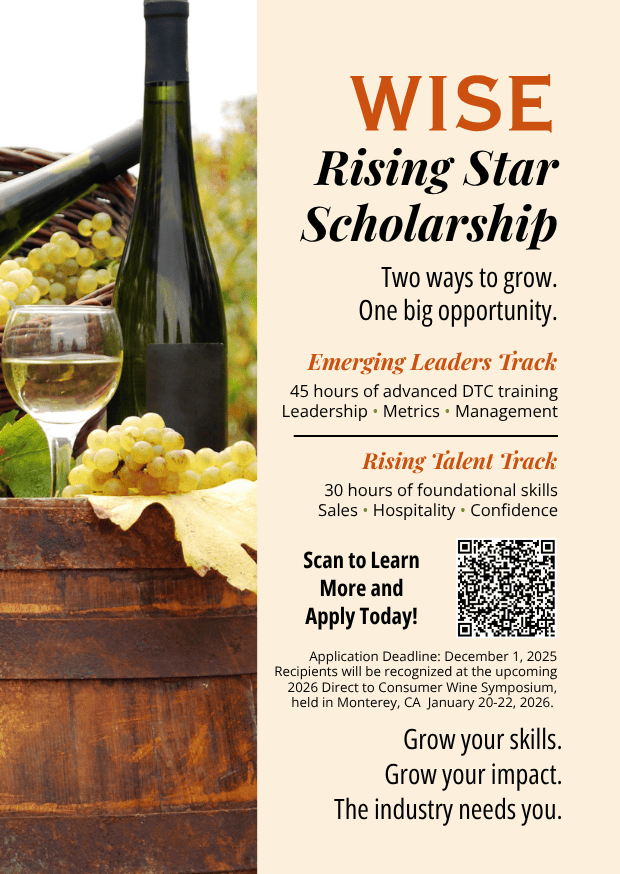 Wine Industry Sales Education (WISE) is proud to announce the launch of the WISE Rising Star Scholarship Program, three professional development scholarships designed to invest in the people shaping the future of the wine industry.
Now in its 16th year supporting winery DTC, WISE continues its commitment to helping winery professionals grow through hands-on education, coaching, and certification. The new scholarships support both emerging professionals and rising managers who demonstrate heart, hustle, and a commitment to excellence. Recipients will be recognized at the 2026 Direct to Consumer Wine Symposium, held in Monterey California January 20-22, 2026.
Two Tracks, One Goal: Empowering DTC Growth
Rising Star Professional Scholarship (Value: $1,275) One Available.
For individuals new to the wine industry or early in their DTC journey.
Includes:
- WISE #111 Tasting Room Professional OR WISE #113 Wine Club Professional
- WISE #117 DTC Text Messaging Professional
A total of 30 hours of foundational, skill-building training focused on guest experience, communication, and sales confidence.
Rising Star Manager Scholarship (Value: $2,050) Two Available.
For emerging managers, supervisors, and team leads ready to expand their impact.
Includes:
- WISE #201 – Management Core Foundation, which is 21 hours of People Leadership and Winery DTC financial acumen
- WISE #211 Tasting Room Management OR #213 Wine Club Management – channel specific management coursework
- WISE #205 DTC Metrics – for all DTC Channels
A total of 45 hours of advanced leadership, team performance, and cross-channel strategy.
Both scholarships offer flexible scheduling through live, interactive Zoom sessions offered in multiple cohorts throughout the year, allowing the recipients to select the timing that works for their busy schedules.
Why It Matters
“Our industry thrives when we invest in people,” says WISE Partner Liz Mercer. “These scholarships help us recognize and support both new talent and emerging leaders who are committed to improving the guest experience, driving performance, and elevating our industry as a whole.”
How to Apply
Applications open November 10 and close December 1, 2025.
Recipients will be notified December 15, 2025, and recognized at the upcoming Direct to Consumer Wine Symposium.
Applicants are asked to submit a short form, résumé, one letter of recommendation, and an essay tailored to their chosen track.
More Information: Full details and application process is found here – WISE
Apply for Scholarship: Apply here, please indicate which scholarship the application is for.
Questions: Info@WineIndustrySalesEducation.com
About the Selection Committee: Lesley Berglund, WISE Co-Founder and Chair, is joined by Erin Kirschenmann, Managing Editor of WineBusiness, Kasey Helt, DTCWS Steering Committee Member with WISE Partners Jennifer Warrington and Liz Mercer. Together, they will select the three recipients of the scholarships.
Let’s raise a glass—and raise up the people who make this industry exceptional.
February 11, 2026
Train Like It’s the Championship Season (Because It Is)
When the Super Bowl and Olympics approach, we celebrate the performance we see on the field. What we don’t see is the year-round conditioning, repetition, and skill-building that made that performance possible.
Winning teams don’t train only when the lights are brightest. They train all year long. The same principle applies to winery DTC teams.
Downtime Is Where Advantage Is Built
Periods of slower visitation or economic uncertainty can feel like a signal to pause. But research shows that the opposite approach separates leaders from laggards.
A landmark study published by Harvard Business Review analyzed more than 4,700 companies across multiple recessions. The findings were striking: “Only 9% of companies emerged from recession stronger than before.”
Even more telling: “Companies that balanced cost discipline with continued investment in people and capabilities recovered faster and gained market share.”
Training Is a Growth Strategy, Not an Expense
Organizations that pulled back hardest on training struggled to regain momentum. Those that stayed committed to skill development entered recovery phases with sharper teams and stronger results.
In Winery DTC, that advantage shows up as:
- Higher conversion to purchase rates
- Stronger club conversion
- Better data capture for engagement beyond the tasting bar
- Higher measurable guest satisfaction scores
Training during slower cycles isn’t about staying busy. It’s about conditioning. It is about strength training.
What WISE Teams Are Focusing On Right Now
We’re seeing wineries use this moment to build both new capabilities and refined mastery:
Building new skills
- SMS strategy that drives response through WISE #117 DTC Text Messaging Professional
- Outbound phone sales with confidence and structure via WISE #116 Outbound Phone Sales Professional
- Roadshow events that convert relationships into revenue by WISE #222 Roadshow Events
Sharpening existing skills
- Advanced tasting room selling through WISE #121 Advanced Tasting Room Professional
- Managers are developing their people leadership soft skills and financial acumen in WISE #201 Management Core
- More consistent guest experiences across teams
Going deeper with onsite coaching
- Custom training aligned to each winery’s goals
- Live observation and real-time coaching
- Practical skills teams can sustain long after we leave
This spring, WISE is also launching WISE Public Speaking Pathways, a NEW suite of live, practice-based public speaking courses designed for winery professionals at every stage of their career. From frontline staff building confidence with guests, to managers and winemakers representing the winery publicly, to executives speaking with influence and authority, each course is tailored to the real communication demands of the role. With virtual and in-person options, Public Speaking Pathways allows individuals and organizations to select the experience that best fits their needs – without a one-size-fits-all approach.
Why Acting Now Matters
Training calendars fill quickly, and the wineries securing time now are positioning themselves ahead of the curve.
Waiting until traffic returns often means:
- Less time to train
- More pressure on staff
- Missed revenue during peak moments both in the tasting room and beyond
The teams that invest now are doing exactly what high-performing organizations do in every industry: preparing before demand returns.
A Final Thought
Championship teams don’t train during the game. They train so the game feels familiar.
The same is true for your tasting room.
This is the season to condition, refine, and strengthen your team — so when the crowd returns, you’re already performing at your best.
February 2, 2026
WISE and Enolytics Announce Strategic Partnership to Elevate Winery Sales Performance Through Data-Driven Education
WISE and Enolytics are officially partnering up—and we couldn't be more thrilled about the benefits and value that this partnership will bring our clients and colleagues. Together, we aim to redefine how wineries turn data into action—improving sales execution, revenue outcomes, and long-term customer relationships.
“This partnership is about empowering winery teams to succeed, even in headwinds,” said Cathy Huyghe, co-founder & CEO of Enolytics. “By aligning Enolytics’ insights with WISE’s sales expertise, we’re helping wineries move faster from insight to ROI. The WISE team is so well-respected and intelligent, plus they are simply interesting and fun people to spend time with.”
Lesley Berglund, WISE co-founder & chairman, went on to add “Data becomes impactful when leaders know how to use it. This partnership with Enolytics allows us to ground sales training in real customer behavior and data insights. That’s where visibility, confidence, and action align to drive measurable improvements in sales performance.”
February 2, 2026
WISE Rising Star & Texas Hill Country Scholarship Recipients Announced.We proudly announced the recipients of the inaugural WISE Rising Stars Scholarships during a live presentation at the DTC Wine Symposium last week, celebrating the next generation of DTC wine industry leaders in front of more than 500 winery professionals.
As one of the event’s original sponsors, WISE continues to invest in the Symposium’s mission of education, collaboration, and forward‑thinking leadership. The Rising Stars Scholarships extend that commitment—supporting people, developing leadership, and strengthening the DTC community across the industry.
The Rising Stars Scholarships received an overwhelming response from across the country. The strength of applications prompted Commerce7 to step in and match one of the scholarships, allowing WISE to expand the program and support additional recipients.
Join us as we raise a glass towards this year's recipients!
Kelsey Gomes is the DTC Marketing Manager at Lange Twins Family Winery & Vineyards. Upon receiving the WISE Rising Manager Scholarship, she noted she is proud of the work she does at LangeTwins Family Winery and Vineyards, building a successful wine club and DTC business while connecting customers with the stories behind the wines they love. Through the industry-specific education and mentorship offered by WISE and the Rising Star Manager Scholarship, she hopes to accelerate her development as a leader so she can empower her team, create meaningful experiences for customers, and help shape a strong future for the business and the industry.
Ivy Thompson is the DTC Manager at Center of Effort Winery in Arroyo Grande, and is also earning her MBA at Cal Poly. She told us her career has been shaped by strong mentorship, community, and a passion for hospitality. Through WISE, she looks forward to expanding her strategic impact by strengthening her data-driven and marketing skill set in an ever-evolving industry.
Giselle (Gigi) Panaigua is the Sales and Engagement lead at Emeritus Vineyards in Sebastopol. She is quoted as saying:
"My approach to winery DTC blends thoughtful strategy with authentic guest connection—because great wine experiences should feel as good as they taste. WISE represents the next step in growing as a leader and contributing to the future of the wine industry"
Zoe Lucas is the DTC Manager at Black Ankle Vineyards, located in Frederick Maryland. She shared "I am incredibly excited to have received this scholarship and am looking forward to all that WISE has to offer, and can't wait to bring what I learn back to Maryland!"
In addition, earlier this month, we were pleased to announce a special WISE Scholarship in partnership with the Texas Hill Country Wineries. Awarded to Michelle Padilla, a Global Hospitality Leadership student at the University of Houston, she was bit by the wine bug at her Wine Appreciation course with Dr. Taylor. She reflected that she became "Much more interested in learning about wine and how it reflects the people and culture behind it...my eyes were opened to the growing potential of the Texas wine industry and made me want to be a part of its future."
To our five scholarship recipients Kelsey, Ivy, Gigi, Zoe and Michelle: we see you. We celebrate you. And we can’t wait to see where your paths lead next!
January 12, 2026
Strong Leaders. Healthy Teams. Successful Wineries.WHY: We believe a rising tide lifts all boats and that the wine industry deserves strong leaders, healthy teams, DTC mastery and winery success.
HOW: We serve by continually raising the bar for professionalism and leadership in the wine industry. We provide opportunities for experiential learning that changes behavior.
WHAT: We are wine industry leaders in professional development, focused on both DTC & General Leadership. We provide Relevant Classes, Mystery Shopping, Coaching, Consulting and Cabinet Programs.
At WISE, we offer a variety of courses, workshops, and coaching that are interactive and hands-on to help enhance your skills and advance your career.
Courses are designed to deliver take-home value using real-life, relevant examples through a combination of lecture, group exercises, and role play, these classes build on existing skills and teach best practices for meeting the demands of today’s changing DTC marketplace.
Courses are live – offered in-person and remotely – so that attendees gain ideas and insights as well as access to a community of their peers. With a true understanding of the value of our attendees’ time, our courses are succinct, efficient and targeted, covering maximum material in a minimum of time.
Visit us at the Unified Wine & Grape Symposium, booth 233, for more information and get started on your wine industry career today.
January 7, 2026
WISE Marks a Decade of Mystery Shopping Insights, Revealing What Separates Top-Performing Tasting RoomsTen years of data show execution, not traffic, is the defining factor in DTC success
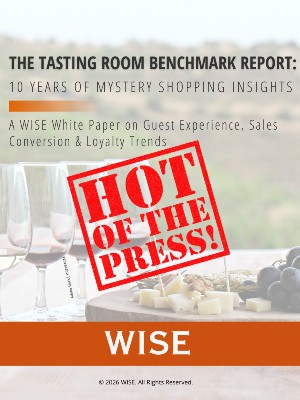 As wineries navigate softer tasting room traffic, rising costs, and heightened pressure on Direct-to-Consumer performance, a new white paper from WISE underscores a critical industry truth: sustainable DTC growth is driven less by volume and more by consistent execution inside the tasting room.
The report, The Tasting Room Benchmark Report: 10 Years of Mystery Shopping Insights, draws on more than a decade of WISE Mystery Shopping data, analyzing 6,000+ real guest experiences across U.S. regions, winery sizes, and business models. The findings point to a persistent gap between strong hospitality and the behaviors that most directly influence revenue, loyalty, and lifetime value.
WISE Mystery Shopping evaluates tasting room performance using a consistent, behavior-based framework that measures both hospitality and sales skills across more than 80 observable criteria. These insights roll up into overall guest satisfaction and three actions proven to drive results: asking for the sale, presenting the wine club with relevance, and capturing guest contact data. Collectively known as the WISE Triple Score, these behaviors represent the measurable link between hospitality and long-term DTC success. While most teams excel at creating welcoming experiences, the data shows these high-impact actions are often uneven or overlooked.
“Mystery shopping has evolved significantly over the past decade,” said Jennifer Warrington, Partner at WISE and Operations Manager for the Mystery Shopping initiative since its inception in 2012. “What began as a simple feedback tool has become one of the most effective ways for wineries to understand how their training, culture, and leadership show up in real guest interactions. The most successful wineries use this data not to critique their teams, but to coach them.”
According to the white paper, wineries that treat mystery shopping as a development and accountability tool, rather than a compliance exercise, see measurable improvements in average order value, club sign-ups, close rates, and post-visit engagement. The most consistent gains occur when results are shared transparently with teams and paired with ongoing coaching.
The research also reinforces a key industry insight: guest satisfaction alone does not guarantee financial performance. The wineries that outperform, even in challenging conditions, are those that intentionally connect hospitality to sales behaviors and follow-up, embedding these practices into daily operations rather than relying on individual talent or intuition.
“Winery metrics tell you what is happening, but mystery shopping helps explain why. This data gives leaders a shared language,” Warrington added. “It helps managers move from instinct to insight, and from anecdotal feedback to actionable coaching. It helps keep teams focused on continuous improvement.”
The full white paper outlines foundational hospitality behaviors, tactical execution strategies, and benchmarking insights drawn from a decade of real-world observations, offering winery leaders a clear framework for turning everyday guest interactions into long-term business results.
The white paper is available at wineindustrysaleseducation.com.
December 2, 2025
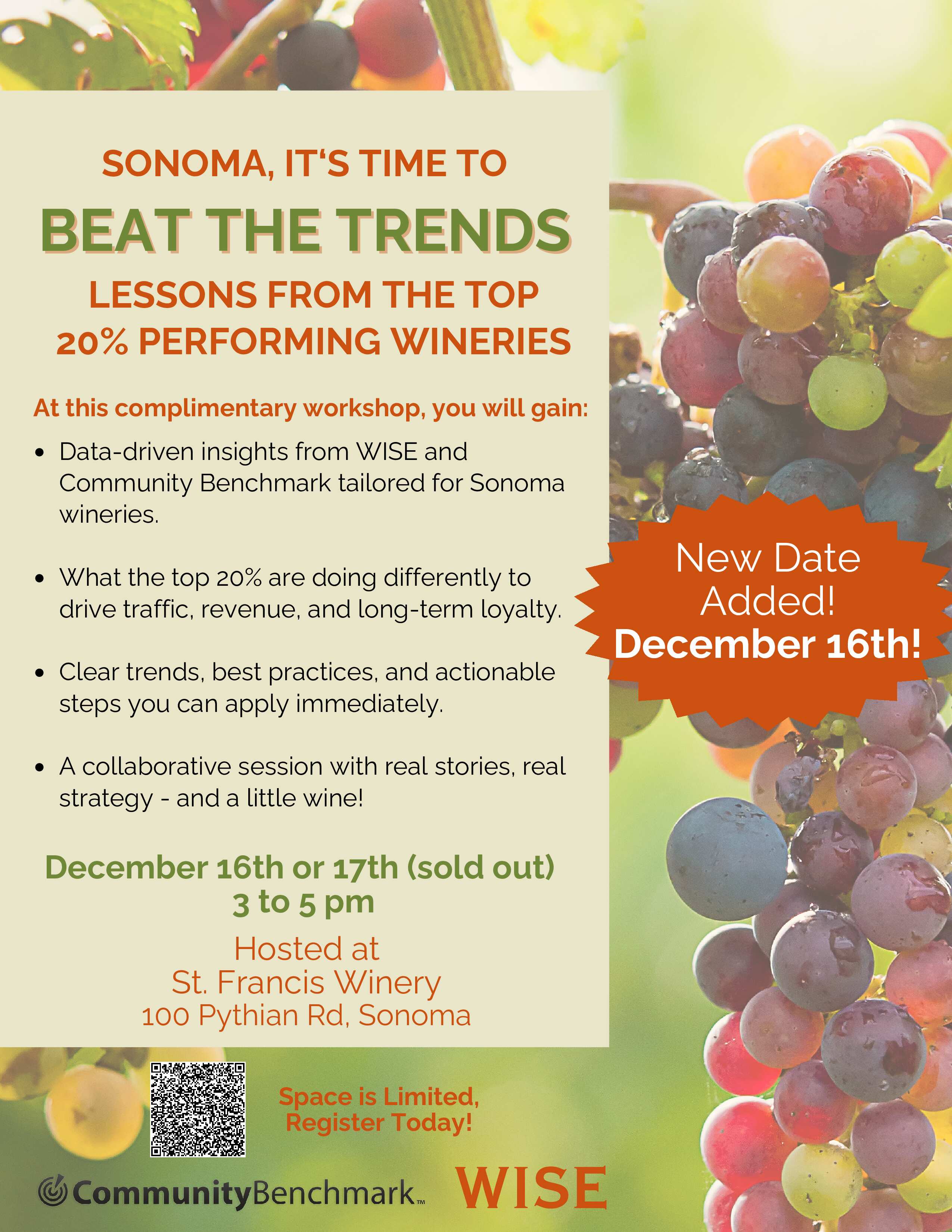
Beat the Trends: Lessons from the Top 20% of Wineries for All Sonoma WineriesSonoma wineries and tasting rooms are navigating a challenging year - softening visitation across the county paired with rising pressure to sustain revenue, club performance, and long-term guest engagement. And yet, across Community Benchmark’s dataset, the top 20% performing wineries are doing more than adapting… they’re excelling.
So what are these leaders doing that others aren’t?
Join WISE Chairman Lesley Berglund and Community Benchmark Founder John Keleher for a complimentary, interactive, data-driven session built specifically for Sonoma wineries. We’ll spotlight the behaviors, strategies, and decisions that set top performers apart - whether they’re growing qualified traffic, generating more revenue beyond the tasting room, or strengthening loyalty in ways that directly impact the bottom line.
You’ll gain a clear, practical breakdown of the trends that matter most, the best practices emerging from the top 20% performing wineries, and the actionable moves you can take to apply these lessons at your own winery - so you can beat the trends, not just ride them out.
If you want real data, real stories from those in the trenches, and real strategies that work in today’s shifting environment, this session is for you.
Come learn, share, strategize… and sip. Bring a bottle and join the conversation. Register here.
December 1, 2025
Win the Follow-Up: Reinventing Guest Check-In for Today’s DTC Challenges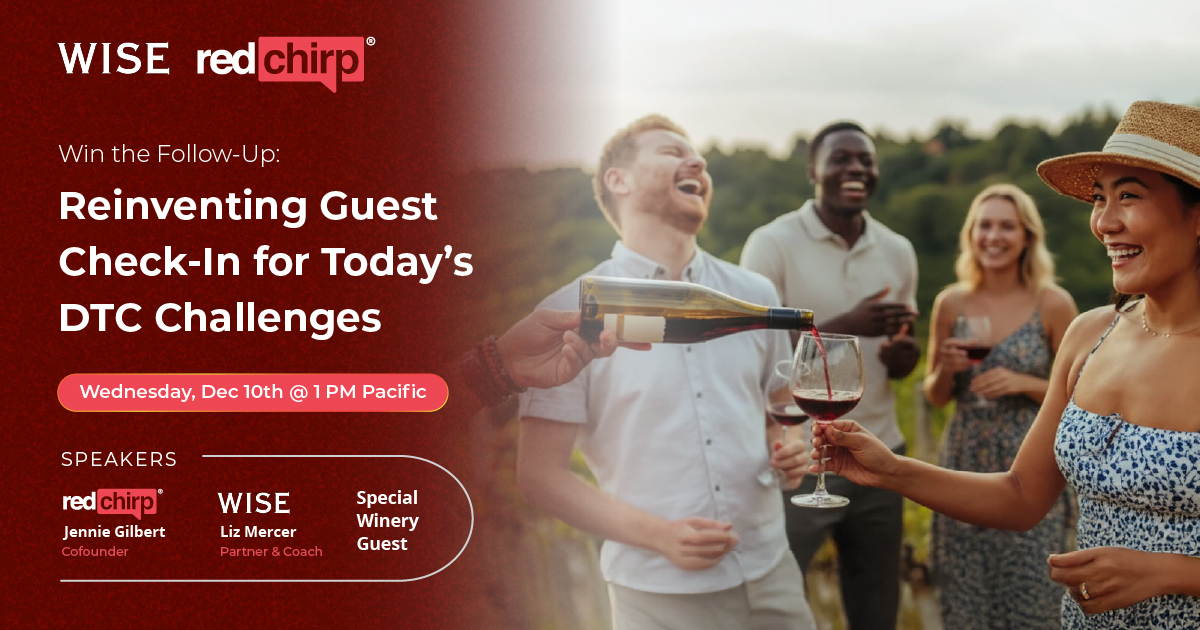
Join WISE Partner Liz Mercer, RedChirp Cofounder Jennie Gilbert, and a special winery guest for a forward-looking session on one of the biggest challenges in DTC wine sales: capturing guest information and consent. In-person tastings are among the richest — but often the most underutilized — sources of customer data, and wineries need fresh tools and strategies to grow their lists, stay connected after guests leave, and drive incremental revenue in today’s challenging landscape.
We’ll introduce an innovative new approach featuring customizable guest check-in forms, seamless integrations, and thoughtful opt-in processes that helps wineries collect actionable data from more visitors while maintaining a great guest experience. You’ll leave with practical guidance on implementation, staff adoption, creative incentives, and goal tracking, giving you a powerful new approach to grow your lists and revenue.
October 30, 2025
Beyond Discounts: How Loyalty Points Drive Customer Retention for Wineries
For years, discounting has been the default lever wineries pull to spark sales and reward loyal customers. But in today’s crowded marketplace, deep discounts can erode brand value and condition customers to buy only when the price drops.
There’s a better way: loyalty points programs. Retention, without discounting, comes from making customers feel known, valued, and part of something special. They’ll stay not because it’s cheaper, but because it’s theirs. Instead of discounting away margin, wineries can encourage repeat visits and purchases by offering rewards that feel aspirational, personalized, and memorable. Loyalty points add up over time, giving guests a reason to come back again and again, all the while protecting your brand’s premium image.
10 Reasons Why Loyalty Points Work
- Shift from price to experience. Points reward frequency and engagement, not bargain hunting. The program should reinforce experience, access, and emotional loyalty, not just transactions.
- Encourage long-term relationships. Customers with points in their “bank” are more likely to return to redeem them.
- Create exclusivity and surprise. Points can unlock experiences money can’t buy, deepening emotional connection.
- Protect your margins. Unlike blanket discounts, points give you flexibility – you decide what’s redeemable.
- Loyalty points = engagement currency. When we use points to encourage engagement, guests can earn beyond purchases, redeem for things that inspire (not discounts) and people love seeing their points add up.
- Tiered programs = status, not discounts. We see examples all the time with the airline and hotel industries. It’s about recognition and privilege, so guests don’t leave because they don’t want to lose their status.
- Complement, not complex. Loyalty programs that complement memberships can add flexibility and a sense of choice, but too many choices can cause analysis paralysis. Loyalty is about connection, not fine print.
- On-Ramp for Non-Members. Loyalty points keep casual guests engaged, giving them a reason to come back even if they’re not ready for a club commitment.
- Insights That Drive Retention. Points activity provides wineries with rich data to personalize outreach and strengthen relationships.
- Tell the Brand Story. A loyalty program with winery-specific naming and experiences feels authentic, not generic, and strengthens emotional bonds. This is a time to have fun!
Technology Enables Loyalty
The good news? Technology makes loyalty programs easier than ever to manage; it makes a loyalty program seamless, sticky, and scalable. Many winery POS and CRM systems (read more here) now offer built-in tracking, reporting, and simple redemption tools. Plus, loyalty points are treated as a deferred expense (not an immediate discount, a ‘promise’ of future value owed to the customer), giving accounting teams more flexibility and protecting your bottom line. Until redeemed or expired, they usually sit on the balance sheet as a liability.
Accounting Considerations: Check with a CPA.
We consulted with Geni Whitehouse of BDCo for the ground rules of loyalty points. Of course, please consult with your own CPA before implementing. In general, when a winery issues loyalty points, it’s making a promise to the customer: “You can use these points for wine, events, or experiences later.” From an accounting standpoint, that promise creates a future obligation – similar to a gift card or store credit.
Here’s the basic flow:
- When points are earned:
• Don’t treat them as an immediate discount (which lowers revenue on the spot).
• Instead, record them as a liability (a balance sheet item), because you owe the customer something in the future.
Example: A customer spends $100 and earns 10 points (worth $10 in rewards).
• Record $90 in revenue.
• Record $10 as a liability (“loyalty program liability”). - When points are redeemed:
• Reduce the liability by the value of points used
• At the same time, recognize that portion of revenue as redeemed.
• Record COGS for whatever was redeemed (wine, tasting, event).
Example: The same customer redeems their 10 points for $10 off wine.
• Reduce the liability by $10.
• Recognize $10 of deferred revenue from the balance sheet to match the redemption. - When points expire (if applicable):
• If your program has an expiration policy and points lapse, you can clear the liability and recognize it as “revenue” (essentially,
revenue you no longer owe).
Why This Matters for Wineries
- Protects margins: Not all customers redeem the loyalty points.
- Smoother financials and better forecasting: Recording points as a liability spreads the impact over time. This gives leadership a clearer picture of true revenue performance. You’ll know what’s “out there” in outstanding obligations, just like you would with gift cards. The data informs staffing (hospitality), production (small-lot allocations), and marketing spend. Without proper accounting, you lose the visibility that makes these insights trustworthy for planning and forecasting
- Unique reason to engage: When a guest accumulates points, it becomes a perfect reason to reach out and invite them back to the winery and bring a friend to ‘spend’ their points. If you have a robust gifting program, this allows the purchaser to redeem points for wine or experiences that they can enjoy, strengthening customer relationships.
The key takeaway: Loyalty points aren’t a ‘sunk’ cost on day one. They are a deferred obligation. This means they preserve your revenue until customers actually redeem them, and often, a portion never gets redeemed at all.
Key Takeaways for Wineries
- Think experiences, not discounts. Make rewards aspirational like exclusive tastings, behind-the-scenes access, or unique bottles that reinforce your brand.
- Keep it simple. Easy tracking and redemption encourage adoption and keep staff/guests engaged.
- Offer meaningful choice. Let customers use points for wine, experiences, or merchandise – people love options.
- Tie it to your story. Rewards should reflect your winery’s unique identity.
- Plan for Technology and Accounting. It is not as complicated as it may seem, but it is worth it to check with your technology and accounting professionals before implementing new programs.
In a market where consumers are tightening their wallets, loyalty points programs offer a smart, brand-protecting alternative to deep discounting. They build lasting relationships, create excitement, and give guests one more reason to choose your winery—again and again.
Winery Examples Leading the Way
- Domaine Serene (Oregon): Rewards include merchandise, exclusive dinners, and overnight accommodations at their Oregon winery as well as at their Chateau in Burgundy.
- Jordan Vineyard & Winery (Sonoma): Guests redeem points for private food-and-wine pairing tables, overnight stays in estate suites, or elegant dinner parties. High-value rewards that keep guests engaged.
- Ruby Hill Winery (Livermore): Their “Grape Rewards” program makes it simple, points go toward wine, events, or merchandise of the member’s choosing.
- Broken Earth Winery (Paso Robles): Loyalty points add an exclusivity factor with access to perks and events.
- Gloria Ferrer (Sonoma): Points unlock elevated sparkling wine tastings in a private lounge. Earn experiential rewards that feel luxe.
- Donelan Wines (Santa Rosa): Points create tiers: special shipping pricing that is earned after the 24th bottle purchase.
Beyond wineries, wine focused retailers show innovative programs show how widespread this strategy is:
- Cooper’s Hawk Winery & Restaurants (multiple states): Points scale into trips and dinners, encouraging repeat dining.
- Vino Volo (Airport wine bars): Points mean instant gratification for travelers, discounted tastings and unique gifts. We at WISE spend a lot of time in airports, and we LOVE this program!
Outside the Wine World: Proof It Works
- Starbucks Rewards: Up to 50% of sales come from loyalty members, driven by stars redeemable for drinks and food. Furthermore, these members spend 2.5 to 3X MORE than non members. (Source)
- Sephora’s Beauty Insider: Customers earn points toward exclusive products and experiences, driving both retention and upsell. The majority of their income comes from their tiered members, with Ulta reporting up to 95% of their revenue is from loyalty members. (Source)
These industries prove the point: customers will go out of their way to stay loyal if they see value beyond a price cut.