This year has been a little weird. We got a lot of rain and up until recently it’s been markedly cold. How different is it though? One thing I like to keep in mind is that the last few years have been hot and early. Perhaps this is just a normal year and we’ve forgotten what normal looks like.
Although there’s been some argument about its importance, the Winkler Growing Degree Day formula allows us to compare different seasons using the same metric. Growing Degree Days (GDD) are calculated by subtracting the grapevines’ threshold temperature (50°F) from the daily mean temperature. The chart below compares growing degree days from 2014 to July 25, 2023 (today) in Alexander Valley, Sonoma County (Data from Western Weather Group).
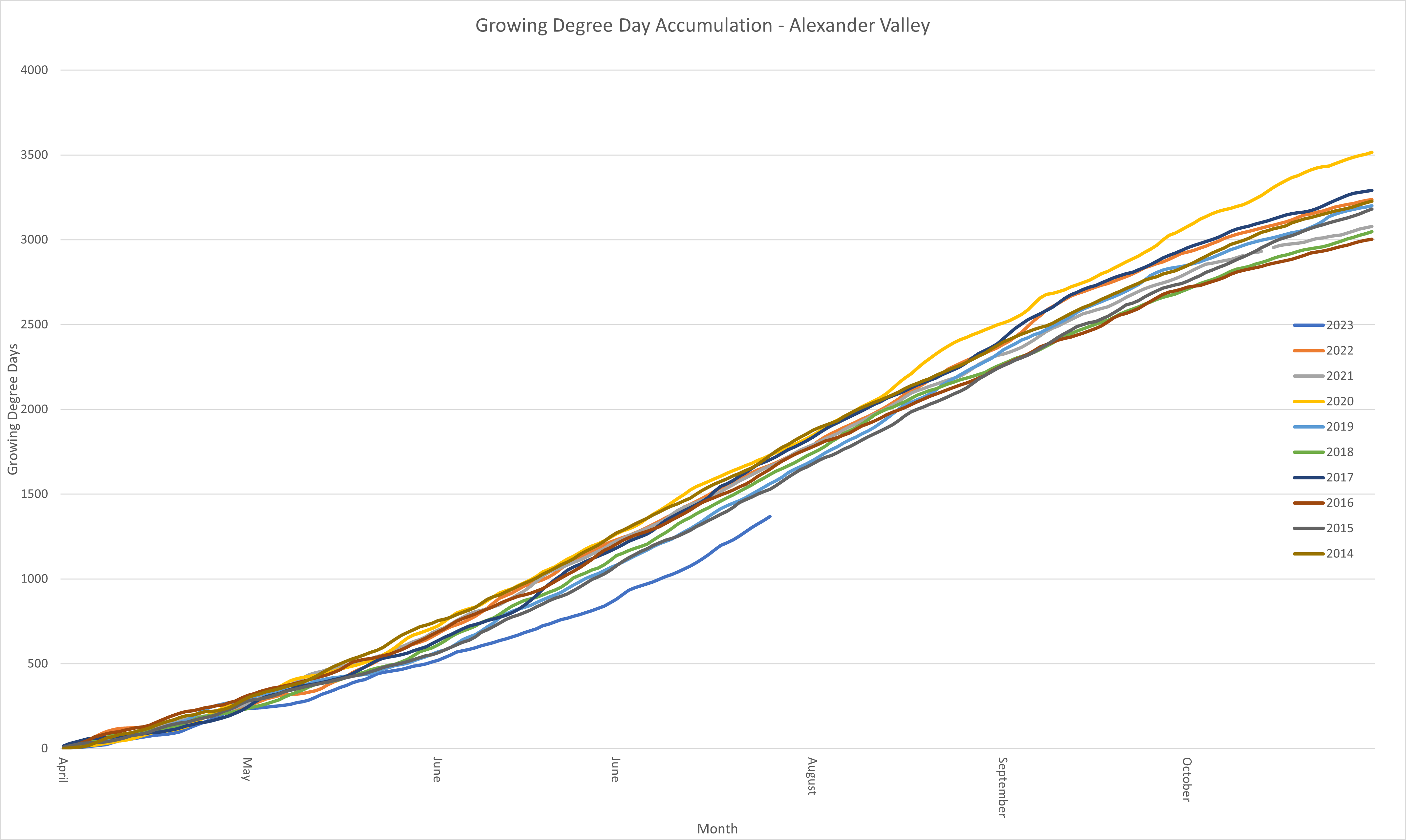
That’s pretty different. The average GDDs at this point in the season for the last nine years is about 1650. Currently we are at 1368.
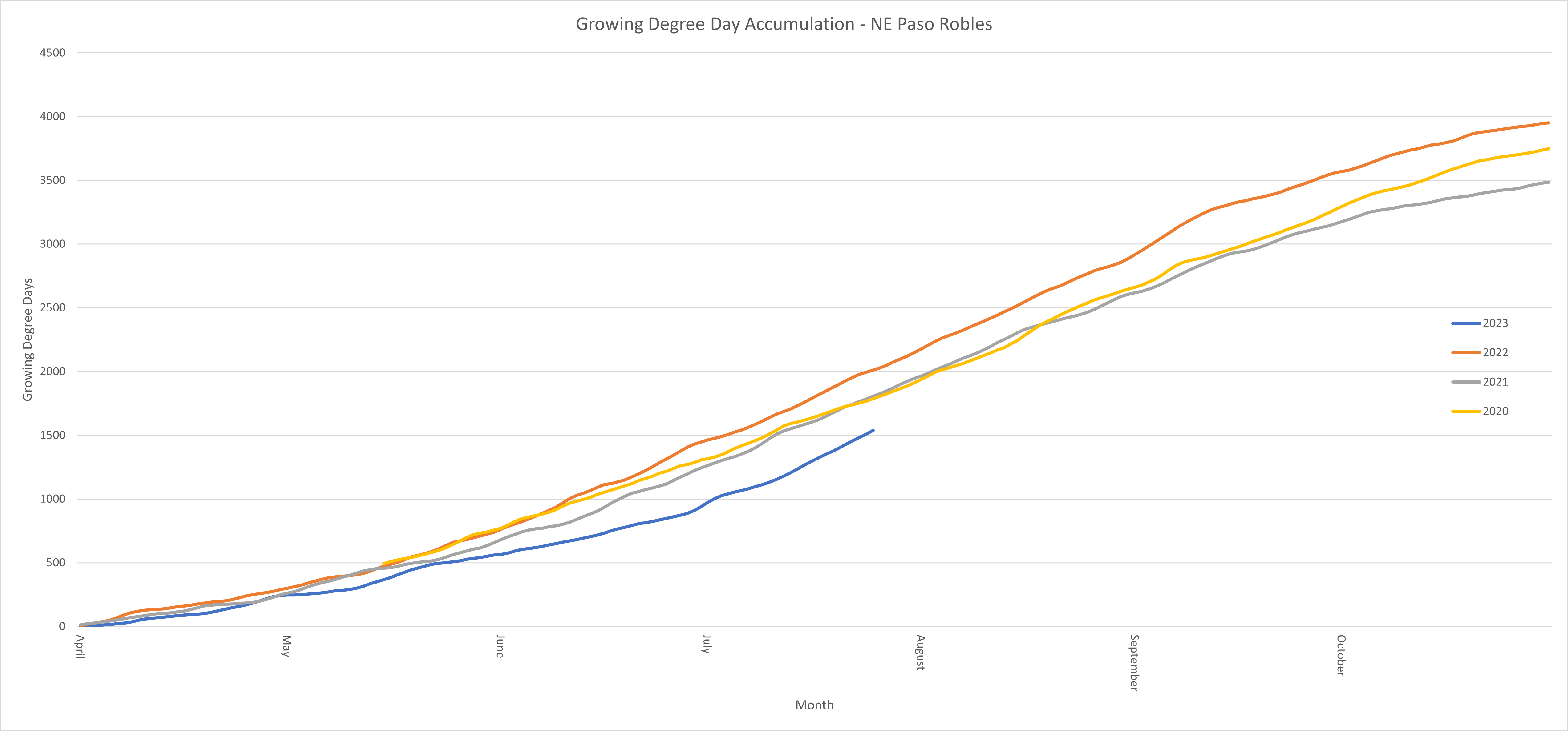
What about in other parts of the state? Here’s a comparison of the last few years in Paso Robles. Granted we don’t have as much data here, but 2023 is still looking behind everything in recent history. As of today this season clocks in at 1540 GDD, while the average for the three previous years is 1870 (Data from Western Weather Group).
What are some of the challenges facing growers in a cold and late year?
Ready, set, no!
One of the main reasons for poor set is early water stress. Thanks to the deluge we got this winter, that wasn’t a big problem. Compared to previous years, canopy growth has been stellar and growth has been relatively even. If your vineyard struggles to fill out the trellis on a non-biblical year, you may be experiencing good or even great fruit set. Congrats.
Where fruit set was bad, it was gnarly. Differences in set this year have illuminated the subtle variations in microclimate. Some vineyards have lost over 50% due to shatter, with colder areas being hit the hardest. And places that sometimes get millerandage (hens and chicks), got it this year.
Fruit set depends on seed development. And seed development depends on a lot of factors. Many of the enzymes responsible for catalyzing the reactions involved in pollen tube formation, fertilization of the gametes, and cell division are functioning optimally between 20-30°C (68-86°). These processes are significantly slowed below 15°C (59°) (Keller, 2020). Some vineyards experienced much colder temperatures this spring.
The cold weather also meant that bloom was extended over a long period of time. If you got a nasty drop in temperature right when a particular vineyard or a particular block was going through bloom, you likely had poor set.
Humidity was also high this spring, and that caused the calyptra or cap to stick to the developing berry. This also limited fertilization as the female gametes were essentially sealed off from the pollen provided by the surrounding anthers. We saw a lot of stuck caps this year and the resulting shatter seems to be variety specific. Syrah for instance recovered in many cases. Pinot Noir did not.
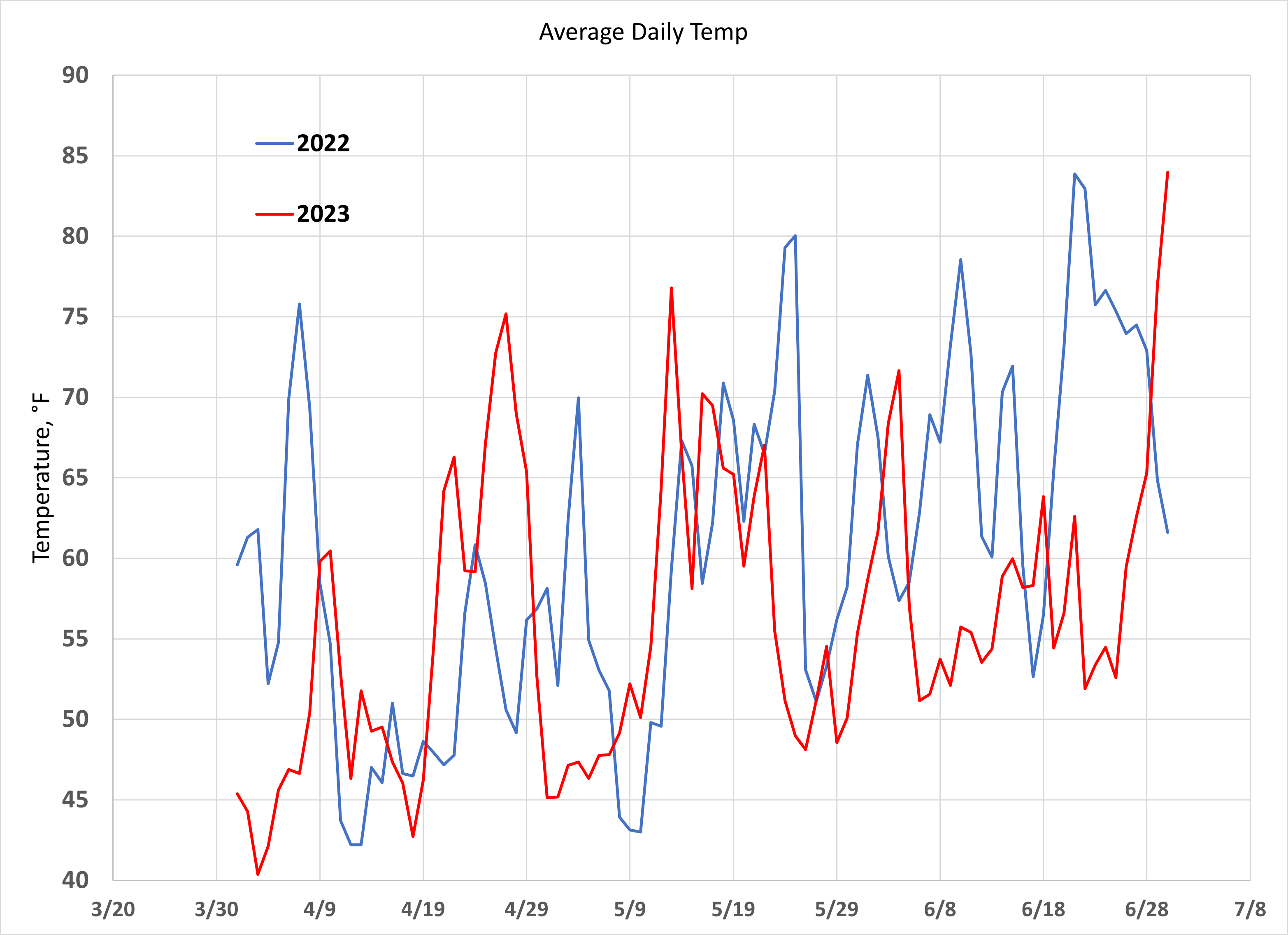
Average temperature in general was cold this year. Unfortunately for this north coast grower, bloom landed right when temperatures took a dive. Shatter here was considerable.
Click here to read the full article.
Mark Greenspan is famous
Tune into episode 24 of the Vineyard Underground to hear AV's Mark Greenspan chat about water, nutrition, and more!
Episode Links:
Episode web page - https://www.vineyardundergroundpodcast.com/vu024/
Apple Podcast – https://podcasts.apple.com/us/podcast/innovations-for-scheduling-irrigation-with-mark/id1648761941?i=1000622243036