
Efficient irrigation starts with understanding exactly how much water your crop is using and how much it really needs. That’s where evapotranspiration (ET) comes in: the combined loss of water through evaporation (from soil and surface) and transpiration (used by the crop). By matching irrigation to ET, growers can reduce waste, improve yields, and make smarter use of limited water resources. With SGMA (the Sustainable Groundwater Management Act) now in full effect across California, it is more important than ever that growers irrigate with precision and are able to prove it with efficient record keeping.
If you’ve ever asked yourself: “How much of my irrigation is actually reaching the root zone?” You’re not alone. This article breaks down how soil moisture monitoring and real-time irrigation control using HotSpot AG tools can give you clear, actionable answers.
Monitoring Soil Moisture and Irrigation
While evapotranspiration (ET) tells you how much water your crop is using, soil moisture sensors reveals in real time what’s actually available in the root zone. Without this data, irrigation decisions are based on guesswork, which can lead to water stress, disease, pests, or runoff. With the technological advancements in agriculture, growers are able to utilize monitoring solutions to view data remotely from a phone, tablet, or computer. As with HotSpot AG, growers are able to utilize real-time monitoring and control tools to apply the right amount of water at the right time. These systems empower labor to focus on high value tasks, cut energy costs, and enable fast responses to shifting weather or crop conditions.
Beyond day-to-day decisions, it’s necessary to record historical irrigation data. This data is essential for improving future strategies, forecasting yields, and maintaining compliance with water use regulations. Without ag tech like HotSpot AG, this level of tracking would be time-consuming, meticulous, and difficult to manage.
How HotSpot AG Supports Smart Irrigation
Identifying soil moisture trends is only the beginning when it comes to effective irrigation management. Equipping your operations with the necessary tools to act on recorded data is what drives real results. HotSpot AG simplifies the process with intuitive monitoring and irrigation controls, allowing growers to integrate soil moisture and water use data into a customized irrigation schedule.
Below you will find three chart examples comparing soil moisture to irrigation records and what those patterns can tell us.
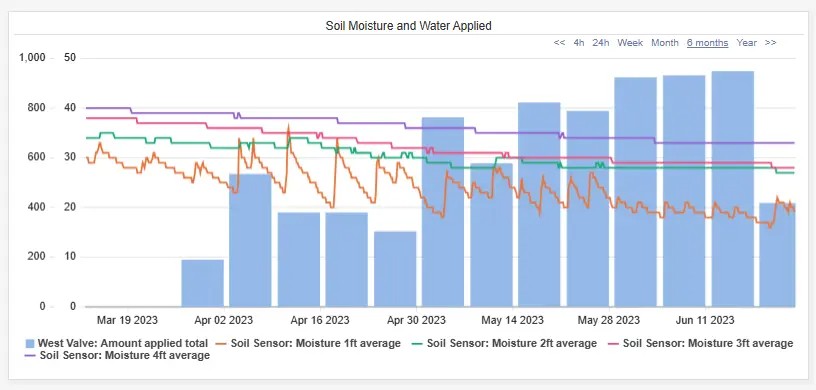
Example 1: Data from the soil sensors placed at 12”, 24”, 36”, and 48”, indicate a gradual drop in soil moisture over the course of several months with an increase in total applied water. This is a healthy indication of plant growth and increased transpiration. Because the soil moisture data does not indicate soil saturation, the grower is confident in knowing that the added irrigation amount is not being wasted.
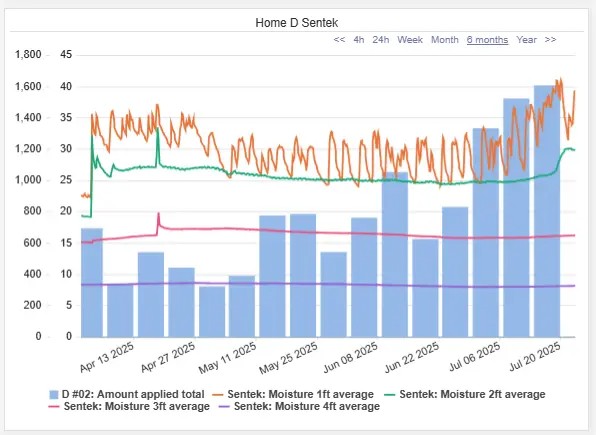
Example 2: This example highlights refilling the soil profile in a 9-year-old pistachio orchard. From May through July 1st, the block followed a Regulated Deficit Irrigation (RDI) approach, applying 60% of ETc to manage early-season growth. As the crop approached nut fill, a critical stage for yield, the agronomist intentionally increased irrigation.
Soil moisture data showed a clear response at the 12” and 24” depths, confirming that the additional water was reaching the active root zone. This approach ensured the trees had access to adequate moisture during a high-demand period, while still maintaining efficient water use earlier in the season.
Example 3: Here, the grower is able to achieve fairly consistent field saturation by tailoring irrigation applications throughout the beginning of the season. The top 12” decreases from mid May to early June as soil surface temperatures rise and stabilize with increased irrigation.
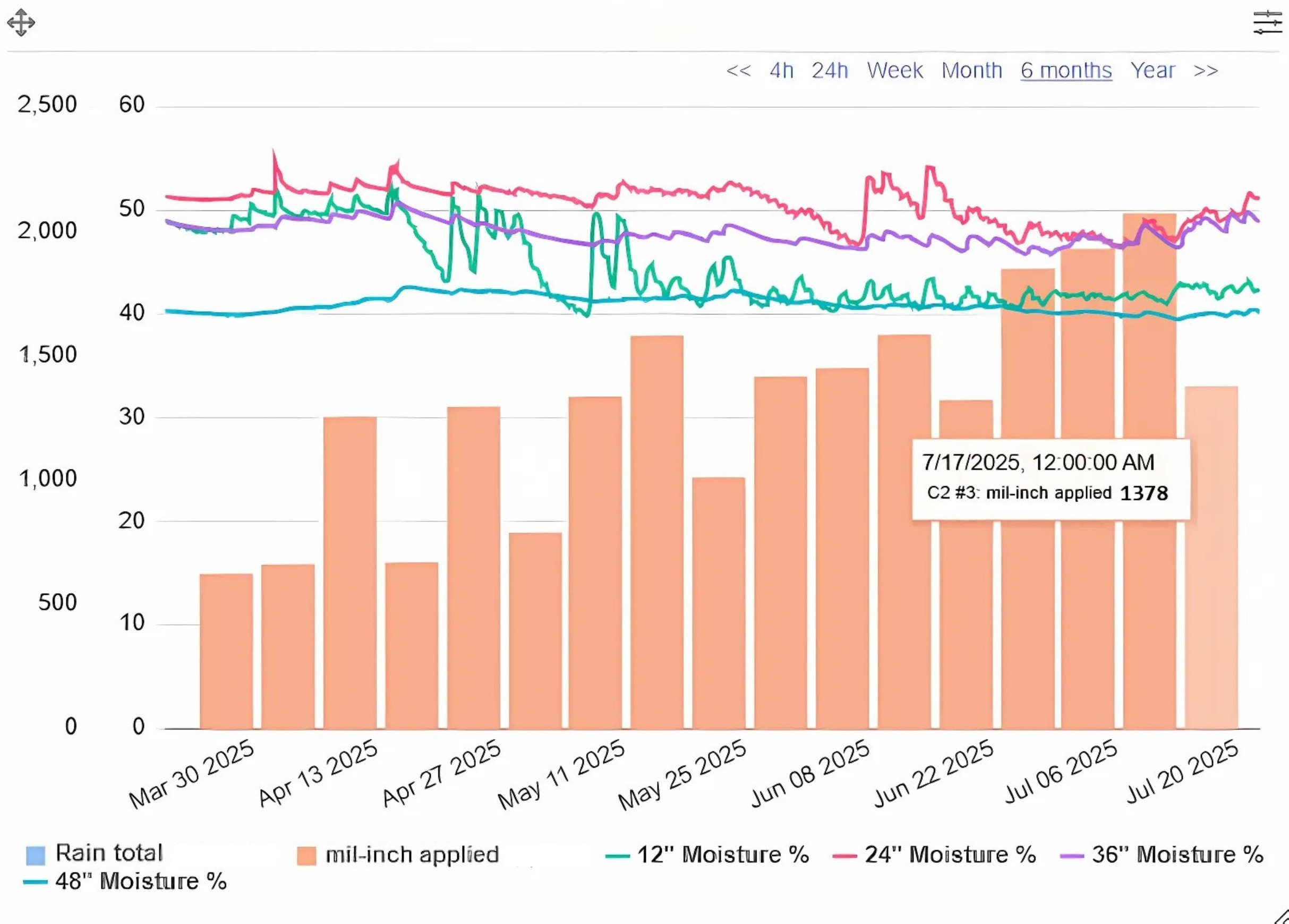
By analyzing historical soil moisture trends alongside past irrigation events, growers gain a clearer understanding of how their crops have responded to water applications over time. This allows them to dial in current irrigation strategies based on what has worked under similar conditions, rather than relying on assumptions or trial-and-error. It becomes significantly easier to justify seasonal investments in irrigation infrastructure, labor, or scheduling when the data directly supports how those choices impact yield, water efficiency, and return on investment.
Uncovering the Cost of Soil Moisture Monitoring
At HotSpot AG, we believe that data-driven irrigation should be both accessible and scalable. Whether you’re looking to monitor a single zone or an entire operation, our soil moisture monitoring packages are built to match the unique needs of each grower
We offer flexible options, such as the 36″ Sentek Drill and Drop Soil Moisture Sensor for $1,400 and the 48″ version for $1,700. For added precision, drip line pressure sensors can be integrated for $290 to measure actual water applied.
HotSpot’s soil monitoring solutions are supported by our TAC-Box, with installations starting at $2,499. Final pricing is determined following a site evaluation to ensure the system is tailored to your farm. Our goal is to deliver practical, cost-effective solutions that generate real returns through improved water efficiency, labor savings, and stronger crop performance.
AgTech solutions such as HotSpot AG can turn sensor data and irrigation logs into actionable insights. By tracking your trends and irrigation records, the grower can see whether their irrigation schedule is keeping up with ET. With a system like HotSpot that can unify data on all fronts, growers can manage water with more efficiency, reduce labor and energy costs, and improve crop performance simply and with confidence.
Ready to maximize your irrigation efficiency? HotSpot AG makes it easy to integrate soil moisture and irrigation data, helping you make smarter water decisions and keep pace with ET. Get a customized, no-obligation estimate today.
Want to see your potential ROI?
Use our complete ROI Calculator to estimate savings on water, energy, and labor — and see what data-driven irrigation can do for your operation.