
AI is changing how customers discover, research, and buy wine online — and that means your website strategy needs to change with it.
We’re moving beyond the days of traditional, keyword-heavy SEO. Today’s search landscape is driven by generative AI — platforms like ChatGPT, Perplexity, Bing Copilot, and Google’s AI Overviews — which don’t just show links. They summarize information, cite sources, and even recommend brands directly in the search results.
For wineries, that means success is no longer just about ranking on page one. It’s about becoming the trusted source these AI systems quote, reference, and build their answers from.
Here are five practical ways to make sure your winery’s site is ready for the AI era — and positioned to be discovered, cited, and recommended.
1. Make Sure AI Can Access and Understand Your Website
AI visibility starts with technical accessibility. If AI crawlers can’t reach or interpret your pages, they can’t include you in their answers — no matter how great your content is.
Start by checking that essential files like robots.txt and meta-robots tags allow known AI crawlers — such as GPTBot, Claude-Web, and CCBot — to index relevant sections of your site. Some companies are even using a new file called llms.txt, which works like robots.txt but gives large language models specific instructions on which pages to use for training or citation.
Also, make sure your canonical tags and redirect structures are properly configured so AI systems see the correct version of each page. And if important content is hidden behind login screens, paywalls, or JavaScript-only rendering, consider providing server-rendered versions or pre-rendered snapshots. Most AI crawlers can’t log in or execute complex scripts.
Finally, test your visibility directly. Search for your wine club page or tasting room info on AI platforms. If your site never appears as a cited source, accessibility may be the issue — and that’s the first thing to fix.
🍷 Corksy Tip: With Corksy’s website tools, you don’t have to stress about technical setup. We automatically generate crawler-friendly files like robots.txt and llms.txt, use server-side rendering to make your pages easier for AI to read, and ensure your site architecture is optimized right out of the box — something most DIY builders don’t handle well.
2. Structure Your Content for AI (and Humans)
Once AI can crawl your site, the next step is making sure it understands what it’s reading. Large language models rely on structure, hierarchy, and semantics to decide which information is trustworthy and relevant.
That means your content needs to be organized clearly. Use strong heading hierarchies, clear introductions, and concise summaries. Put a brief, direct answer near the top of every page or section — AI systems love definitive statements they can quote.
Breaking content into short paragraphs with clear subheadings also helps. And don’t forget structured data: adding schema markup (like Article, FAQPage, or HowTo) tells AI exactly what a page is about. Internal links between related topics strengthen your site’s authority and context, and regularly updating your content with timestamps signals freshness — another ranking factor for AI.
These adjustments don’t require rewriting your entire site. A few structural improvements can dramatically increase the odds of your content being cited.
🍷 Tip: With Corksy, your website automatically includes many types of schema markup — from product pages to events and blog posts — without you having to write a single line of code. That gives AI the context it needs to trust and surface your content, putting you ahead of wineries still relying on outdated site structures.
3. Build Credibility With Transparency and Data
AI systems prefer trustworthy, verifiable information — and that means credibility matters more than ever.
Start by backing up your claims with real data and citing reputable sources. Instead of writing, “wine club members are more loyal,” say, “According to WineBusiness.com, wine club members spend 2.5x more per year than non-members.” Specific, sourced statements like this are more likely to be quoted by AI.
Adding author bios, including your winemaker’s credentials or your team’s experience, also builds authority. Referencing respected organizations — even indirectly — helps AI connect your content to known knowledge graphs. And don’t underestimate the power of digital PR: features, interviews, and guest articles on external sites all strengthen your authority signal.
Finally, transparency counts. Note when your data was last updated, how you collected it, or the sample size behind any insights. In AI-driven search, credibility and verifiability are the new ranking currency — just as Google’s familiar E-E-A-T (Experience, Expertise, Authoritativeness, Trustworthiness) principles suggest.
🍷 Tip: Your website is only as powerful as the story it tells. Corksy makes it easy to showcase your credibility — from adding winemaker bios and sourcing notes to embedding press mentions and reviews — helping AI understand why your winery is a trusted authority worth recommending.
4. Write for AI Query Patterns — Not Just Keywords
AI search doesn’t work like Google did 10 years ago. It doesn’t just match keywords — it interprets intent and natural language.
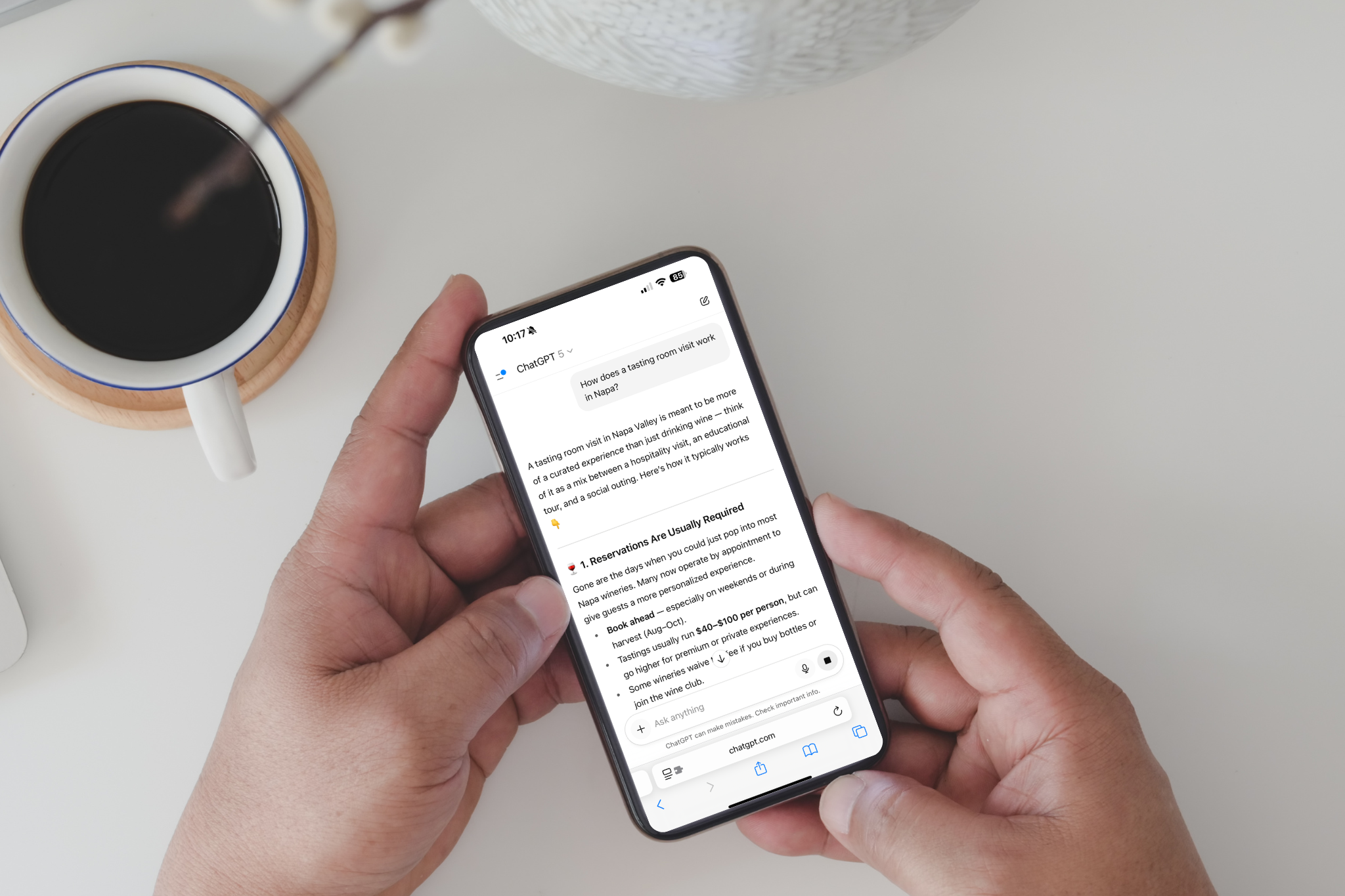
To align with that, start studying how people phrase questions in AI chat tools. Run prompts like “What’s the best wine club in Virginia?” or “How does a tasting room visit work?” and see which phrasing gets the best results. Then, use those conversational patterns in your headings and copy.
Framing your page titles as direct questions (“How does a wine subscription work?”) and answering them clearly helps AI recognize your content as relevant. Cover related follow-up questions too — AI tools prefer pages that address a full topic cluster rather than just one angle.
And instead of repeating the same keyword over and over, use natural variations and synonyms. AI understands context, so variety builds stronger topical authority.
🍷 Tip: Corksy gives you complete control over your site’s content — so you can easily update headlines, page copy, and CTAs to reflect conversational search trends. Combined with our built-in SEO tools, it’s simple to stay aligned with how people are actually asking questions today.
5. Measure AI Visibility — and Keep Iterating
Optimizing for AI isn’t a one-and-done project. Like wine itself, it’s a process that gets better with time — and feedback.
Track when and where your content shows up in AI results. Tools like Semrush’s AI suite can help monitor citations across platforms like Google AI Overviews, Bing Copilot, and Perplexity. You can also manually test prompts and record when your winery is mentioned.
Watch for indirect signals, too. If more people start searching your winery name or wine club by brand, it’s often because AI is citing you. And remember — even if total traffic dips due to zero-click results, the visitors you do get are often more qualified. Track metrics like time on page, scroll depth, and conversions, not just raw clicks.
Finally, refresh older content regularly. Update stats, refine messaging, add new examples — and keep testing new approaches. The goal is steady improvement, not a one-time fix.
🍷 Tip: With Corksy, you can quickly update and publish content as often as you need — no developer required. That means you can iterate in real time, respond to changing AI trends, and keep your website fresh and competitive all year long.
The New Goal: Be Referenced, Not Just Ranked
AI search is already reshaping how people discover and trust information — and it’s only accelerating. Google’s AI Overviews now appear in more than half of all search results, and the company is building an AI-only search mode that prioritizes summarized answers over traditional links.
For wineries, this means that simply ranking isn’t enough anymore. Your content needs to be accessible, understandable, and authoritative enough to be used by AI systems — not just seen by them.
By focusing on five key areas — technical accessibility, structured content, credibility, conversational language, and ongoing iteration — you can ensure your winery is visible, trusted, and recommended in the AI era.
💡 Want to know how your site stacks up? Get a free website audit here and uncover opportunities to improve visibility, engagement, and sales.
If you want to dive deeper into common winery website errors and how to fix them, check out our recent AI-Ready Winery Webinar where we explored the biggest pitfalls and opportunities we’re seeing across the industry.