

American AgCredit

4845 Old Redwood Highway, Santa Rosa, CA, United States of America, 95403

March 1, 2026

The 2014 Farm Bill: What it Means for Agriculture

As the premier provider of financial services to agriculture and agribusiness, American AgCredit has been an important partner for area farmers and ranchers, wineries, vineyards, dairies and others. With this in mind, the Santa Rosa-based Farm Credit Association carefully watched and monitored the passing of the Agricultural Act of 2014, which was o cially signed by Congress on February 7, 2014.

The 2014 Farm Bill makes major changes in commodity programs, adds new crop insurance options, streamlines conservation programs, and expands programs for specialty crops, organic farmers, bioenergy, rural development, and beginning farmers and ranchers. Here are some Farm Bill highlights:

Farm Safety Net:Eliminates direct payments and continues crop insurance. Producers choose between the Price Loss Coverage and Agricultural Risk Coverage. It establishes the Dairy Margin Protection program, restores livestock disaster assistance for losses dating back to 2011, and establishes a permanent livestock disaster program.

Rural Development: Continues USDA Rural Development programs, provides $15 million to support rural business development and growth, provides $150 million for water and waste water infrastructure, and reserves 10% of certain programs for regional, long-term investments.

Trade and Foreign Agriculture: The 2014 Farm Bill maintains $200 million annually for international market development, authorizes up to $80 million for longrange planning and increases exibility for assistance in emergency food aid situations.

Research: Endows $200 million for a foundation for agricultural research and doubles the funding for specialty crop research to $80 million annually.

Renewable Energy and Energy Efficiency: Reauthorizes and provides $880 million for energy programs, expands the Biore nery Assistance Program to include biobased product and renewable chemical manufacturing, and expands the Biopreferred program to include forestry products.

Forestry: Makes Stewardship Contracting Authority permanent, allowing the Forest Service to conduct restoration work and stimulate job growth, and makes the Good Neighbor Authority permanent and available nationwide.

Nutrition: Through its SNAP program, the 2014 Farm Bill provides $100 million to increase fruit and vegetable purchases, provides $250 million in additional funding for emergency food assistance, and authorizes $125 million for the Healthy Food Financing Initiative to make nutritious food more accessible.

Next Generation Farmers and Ranchers: Before the 2014 Farm Bill, the 2008 Farm Bill established the Beginning Farmers and Ranchers Development Program with $75 million for 2009 to 2012. e 2014 Farm Bill now provides $100 million for the Beginning Farmers and Ranchers Development Program, increases access to capital, and supports crop insurance along with other risk management tools including reducing crop insurance premiums during the rst 5 years of farming.

Local and Regional Food Systems: Before the 2014 Farm Bill, the Farmers Market Promotion Program (FMPP) was funded at $10 million annually. The 2014 Farm Bill provides $30 million annually for the “Farmers Market and Local Food Promotion Program”. Funds are also reserved for locallyand regionally focused businesses.

Specialty Crops and Organics: Before the 2014 Farm Bill, the 2008 Farm Bill funded the Specialty Crop Block Grant Program (SCBG) at $52 million annually to promote fruit and vegetable production. The 2008 Farm Bill also provided $55 million to strengthen the nation’s infrastructure for pest detection and threat mitigation, and to safeguard nursery production. The 2014 Farm Bill increases to $72.5 million annually for the specialty crop block grant program, provides new resources for organic farmers, and increases funding for pest and disease management and disaster prevention to $62.5 million per year.

These policy changes, along with the additional funding devoted to farming and ranching, secure agricultural programs into 2018, with many provisions extending beyond that. Future planning for your farm or ranch should take all these changes into consideration. American AgCredit is quali ed and focused on providing the appropriate nancial services and assistance that best bene t your business.

As part of the Farm Credit System, American AgCredit provides nancial services to agricultural and rural customers throughout California, Nevada, Kansas, Oklahoma, Colorado, and Northern New Mexico – as well as to capital markets customers in 30 states. Financial services include production and mortgage nancing, equipment and vehicle leasing, crop and life insurance, lines of credit, and the Young, Beginning and Small farmer program. In addition, the Association provides interest-free loans for qualifying 4-H and FFA Ag Youth programs, and college scholarships. Founded in 1916, the Association is the 7th largest Farm Credit lender in the U.S, and has given back more than $215 million since 2005 to member-borrowers through its cash dividend program. For more information, log on to the website at www.AgLoan.com.

By Mike Flesher & MariaSundeen. First published in the North Bay Business Journal

March 1, 2026

Agriculture Financing: Understanding the Basics of Your Financial Statements

By Clay Popko, Vice President, Vineyard & Winery Group

You may know if your agricultural operation is making money or not, but do you know how profitable it is? For example, how much do you profit per acre of wine grapes? If you are unsure, you may want to utilize a balance sheet, a profit and loss statement (income statement), and a budget to help answer these questions.

THE BALANCE SHEET

The balance sheet is a snapshot of an operation’s financial situation at a specific point in time, and it captures everything owed or owned. Balance sheets comprise assets, liabilities, and net worth (net worth is everything you own minus everything you owe).

Comparing a balance sheet from the beginning of the year to one at the end of the year will show how your business performed during that time period. It is important to note that you should maintain a consistent book value for your assets on the balance sheet rather than using market values, as market values are constantly changing due to market forces outside of your control. 

An example:

On January 1, 2019, you purchase a 20-acre producing vineyard for $3,000,000. Upon the close of escrow, the market value is $3,000,000. At that point, the book value is $3,000,000 as well. This represents your total cumulative costs and expenses of your vineyard investment to that point in time. During the year you sold 100 tons of fruit for $300,000 in gross revenue and had total farm operating expenses of $200,000, posting a gross profit of $100,000. However, let’s also assume 10% appreciation in the value of the land (not unreasonable in today’s environment). So now, although no cash has changed hands, the value of your vineyard has gone up $300,000.

Book Basis

Your net worth is $3,100,000, the initial investment of $3,000,000 plus net income of $100,000. Keep in mind you will now have $100,000 in cash in your operating account.

Market Basis: 

Your net worth is $3,300,000, the current re-sell value of your vineyard, or perhaps $3,400,000 if a buyer insists they get your operating account in an acquisition. Keep in mind that general success of your operation can affect the re-sell value, or market value.  However, buyers of your business will insist on seeing book value results.

THE PROFIT AND LOSS STATEMENT 

A second helpful resource is the profit and loss (P&L) statement, also known as an income statement. This is a running tally of all transactions in a given time period. When paired with the two balance sheets, a year-end P&L statement can be powerful. Profit alone does not necessarily help you understand how cash moves through your operation.

An example:

When you pair your year-end balance sheet with the corresponding P&L statement, you might see that cash has increased more than your profit. This could be an indication that you are managing your accounts receivable more efficiently, i.e. generating cash by collecting your accounts receivable faster. Conversely, inventory growth may be using much of the cash from your profits. Understanding the basics of these financial statements allows you to control how and where money should flow in your operation.

THE BUDGET

Using a budget to plan around income and expenses can provide producers with increased awareness about buying and selling decisions. Producers can know when they need to prepay expenses or hold inventory. A budget can also help producers make decisions on whether or not they want to invest in a new piece of equipment, or if they can afford to buy a neighboring property, for example.  

There are several “template” tools available to make budgeting easier. For example, you may consider using the Schedule F on your previous year’s tax return, which is also specific to your operation. It is also important to remember that the budget is a living document. Tracking income and expenses against your budget is a must, but don’t be afraid to adjust it when needed. New opportunities and obstacles will always pop up.

With a balance sheet, profit and loss statement, and a budget, you can become better prepared to move your operation into the future.

AMERICAN AGCREDIT

Founded in 1916, American AgCredit is part of the nationwide Farm Credit System, and is the nation’s fifth largest Farm Credit cooperative. American AgCredit specializes in providing financial services to agricultural and rural customers throughout California, Nevada, Kansas, Oklahoma, Colorado, and New Mexico – as well as to capital markets customers throughout the country. We offer a broad range of agricultural loan, leasing and insurance services from orchard, timber, row crops, winery and livestock financing to equipment leasing and construction financing.

March 1, 2026

The Agricultural Economy: A look forward for California and the US

By Matt Clark, Senior Industry AnalystAmerican AgCredit 


U.S. farm income contracted somewhat in 2018 according to the most recent United States Department of Agriculture (USDA) update, released Friday, November 30th.  The report indicated that net cash income in 2018 declined 10 percent from the previous year to about $93.4 billion, the lowest net cash income since 2009.  Strikingly, net cash income has declined 38 percent from the recent peak in 2012 when many in the agricultural industry experienced a protracted period of exceptional profit margins.  Only one other time period, the mid-1970s, has sustained a similar decline.

image


The decline in farm income from the previous year was a result of both a decline in gross cash receipts and an increase in production expenses.  For example, gross cash receipts for agriculture fell less than one percent from the previous year.  Direct farm expenses, such as labor, feed, fertilizer, chemical, etc. increased more than two percent.  Other farm expenses also increased slightly adding to the squeeze on profit margins.


However, due to strong balance sheets built during the run-up in farm income, the aggregate U.S. farm sector remains in adequate financial shape though tighter than previous years, by several measures.  First, solvency measures such as debt-to-asset and debt-to-equity ratios, while seeing a modest recent rise, remain well below levels observed in the last farm crisis. For instance, though above the historic lows of the early 2010s, debt-to-equity remains below levels observed from 1962 through 2003, a 41-year period. Second, liquidity measures have tightened, but also remain above the water line.  The USDA essentially reports that the aggregate current ratio remains in positive territory though down significantly from the peak years.  The decline in liquidity likely also explains the slight uptick in debt levels; the USDA has estimated an aggregate debt load increase of less than two percent from a year ago. 


Finally, delinquency rates for non-real estate farm loans also remain historically low. According to the Federal Reserve Bank of Kansas City, the delinquency rate for agricultural loans held at commercial banks currently sits around two percent, up slightly from the valley observed in 2012 though still below recent averages. 

image


California 

In California, the largest contributor to the nation’s cash farm receipts, the outlook is somewhat mixed and depends heavily on region and industry. Areas impacted by fires are understandably expected to experience a step back in farm income.  Drought has also been a factor in several key production areas, with 2018 showing no signs of improvement. In fact, NOAA estimated that from January 2018 to December 2018, California’s acres showing signs of drought increased 48 percent.


In areas unaffected by fire and drought, gross cash receipts expectations vary by specific industry, but in general look to be stable or slightly down from the previous year.  As an example, the USDA estimates gross cash receipts for the dairy industry to be down nine percent from the previous year, but estimates poultry receipts to be seven percent higher.  After several years of strong production, gross receipts for tree fruit and nuts are expected to be slightly lower than the previous year.  Likewise, vegetable gross receipts are expected to be down slightly, though consumption remains stable.


Similar to the broader farm economy, production expenses for California also increased, with the cost of labor particular concern.  In Napa and Sonoma counties, key wine grape production areas, the unemployment rate in 2018 has hovered near 2.5 percent, which are historic lows.  In other large agriculture-centric counties such as Fresno, Madera, Merced and Stanislaus counties, the labor market also tightened.  For example, in October the Bureau of Labor Statistics estimated the unemployment rate in Fresno County was 6.3 percent, down from 2016 and 2017 levels of 9.0 and 7.2 percent, respectively. 


Overall, California agricultural producers faced multiple challenges from fires, drought, trade issues, labor concerns, water rights issues, heightened supply, and more in 2018.  Piecing these parts together, final 2018 profit margins will likely be tighter than the previous year.  However, California farmers and ranchers have proved to be resilient over the years, in part due to the state’s very diverse commodity base. This diversity is expected to continue helping California overcome many of the recent challenges and keep it at the top of the agricultural receipt list for all U.S. states.


About American AgCredit

Founded in 1916, American AgCredit is a cooperative association that provides credit and financial services to rural communities and agriculture throughout California, Colorado, Kansas, New Mexico, Nevada and Oklahoma, as well as to capital markets customers in all 50 states. Our unmatched expertise allows us to provide farmers, ranchers and agribusinesses with the resources and financial solutions they need to be successful.

March 1, 2026

Leasing Can Help Farmers Manage New Tax Laws

While every agricultural operation depends on reliable equipment, the real value of equipment comes from operation – not ownership. Many producers choose leasing as a financing option to help improve efficiency, increase cash flow and lower tax liabilities. Additionally, leasing is a great opportunity to help farmers and agribusinesses manage substantial new changes to the tax law.

For Devonna Smith, CFO at Chappellet Vineyard in St. Helena, the key to remaining successful is to stay focused on long-term goals. “Tax reform laws should not be a driving force behind making changes to the long-term financial plan of the company,” she said. “But obviously the tax rate reduction to 21% will have a positive impact on our cash flow. This has allowed us to move forward with capital projects we had postponed due to cash flow considerations.” Chappellet’s ability to expense what was formally considered capital expenditures has allowed the winery to reevaluate their timing.  “With the new cap on tax deductibility of interest expense, it makes leasing versus borrowing even more appealing.”  American AgCredit and Chappellet have enjoyed a long-term business relationship which has recently expanded to include the leasing of barrels and new solar panels to power their operations.

Farmers and Agribusinesses can use leasing to:

  • Leverage 100% bonus depreciation and increased Section 179 deductions using conditional sale leases to take advantage of deductions as tax owner while preserving your working capital;
  • Enhance planning with steady, annual write-offs of lease payments with true tax leases rather than 100% expense in the first year only;
  • Maximize the value of depreciation of an asset and lock in long-term fixed rates via lower lease rates on true tax leases;
  • Preserve cash, working capital and other credit lines; and,
  • Mitigate net operating losses, which now have various limitations on carry-forwards and carry-backs, by shifting depreciation deductions to the lessor on true taxes leases.

Leasing provides additional advantages including helping farmers and agribusinesses to save money on equipment with special pricing, to pay only for the value of the equipment used, to help win the battle of inflation with fixed rates and no down payments, and to free up capital for income-earning investments.

To learn more about leasing with American AgCredit, contact us at 800-800-4865 or online at AgLoan.com.

The federal tax legislation has wide-ranging implications for many farmers and agribusinesses, and the substantial changes may impact each taxpayer differently. It is important to consult with your tax advisor regarding your individual tax situation. 

March 1, 2026

Lake County Gets Noticed as Quality Cabernet Sauvignon Region

By Vice President for the Vineyard & Winery Group of American AgCredit, Clay Popko. 

Like many in the highly competitive North Coast wine industry, the analysts and lenders at American AgCredit are always searching for information to help us better understand the market and anticipate future trends.

The USDA Grape Crush Report, released on Feb. 9, is one of those key information sources. Here are key data from the report:

  • Napa Valley cabernet sauvignon has hit an all-time high price per ton at $7,421.44 and has increased at an average compound annual growth rate (CAGR) of 7.24 percent from 2010–2017. During this same period of time, Napa Valley cabernet sauvignon total acreage has only increased by an average of 1.21 percent.
  • Sonoma County cab has hit an all-time high price per ton at $3,019.50 and has shown an average CAGR of 5.49 percent. In a similar scenario to what has been seen in Napa, acreage in the county has only increased by an average of 1.71 percent.
  • Likewise, Lake County cab hit an all-time high price per ton of $2,351.92 and has increased at an average CAGR of 7.58 percent. However, unlike Napa and Sonoma, acreage has to an extent followed suit, with an increase of 4.07 percent.

WHAT THE DATA ARE TELLING US

Wine grapes and wine, at nearly $2 billion in loan volume, comprise the largest component of our commodity portfolio, and not surprisingly, the lion’s share of that is in Napa, Sonoma, Mendocino and Lake counties. As such, understanding the trends and nuances that lie behind the data help us, in turn, provide better information and service to our customers.

American AgCredit has noticed a planting trend throughout the North Coast, demonstrated by the recent increases in the nonbearing components (see the charts in the gallery for this story). However, the charts tell two different stories of the nature of that planting.

For Napa County, where undeveloped plantable land is hard to find, nonbearing acreage largely represents replantings. Following the phylloxera infestation of the late ’80s and early ’90s, a large percentage of the producing acreage was planted effectively at the same time.

Twenty-five years later, many of those vineyards are now reaching the end of their economic lives and so are once again being replanted en masse. With the long average economic life of a vineyard, replanting is often an opportunity to update the vineyard to varietals, clones, rootstocks and technology that better fit modern farming practices and consumer taste preferences. With the historically high prices and large consumer demand, much of the replanting is moving towards cabernet sauvignon.

Conversely, undeveloped plantable land in Lake County is more readily available, and accordingly, the nonbearing acreage largely represents new plantings. Viticulturists planting this new land in Lake County have the opportunity to apply new technology and growing styles from the initial development of the vineyard.

The application of these modern viticultural practices, along with legacy knowledge about the county’s terroir, is producing high-quality fruit.

And, the price data from the USDA Crush Report (see the price-per-ton table in this story) validates that the quality of Lake County fruit is being recognized by the wider market.

We will continue to monitor these price and production trends through all the North Coast American viticultural areas (AVAs, aka appellations). Like many others, we are intrigued to see where the cabernet sauvignon journey takes us, and look forward to seeing what the future holds for the Lake County vineyard industry.

March 1, 2026

Crop Insurance Provides Relief for Grape Growers in Wake of Wildfires

No one has more respect for Mother Nature than farmers. In Sonoma County alone, with close to 60,000 acres under vine, almost 70 percent are insured against any number of the vagaries that can occur– and there is a reason for that.

Summer Jeffus, the Regional Marketing Manager for American AgCredit, one of the premier organizations based in Sonoma County that provides crop insurance relief to growers, attests to the present year faced with adversity.

“We started with hail at the beginning of the growing season, then heat waves and early rains at the beginning of harvest” Summer said. “And now the Northern California’s Wine Industry has taken another hit from the wildfires raging through our regions. The 2017 vintage is one for the history books.”

Fortunately, for growers throughout California, Oregon and Washington there is an excellent, federally subsidized program administered through American AgCredit that provides protection against such financial losses in the vineyard.

Besides offering agricultural financing and leasing, American AgCredit’s crop insurance protection covers unavoidable loss due to adverse weather, bird and wildlife damage, diseases and pests, and smoke taint. Crop insurance is an average grape production yield guarantee.

The amount of coverage ranges from between 50 and 85 percent and is derived by a calculation that takes into account the grape variety, total number of acres, average yield per acre and percent of coverage selected. America AgCredit provides vineyard owners with a crop insurance worksheet to calculate their benefits, which can be accessed below.

Download Worksheet: NapaSonoma-MarinMendocinoLake County

“Because we are USDA regulated, our rates and premiums are reasonable, unlike any other insurance,” confirms Fred Carvajal, Crop Insurance Agent with American AgCredit. “It’s very affordable. The difference with us is our level of experience. We specialize in wine grape crop insurance. Our mission is to make sure our customers receive their full benefits and this sets us apart from the other insurers.”

American AgCredit Crop Insurance Agent Shannon Antonini said she has seen many people with lower levels of coverage, but once a grower has a loss, they can see the value of American AgCredit’s program.

“Forty eight percent of those that buy crop insurance are insured for between 70 to 75 percent,” Shannon said. “It just makes sense to protect your investment. That’s why we’re here.”

The last day to sign up for the 2018 crop year in January 31, 2018 for California and November 20, 2017 for Washington and Oregon.

In addition to providing crop insurance protection for grape growers, American AgCredit also specializes in leasing a wide range of farming and harvesting equipment, from tractors to above ground irrigations systems. Brand new this year on the North Coast is a crop insurance policy for olive orchards that produce oil.

For more information or to speak to an American AgCredit agent, go to: www.agloan.com.

SEND ME INFO


March 1, 2026

American AgCredit Reports Net Income of $104.5 Million for 2016

Cash dividends to customers total a record $50.2 million

American AgCredit, the nation’s 5th largest agricultural lending cooperative, announced a net income of $104.5 million for the year ended December 31, 2016, along with a cash dividend distribution of $50.2 million to its shareholders. This compares to a net income of $99.7 million and a cash dividend of $43.5 million for the prior year. American AgCredit has returned more than $350 million to its customer-owners since 2005.

“Despite facing a variety of challenges in 2016—low commodity prices, weather patterns and global supply and demand—American AgCredit realized another successful year,” said Byron Enix, Chief Executive Officer. “Our growth in loan volume and resulting cash dividend disbursement this year directly represent our success.”

2016 Results of Operations

The Association produced after-tax net income of $104.5 million in 2016, compared to $99.7 million in 2015 and $98.9 million in 2014. The $4.8 million increase in net income from 2015 was primarily due to a $26.8 million increase in net interest income as a result of strong loan growth partially offset by a $16.3 million increase in non-interest expenses and an $11.4 million increase in provision for credit losses.

Net interest income was $212.5 million compared to $185.6 million for the prior year. The 2016 increase of $26.8 million represents a 14.4% increase over 2015 and was primarily due to strong accrual loan volume growth experienced during the year partially offset by some minor interest rate spread compression. Average earning assets grew by $883 million during 2016, representing an annual growth rate of 13.3%. Loan volumes ended the year at $8.00 billion compared to $7.29 billion in the prior year, an increase of $709 million.

“The 2016 year was one of exceptional performance for American AgCredit,” remarked Vern Zander, Chief Financial Officer, “And we anticipate continued success moving forward as the Association is well capitalized and continues to experience strong loan growth.” “We are pleased to return a record $50.2 million in cash dividends, representing 48.02% of our 2016 net income,” added Zander. “Our dividend program reflects our financial strength and enables us to return value to our customer-owners. Their success is our success.”

About American AgCredit

Founded in 1916, American AgCredit is part of the nationwide Farm Credit System, and is the nation’s fifth largest Farm Credit cooperative. American AgCredit specializes in providing financial services to agricultural and rural customers throughout California, Nevada, Kansas, Oklahoma, Colorado, and New Mexico – as well as to capital markets customers throughout the country. Financial services provided by American AgCredit include production and mortgage financing, equipment and vehicle leasing, crop and life insurance, lines of credit, and the Young, Beginning and Small Farmer Program. In addition, the Association provides interest-free loans for qualifying 4-H and FFA AgYouth programs, as well as college scholarships to young people interested in agriculture.

March 1, 2026

Rallying Around Our Community in a Time of Need

American AgCreditAs the smoke begins to clear from the largest wildfire in Sonoma County history, we express our sympathy for those who suffered losses and admiration for the first responders who helped protect our community.

The Kincade fire burned more than 77,000 acres, forcing nearly 200,000 residents to evacuate their homes and dealing a blow to the local economy, especially for those in agriculture. Thousands of firefighters battled the blaze, which burned hundreds of buildings and destroyed several vineyard properties in the Alexander Valley and Chalk Hill regions.

“In times like these the agricultural community always steps up to support each other,” said American AgCredit CEO Byron Enix. “It’s heartwarming to see lifelong relationships shine through in times of need and American AgCredit is one of many to offer support to impacted customers and the local agricultural community.”

American AgCredit is working alongside agriculture industry groups to contribute relief funds to support recovery for agricultural producers and our communities.

The Association has committed to contributing $100,000 in total assistance, with $25,000 going to each of the following groups:

If you would like to join us in supporting the rebuilding and recovery efforts, please click on the links above to contribute.

In addition to these contributions, American AgCredit is making available $50 million in short term interest-free loans for customers impacted by the wildfire and related events. For other producers affected by the fire, we are able to expedite loans through our approval and closing process at market rates.

“Our commitment is to serve agriculture and our local communities,” said Clay Popko, Regional Banking Executive for Northern California. “Perhaps the most significant piece of that is how we support our current customers. Times like these are when that commitment is most important.”

About American AgCredit

Founded in 1916, American AgCredit is part of the nationwide Farm Credit System, and is the nation’s fifth largest Farm Credit cooperative. American AgCredit specializes in providing financial services to agricultural and rural customers throughout California, Nevada, Kansas, Hawaii, Oklahoma, Colorado, and New Mexico—as well as to capital markets customers throughout the country. Learn more at www.AgLoan.com.

March 1, 2026

Crop Insurance Deadline Nov. 20 - Oregon, Washington

Because the crop insurance program is federally subsidized and the parameters are set by the United States Department of Agriculture, the difference between agents lie in service and expertise.

American AgCredit’s agents meet with clients face to face and customize the policy to the individual’s farming and risk tolerance preferences. The premiums are based on farming operations, grape prices, and historical production. “An average production level is established based on the past four to ten years of data,” explains Carvajal. “When a new customer comes on board, if your crop suffered from the frost in 2008, we can opt to only use data from 2009 forward for that new policy.”

Crop Insurance Deadlines

  • Oregon & Washignton, November 20, 2015
  • California, January 31, 2016

Call for more information 800-800-4865

SEND ME INFO

March 1, 2026

Managing Risk with Crop Insurance

The economic stability of the U.S. agriculture as a whole as well as the individual vineyard and grower is promoted through the system of crop insurance by the USDA Risk Management Agency . It’s a federally subsidized safety net and risk management tool that protects against natural disaster and crop failure.

“It’s mother nature insurance,” explains Fred Carvajal of American AgCredit, “one or a combination of perils during the year, too hot, too cold, or wildlife that cause damage or loss can trigger the insurance.”

The crop insurance deadline for the 2015 grape harvest is January 31, and based on Carvajal’s 12 years of experience with crop insurance policies, the most common misconception is that crop insurance is too expensive.

“It’s a very good investment and easily pays off in those bad years,” agrees Steve Hill, Parmelee-Hill Vineyards. “One of our worst years we ever had was 2008, and it was caused by a frost early in the spring.”

Because the crop insurance program is federally subsidized and the parameters are set by the United States Department of Agriculture, the difference between agents lie in service and expertise.

American AgCredit’s agents meet with clients face to face and customize the policy to the individual’s farming and risk tolerance preferences. The premiums are based on farming operations, grape prices, and historical production. “An average production level is established based on the past four to ten years of data,” explains Carvajal. “When a new customer comes on board, if your crop suffered from the frost in 2008, we can opt to only use data from 2009 forward for that new policy.”

One bad failed crop not only lowers the production average, but without insurance, it is a capital loss that a business can never recover.

An experienced agent will guide the grower through the multiple kinds of crop insurance that cover different types of perils and ranges of loss. “It’s about crop insurance,” says Carvajal, “but it’s also about relationships in the community. Most of my clients have been with me for over ten years, and most new business is referral based.”

“American AgCredit has been fantastic to myself personally and to our family through all aspects of our business.” says Ned Hill, La Prenda Vineyard Management, whose been a crop insurance client for 13 years. “I tell people to get crop insurance based on our own experiences.”

For more information about crop insurance, contact American AgCredit.

Send Me Info

March 1, 2026

Farm Credit Lender American AgCredit Earns $111 Million for 2013 and Distributes $37 Million in Cash Dividends to Customers

Net Earnings for 2013 topped $111 million with $37 million in cash dividends distributed to shareholders

American AgCreditSANTA ROSA, CA (March 2014) – American AgCredit, a farmer-owned financial cooperative, today announced annual net income of $111 million for the 2013 calendar year along with a cash dividend distribution of $37 million to its shareholders. This compares to net income of $107 million in 2012.

“As a cooperative, our earnings either contribute to our capital, allowing us to support our customers’ financial needs, or they are returned to producers in the form of cash-back dividends,” said Byron Enix, President and CEO. “We firmly believe that sharing the rewards with our members makes good business sense and allows them to share in the success they have created.”

The increase in income primarily was due to greater net interest income from loan growth and a reduction in the provision for credit losses due to an increase in credit quality. Loan volume ended the year at just over $6 billion, resulting in a year-over-year growth rate of 3.9%. Net interest income finished the year $7.8 million above plan due to higher than expected loan volume and recovery of $4.0 million of non-accrual interest income. Fee income totaled $13.8 million.

"Agriculture has continued to be stable throughout challenging weather, changing real estate prices, and fluctuating commodity markets,” said Chief Financial Officer Vern Zander. “Our success is a direct result of the success and stability of our customers and their businesses.”

With the $37 million in cash dividends paid out to shareholders, this brings the amount of net income distributed since 2005 to $215 million.

"American AgCredit returns dividends to customers based on their patronage, or loan volume, effectively reducing their interest rate,ʺadded Zander. ʺThis allows our customers to use those savings to re-invest in their own operations as well as their local communities.”

About American AgCredit
Founded in 1916, American AgCredit is part of the nationwide Farm Credit System, and is the nation’s 7th largest Farm Credit cooperative. American AgCredit specializes in providing financial services to agricultural and rural customers throughout California, Nevada, Central Kansas, Northern Oklahoma, Central and Western Colorado, and Northern New Mexico – as well as to capital markets customers in 30 states.

Financial services provided by American AgCredit include production and mortgage financing, equipment and vehicle leasing, crop and life insurance, lines of credit, and the Young, Beginning and Small Farmer Program. In addition, the Association provides interest free loans for qualifying 4-H and FFA AgYouth programs, as well as college scholarships to young people interested in agriculture.

For more information about American AgCredit’s financial services, call 800-800-4865 or visit the website at www.AgLoan.com for a listing of offices by region.

March 1, 2026

Long‐Time Ag Finance Professional William “Bud” Bensley Retires after 38 Years with Farm Credit

STOCKTON, CA (Feb 2014) – American AgCredit, headquartered in Santa Rosa California, recently announced the pending retirement of William S. “Bud” Bensley who has most recently held the position of Senior Vice President – Credit in the Association’s Valley District with branches located in Stockton, Turlock, Oakdale and Merced. 

Born and raised on a dairy farm in the Village of Springville in Western New York, Bensley graduated from Cornell University with a bachelor’s degree in economics following service in the Navy. 

Over the past 38 years Bensley has held various administrative and management positions in the Farm Credit System starting with Farm Credit of Southern Maine in 1976 followed by relocation to Livermore Production Credit Association in Livermore, CA in 1980.   

Bensley has served on numerous committees and organizations over the years including the San Joaquin County Ag Advisory Committee, Central Valley Farmland Trust, San Joaquin Ag Foundation, Central Valley Chapter of the Risk Management Association, Ag Committee for California State University Stanislaus, Ag Science Center Cabinet and is a member of the Linden Lions Club as well as other memberships and affiliations. 

“I feel honored to have had the privilege of working with the agriculture community here in the valley over these many years,” Bensley stated. “I am very confident that we will find a way to successfully adjust to the challenges we will face in the future.” 

“We will certainly miss Bud’s creativity and enthusiasm,” said Chief Marketing Officer Terry Lindley. “He worked a lot with outreach in the Valley Region, always believed strongly in the customer and did everything to provide them with as much service as possible.” 

He is uniquely community‐minded, and served a lot of organizations throughout his region, added Lindley. “He is innovative in that kind of outreach and support for agriculture.”

About American AgCredit 

Founded in 1916, American AgCredit is part of the nationwide Farm Credit System, and is the nation’s 6th largest Farm Credit cooperative. American AgCredit specializes in providing financial services to agricultural and rural customers throughout California, Nevada, Central Kansas, Northern Oklahoma, Central and Western Colorado, and Northern New Mexico – as well as to capital markets customers in 30 states. 

Financial services provided by American AgCredit include production and mortgage financing, equipment and vehicle leasing, crop and life insurance, lines of credit, and the Young, Beginning and Small farmer program. In addition, the Association provides interest‐free loans for qualifying 4‐H and FFA AgYouth programs, as well as college scholarships to young people interested in agriculture.  

For more information about American AgCredit’s financial services, call 800‐800‐4865 or visit the website at www.agloan.com for a listing of offices by region.

March 1, 2026

No Ordinary Bank

The financial needs of farmers and ranchers are unique, something Congress recognized when establishing the Farm Credit System in 1916. This single act of foresight has helped ensure America’s agricultural producers have had consistent access to capital and other financial services for more than 100 years.

American AgCredit, the nation’s fifth largest Farm Credit Association, provides financial services to producers in California, Colorado, Hawaii, Kansas, Nevada, New Mexico and Oklahoma.

Vineyard customer handshake

“We’re a government-sponsored entity, intentionally structured to serve the needs of agriculture and only agriculture,” said Clay Popko, Retail Banking Executive at American AgCredit. “This structure and our unique source of funds mean we are able to provide long-term, competitive rate loans and repayment schedules that align with our customers’ income schedules.”

Another distinctive aspect of the bank is that it is a cooperative, collectively owned by its borrowers. Those borrowers elect the Association’s Board of Directors, who are also customers. In other words, customers themselves have a major say in the strategic direction of the company, ensuring it remains true to its focus on agriculture. This cooperative model also means American AgCredit is able to pay patronage to borrowers. In total, American AgCredit has returned more than $500 million in cash patronage and has distributed patronage payments in each of the last 14 years.

“All of this adds up to us being truly built for agriculture,” said Popko. “No other bank is custom designed the way we are to serve the financial needs of farmers.”

This dedication to agriculture attracts a certain type of employee to the company, those who have direct exposure to or a passion for agriculture. “Over the years, many people interested in farming or who grew up on a farm end up coming to work for us,” said Popko. “So we have a company culture that’s really agriculture focused.”

The associated expertise of the employees has direct benefits to customers. Team members understand the needs and challenges of agriculture, and can help guide customers to the best financial solutions.

Vineyard rows

“Our employees understand the finances, the trends, the history, and they can empathize with our customer-owners,” said Popko. “We speak the same language they do.”

American AgCredit offers flexible programs designed to help agricultural operations succeed, including:

  • Production, operating and mortgage financing
  • Short and long-term loans
  • Real estate loans
  • Equipment and vehicle leasing
  • Lines of credit
  • Crop insurance
  • Specialty loans for young, beginning and small producers and emerging market producers
  • Syndication and participation in Capital Markets financing

“We’re really good at long-term and short-term credit,” said Popko. “When you’re a farmer, you often need both. We can do an annually renewing line of credit or a 25 year mortgage loan with no balloon payments.”

With headquarters in Santa Rosa, California, American AgCredit has developed deep expertise and relationships in the wine industry.

“The wine industry can be complex, a complexity rooted in every aspect of the business, from the land up to the wine processing and distribution through hospitality,” said Popko. “To navigate the nuances of all those layers of complexity it helps to have experts working with you. We are here to provide sound, stable financing and guidance for this complex industry.”

American AgCredit’s commitment to be the best lender to agriculture includes serving all segments, from cattle ranches and dairies to row crop farmers, tree fruit growers and specialty crop producers. The Association serves customers through 34 branch offices and has expertise rooted in those local farm communities.

To learn more about how American AgCredit financial services can benefit your operation, call 1-800-800-4865 or visit www.agloan.com.

SEND ME INFO


March 1, 2026

American AgCredit Announces New President and CEO Byron Enix

New President and CEO Announced; Long-time CEO Ron Carli to Retire in 2014 

SANTA ROSA, CA (December 2013) – On Tuesday, December 3, 2013, Byron E. Enix was named President and CEO of American AgCredit, ACA, effective January 1, 2014. He will replace retiring President and CEO Ron Carli. Mr. Carli retires on January 31, 2014, after 35 years of service to the Farm Credit System.  

Mr. Enix has more than 29 years experience in the Farm Credit System and has served as Executive Vice President and Chief Operating Officer for American AgCredit since February 2012. Currently, Mr. Enix is leading the company through cultural and technology changes as a result of several mergers. He serves as Vice Chairman of American AgCredit’s Management Executive Committee and is a member of both the Asset/Liability Management Committee and the Enterprise Risk Committee. 

“I’m grateful to have the vote of confidence of the Board of Directors to take on this role and plan to do my very best to take this Association into the future for the benefit of our customers,” he said. 

Mr. Enix was raised in Wichita, Kansas, and his family has been involved in agriculture for several generations. After graduating in 1984 from Oklahoma State University with a BS in Agricultural Economics, he began his career as a loan officer in the Vinita, Oklahoma, Federal Land Bank Association and later moved into branch manager positions in Oklahoma and Colorado. He held several management positions, including Senior Vice President‐Lending and Chief Financial Officer at Farm Credit Services of Mountain Plains in Greeley, Colorado, where he served on the Executive Committee and Executive Loan Committee. He became Senior Vice President of Credit at American AgCredit in 2010 and was instrumental in leading a large region through a successful merger integration.  

When he takes the helm of American AgCredit, Mr. Enix will be in charge of all operations of the company which has assets in excess of $6 billion and more than 400 employees.  

March 1, 2026

American AgCredit Acquires Crop Insurance Provider, Chris Maloney Crop Insurance Services

Expansion of crop insurance services includes acquisition of one of the largest providers in California

SANTA ROSA, CA (August 2013) – Farm Credit lender American AgCredit announced today the acquisition of Chris Maloney Crop Insurance Services (CMCIS). Located in Sonoma County, California, CMCIS is one of the largest writers of grape crop insurance and Livestock Gross Margin‐Dairy (LGM) livestock insurance in the State of California.

With this new partnership, American AgCredit adds to the breadth of financial services it offers, which includes mortgage and operations financing, farm land appraisal, and leasing. “The ability to provide expanded services to agricultural producers is an important component of our business approach,” said President and Chief Executive Officer Ron Carli. “We consider it a great privilege to support agriculture, and are focused on assisting producers even more by providing this critical service to help their business.”  

Chris Maloney founded the agency in 1999, which services perennial crops, primarily grape growers and dairy farmers throughout California. This acquisition follows the acquisition of Fiorini & Squires Insurance Agency (F&S) out of Turlock, CA, on November 1, 2011. This expansion allows American AgCredit to offer multi peril crop insurance and LGM Dairy coverage on the North Coast as well as the Central Coast, Salinas, and Central Valley Regions, putting the $6 billion association at the forefront of the crop insurance business. 

“We’re excited to be part of the American AgCredit team,” said Chris Maloney. “The opportunity to have access to additional financial services for our customers – and the opportunity for American AgCredit’s customers to access specialized crop insurance – is significant.” 

Existing agents Shannon Antonini and Fred Carvajal, along office manager Emily Carvajal, remain on staff and bring with them significant industry expertise and ensure that customers will maintain their same agent.

According to Vice President of Insurance Services Mike Phillips, because crop insurance coverage varies by state and has very specific criteria for protection, it is important to bring specialized expertise on board.  

“We are very fortunate to now have this knowledgeable, experienced and dedicated insurance team on staff now,” Phillips said. “And we want existing CMCIS customers to know that the excellent level of service and knowledge that they have had will continue with us.” 

  “My founding principal is that our first responsibility is our clients,” said Chris Maloney. “We take pride in ensuring that our clients receive the full benefits of their insurance coverage.”  

About American AgCredit 

Founded in 1916, American AgCredit is part of the nationwide Farm Credit System, and is the nation’s 6th largest Farm Credit cooperative. American AgCredit specializes in providing financial services to agricultural and rural customers throughout California, Nevada, Central Kansas, Northern Oklahoma, North Central and Western Colorado, and Northern New Mexico – as well as to capital markets customers in 30 states. 

Financial services provided by American AgCredit include production and mortgage financing, equipment and vehicle leasing, crop and life insurance, lines of credit, and the Young, Beginning and Small farmer program. In addition, the Association provides interest‐free loans for qualifying 4‐H and FFA AgYouth programs, as well as college scholarships to young people interested in agriculture. For more information about American AgCredit’s financial services, call 800‐800‐4865 or visit the website at www.agloan.com for a listing of offices by region.

Contact:  

Mike Phillips, Vice President, Insurance Services: 800‐466‐1146 / MPhillips@AgLoan.com 

Terry Lindley, Chief Marketing Officer: 800‐800‐4865 / TLindley@AgLoan.com 

March 1, 2026

Record Cash Dividends for American AgCredit Represents Significant Growth in Loan Volume for 2012

Net Earnings for 2012 are $107 million with cash dividends to member‐borrowers hitting a record $45 million 

SANTA ROSA, CA (April 2013) – On the heels of a successful year, Farm Credit lender American AgCredit distributed $45 million in dividends to its customers for 2012. The Association experienced significant loan growth in 2012, with loan volume increasing 6.7% overall for the year.  “This is the second year in a row that we’ve handed back 1% in dividend earnings to our members, and for 2012 this is the largest cash dividend in our history,” said President and Chief Executive Officer Ron Carli. ʺAgriculture has continued to be a strong sector in a challenging economy. This year’s growth in loan volume and resulting cash dividend payout directly represent our success and the success of agriculture as we move forward.” 

2012 Financial Results 

Earnings for the year totaled $107.3 million, up nearly 16% from 2011 (excluding adjustments for non‐recurring 2011 transactions). Total loan volume at year‐end was $5.8 billion, up from $4.4 billion, with the majority of the increase attributed to the January 2012 merger with Farm Credit Services of the Mountain Plains. Net interest income was $160 million, with a permanent capital ratio at year‐end standing at 21.12%.

Net interest income increased substantially compared to 2011, with growth of nearly 25%. Improvement in economic conditions has opened up opportunities for capital investments in all sectors of agriculture, with wine grapes, nuts, grains, and cattle remaining strong.   

“2012 represents the first year as an integrated Association with Farm Credit Services of the Mountain Plains,” Carli stated. “We remained strong through expanding our territory and increasing the diversity of our portfolio and lending base.” 

Credit quality in the loan portfolio remained stable at 95.8% acceptable as of December 31, 2012.

"CEO Ron Carli emphasized the Association’s commitment to sound underwriting standards and its geographic, commodity and customer diversity. ʺOur strength lies in the strong financial condition of our borrowers and their own sound business practices.”

2012 Dividend Payout 

Based on the strength of its 2012 earnings, American AgCredit has paid out $45 million in dividend distributions to its customers, the highest customer dividend paid out in the history of the Association – representing 29% more than the previous year’s dividend of $34.8 million. 

Over the past six years, American AgCredit has returned more than $166 million in dividends to member‐borrowers in California, Colorado, New Mexico, Nevada, Kansas and Oklahoma.

ʺAs a cooperative, American AgCredit returns dividends to customers based on their patronage, or loan volume, effectively reducing interest rates paid by returning 1% of our borrower’s average daily loan balances,ʺ said Chief Financial Officer Vern Zander. ʺA strong capital base and a customer dividend are important components of American AgCredit’s business values.” 

“Our emphasis on a strong capitalized organization has ensured growth that allows for a substantial cash dividend,” added Carli. “Our mission is to ensure that reliable financing remains available to agricultural producers in our territory. In order to do this, American AgCredit must remain a safe and sound organization that can meet the needs of a constantly changing marketplace.”  

About American AgCredit 

Founded in 1916, American AgCredit is part of the nationwide Farm Credit System, and is the nation’s 6th largest Farm Credit cooperative. American AgCredit specializes in providing financial services to agricultural and rural customers throughout California, Nevada, Central Kansas, Northern Oklahoma, Western Colorado, and Northern New Mexico – as well as to capital markets customers in 30 states across the nation.  

Financial services provided by American AgCredit include production and mortgage financing, equipment and vehicle leasing, crop and life insurance, lines of credit, and the Young, Beginning and Small farmer program. In addition, the Association provides interest‐free loans for qualifying 4‐H and FFA AgYouth programs, as well as college scholarships to young people interested in agriculture.

For more information about American AgCredit’s financial services, call 800‐800‐4865 or visit the website at www.agloan.com for a listing of offices by region. 

March 1, 2026

Farm Credit Alliance Partners Team Up with Moss Adams, Turrentine Brokerage to Launch Wine Industry Benchmarking Survey

Call for Participants in largest Wine Industry Financial Benchmarking Survey since 2009! 

SANTA ROSA, CA (June 2013) – Moss Adams LLP, in partnership with Farm Credit Alliance Partners ‐  American AgCredit, Farm Credit West, Northwest Farm Credit and CoBank ‐ and Turrentine Brokerage, announced the launch of the 2013 Moss Adams Wine Industry Financial Benchmarking Survey.   

The confidential results will be a useful tool for wineries and vineyards in California, Oregon and Washington to measure their businesses against industry leaders and develop strategies to improve their operating and financial results. This survey will build on the results reported in 2009 that analyzed a range of topics including general industry trends, sales and production data, viticulture data along with operating and financial metrics by region.  

“As a leading provider of financing to wine‐industry businesses throughout the U.S., we are excited to assist in developing this great work and gathering a true measurement of the industry as a whole,” said Terry Lindley, Chief Marketing Officer for American AgCredit. “Through this partnership with Moss Adams, Farm Credit will be able to assist in engaging even more industry participation to ensure results are precise and relevant. I know it will be an enormously useful tool not only for us as a lender, but for our customers as well.”  

This survey is aiming to be the most comprehensive survey of the industry and will include both financial and operational benchmarks. The success of the final report will be dependent upon significant involvement from a depth of wineries, vineyards, negociants and other industry leaders.

This year’s survey includes distinct differences from the 2009 edition in both length and style. Most noticeably, participants will complete the survey on one of four tracks based on their business model in an effort to streamline the survey process.

Participants are also given a complete list of all information needed ahead of time to shorten the time required for completion. All participant information will remain confidential.  

Begin the survey at www.mossadams.com/winesurvey.  

Promotion of the survey will also be leveraged through relationships with established wine industry trade groups. This includes, but is not limited to, the following organizations: 

  • Sonoma County Vintners  
  • Napa Valley Grape Growers  
  • Sonoma County Wine Grape Commission  
  • The Wine Institute of California 
  • Family Winemakers  
  • California Association of Winegrape Growers  
  • Paso Wine Country Alliance  
  • Lodi District Grape Growers Association 
  • Monterey County Vintners & Growers Association  
  • Santa Barbara County Vintners Association  
  • Oregon Wine Board  
  • Winegrowers of Dry Creek Valley  
  • Russian River Valley Winegrowers  
  • WA Winegrape Growers  
  • WA Wine Industry Foundation  

Findings from the survey will be released in October 2013 and will encompass the 2012 fiscal year operating and financial data. Participating wineries and vineyards will receive a complimentary copy of the final report. Nonparticipants will be able to purchase an electronic copy for $495.  

For a complete list of regional winery and grower associations in California, go to: http://www.wineinstitute.org/resources/external-links/regional-winery-grower-associations-of-california

About Moss Adams 

Moss Adams LLP is one of the largest accounting and consulting firms in the nation. Together with its affiliates, the firm provides insight and expertise to nearly 300 wine industry clients throughout the U.S.  

About Turrentine Brokerage 

Turrentine Brokerage is a leading provider to growers, wineries and financiers in the brokering of winegrapes from all California regions and wines in bulk from California and around the world. A reputable source for exclusive and superior market information with over 40 years of service, and the industry’s most experienced team of brokers and analysts.

About the Farm Credit Alliance Partners 

Farm Credit Alliance Partners ‐ American AgCredit, Farm Credit West, Northwest Farm Credit and CoBank ‐ provide financing, leasing, insurance, and other financial services to agriculture and agribusinesses as part of the Farm Credit System. Combined, they serve more than 70,000 farmers, ranchers, cooperatives, and other rural borrowers in all 50 states. 

About American AgCredit 

Founded in 1916, American AgCredit is part of the nationwide Farm Credit System, and is the nation’s 6th largest Farm Credit cooperative. American AgCredit specializes in providing financial services to agricultural and rural customers throughout California, Nevada, Central Kansas, Northern Oklahoma, Western Colorado, and Northern New Mexico – as well as to capital markets customers in 30 states across the nation.  

Financial services provided by American AgCredit include production and mortgage financing, equipment and vehicle leasing, crop and life insurance, lines of credit, and the Young, Beginning and Small farmer program. In addition, the Association provides interest‐free loans for qualifying 4‐H and FFA AgYouth programs, as well as college scholarships to young people interested in agriculture.  

For more information about American AgCredit’s financial services, call 800‐800‐4865 or visit the website at www.agloan.com for a listing of offices by region.  

March 1, 2026

American AgCredit Promotes Key Staff in Regional Reorganization

SANTA ROSA, CA (December 2010) ‐‐ American AgCredit, the nation’s 7th largest Farm Credit cooperative, announced today the promotion of three long‐time employees: Bill Rodda, Jim Rizza and Clay Popko.

Vice President Bill Rodda has been promoted to Branch Manager of the new Santa Rosa office. Bill has been working with Farm Credit since 1981, and manages both commercial and capital markets portfolios. Vice President Jim Rizza has been promoted to Regional Vice President of the Central Region. Jim began his Farm Credit Career in 1981 and has been with the St. Helena office since January of 1985, most recently serving as Branch Manager. Clay Popko was promoted to Branch Manager of the St. Helena office, where he has been a Vice President since 2003. Clay began his career with American AgCredit in 1994 working for the Santa Rosa group.

“With our expansion into Kansas and Oklahoma, we are also aiming to streamline our California operations,” said CEO Ron Carli. “Promoting seasoned staff to critical management positions will help us to better manage the Central Region and maintain good relations with our customers.”

About American AgCredit Founded in 1916, American AgCredit is part of the cooperative nationwide Farm Credit System, and is the nation’s 7th largest Farm Credit cooperative. American AgCredit specializes in providing financial services to agriculture and rural customers throughout California, Nevada, Central Kansas, and Northern Oklahoma, as well as to capital markets customers in 30 states across the nation. Financial services provided by American AgCredit include production and mortgage financing, equipment and vehicle leasing, lines of credit, and the Young, Beginning and Small farmer program. In addition, the Association provides interest‐free loans for qualifying 4‐H and FFA AgYouth programs, as well as college scholarships to young people interested in agriculture. For more information about American AgCredit’s financial services, call 800‐800‐4865 or visit the website at www.agloan.com for a listing of offices by region.
# # #

March 1, 2026

2022 Grape Crush: Don’t Bet Too Heavily on a Repeat Performance

Starting last November, American AgCredit is now offering Terrain, at no charge to their customers. Terrain is a team of analysts and economists who provide insights on economic factors, trends and markets. Terrain’s senior wine and grape analyst, Dr. Chris Bitter, has published his first outlook, “2022 Grape Crush: Don’t Bet Too Heavily on a Repeat Performance.”

In the outlook he writes, “Growth in wine sales has been progressively stronger at successively higher price points, and grape price appreciation in Napa, the state’s premier wine appellation, has outpaced that of the other coastal regions by a wide margin.” 

Read the outlook online for his thoughts on consumer wine demand and what could happen with prices if grape yields return to the four million-ton normal.

2022 Grape Crush: Don’t Bet Too Heavily on a Repeat Performance

February 2, 2026

Winescape: A Balancing Act

An exceptionally small 2025 grape harvest would help balance wine inventories and potentially stimulate grape demand next year

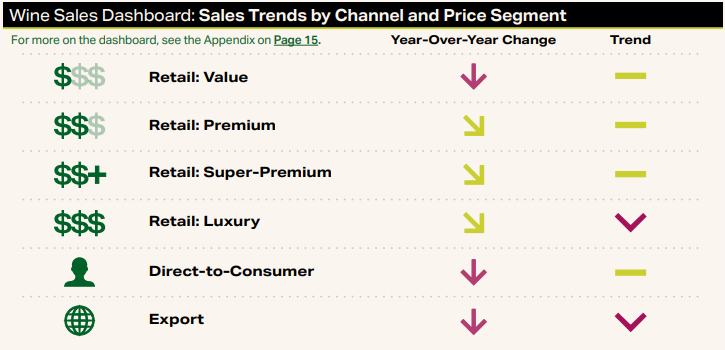
There wasn’t much change in the complexion of the wine market in the third quarter. Sales continued to decline across channels and price points, though at varying rates. Some segments improved while others worsened. Wine exports continued to flag because of provincial bans in Canada. 

I continue to believe the slump is mainly structural, particularly at the lower end of the market (see Page 3). But I also believe economic factors such as inflation and depressed consumer sentiment have played a role, and I expect wine sales to firm up once the economic backdrop improves. Unfortunately, we aren’t expecting much change in the economy, for better or worse, in the months ahead, so the wine market isn’t likely to see much improvement either. 

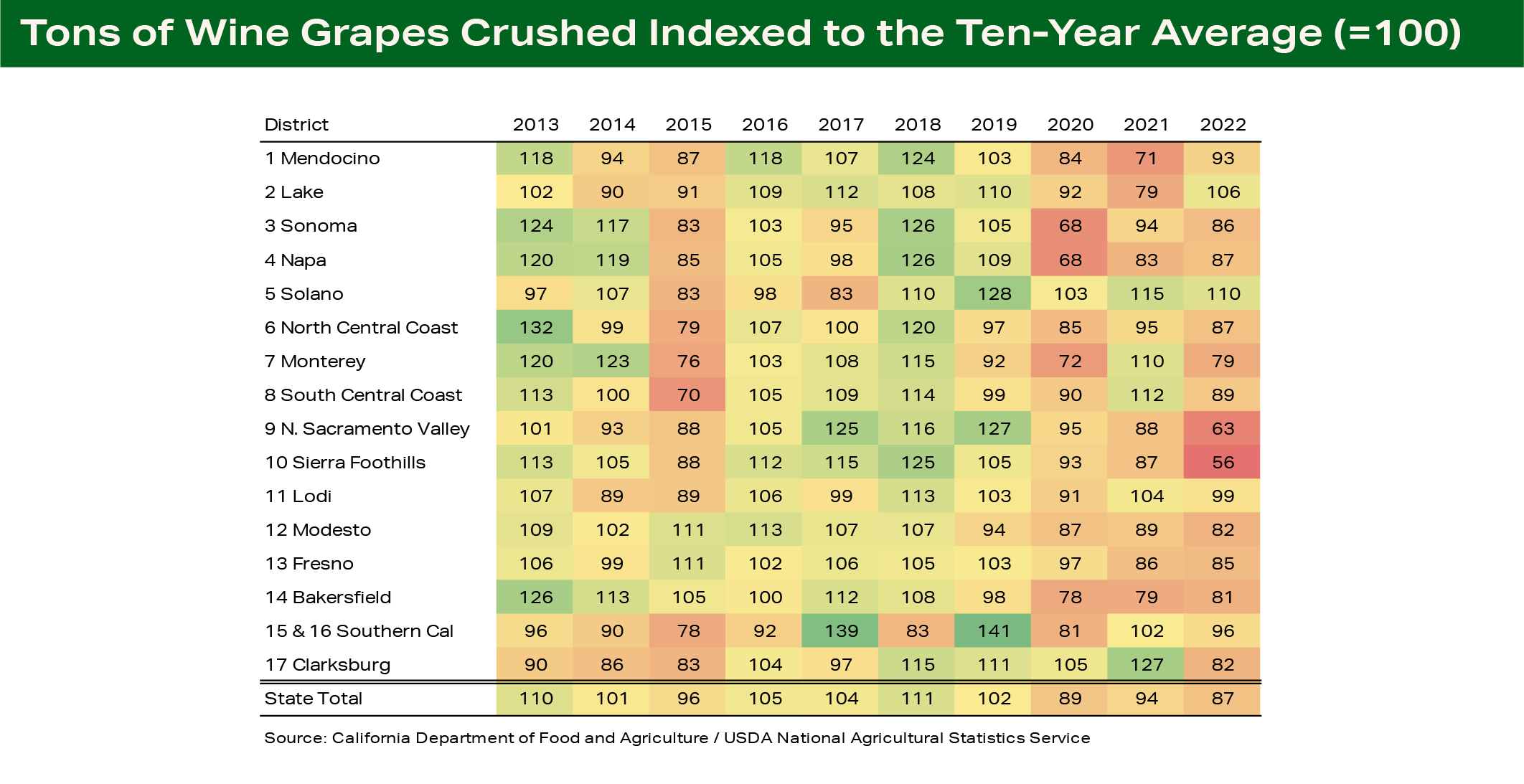
2025 was a painful year for California grape growers. Weather was an issue, but the grape market proved to be an even greater challenge. There simply wasn’t enough demand to absorb all the fruit due to slumping wine sales, excess inventory and gun-shy buyers. Hundreds of thousands of tons were thought to have been left hanging. Experts believe the crush will come in below 2.5 million tons, which would be the slightest of the 21st century. 

I expect some improvement in the grape market in 2026 because of the ongoing supply-side correction (nearly 40,000 acres were removed between October 1, 2024, and August 1, 2025) and a potential reduction in wine inventory stemming from the small harvest, though this is far from certain. 

This issue’s Trending Topic focuses on the wine inventory glut (see Page 9). The inventory overhang is difficult to measure now, let alone forecast, because of imperfect data and uncertainty regarding the 2025 crush size and trajectory of wine sales. If the harvest turns out to be as small as predicted, inventories should be more balanced heading into next year’s harvest. However, my analysis indicates that a wide range of outcomes are possible. 

A material reduction in inventory would stimulate grape demand next year. Under my base-case scenario, I expect more grapes to be sold in 2026. This, coupled with lower grape production potential, should result in a better balance between supply and demand in the aggregate. No matter the scenario, the balance will continue to vary widely across appellations, varieties and quality tiers. 

Wineries and growers should closely monitor the situation in the months ahead as fresh datapoints are released. I’ll provide an update in the spring edition of “Winescape.”

This issue:

  • Assesses the nation’s wine inventory glut and how quickly it might be resolved
  • Gives an update on the size of the California grape harvest and its potential impact on inventory
  • Shares an early outlook for how the wine and grape markets will fare in 2026

Download the winter issue of Winescape