


March 1, 2026
UntitledMarch 1, 2026
UntitledMarch 1, 2026
CboxQCâ„¢ At-line – COâ‚‚ and Oâ‚‚ meteMarch 1, 2026
Determine the alcohol content of your wine quickly and easily with our wine analysis systemWhen combined with a density meter, Alcolyzer Wine M/ME determines further parameters in a single cycle, e.g. extract content. The patented NIR measuring method eliminates the influence of other sample constituents on the alcohol measurement and therefore guarantees highly precise results.

Key Features
Efficient and high-performance wine analysis
Measure the alcohol content of wine, sparkling wine, cider and sake from 0 to 20 %v/v
Other wine constituents have no influence on the alcohol analysis
Fill the measuring cell via syringe, peristaltic pump or automatic sample changer
Low sample volume, high sample throughput
Save time in the lab
Minimum sample preparation
Short measuring cycles
No cleaning between samples
Universal adjustment saves you time
Adjustment/calibration with water and an alcohol/water solution
One single adjustment is valid for all your samples
10.4" touchscreen
Applies state-of-the-art PCAP technology
Provides a premium user experience and overview
March 1, 2026
50 % discount on brand new refractometers and polarimeters
Out with the old and in with the new! Get a jump on your spring cleaning and leave your lab sparkling with Anton Paar’s trade-up program: Users can trade in any manufacturer’s refractometer or polarimeter to receive a 50 % discount on a brand new Anton Paar Abbemat refractometer or MCP polarimeter*. Act now! This attractive offer is valid for a limited time only.
The MCP series from Anton Paar is the most powerful polarimeter series on the market. The versatile instruments provide the highest measuring accuracy, maximum user-friendliness and full compliance with all relevant international standards (Pharmacopoeia, OIML, ASTM). The instruments’ greatest strength is their robust and modular design, supported by state-of-the-art data management.
Anton Paar’s range of Abbemat refractometers embodies over forty years of technical expertise. They measure the refractive index and concentration of liquids, gels and solids. These truly universal refractometers cover all applications in all industries. An Abbemat is a secure investment for the future, providing reliable and accurate results for years to come.
For a limited time only, Anton Paar’s special trade-up program now provides these high-quality instruments at an amazing price. Spring cleaning has never resulted in more sparkle than this!
Interested? Email us at: optotec.us[at]anton-paar.com.

March 1, 2026
Anton Paar Introduces the Craft2Craft, Precise Fermentation ControlThe Craft2Craft Cases guarantee precise fermentation control, high shelf life stability and the great, consistent taste of your products. The cases include the DMA 35 density meter and the CarboQC At-line|CboxQC At-line|OxyQC CO2 and oxygen meters.
The DMA 35 portable density meter determines the extract content in beer wort and can also be used to closely monitor the fermentation process. The CO2|O2 meters for measurements at tanks and out of packages offer the simultaneous determination of CO2 and O2 and an insight into the amount of nitrogen in beer. Results are delivered within a few minutes – this system proves indispensable even in the smallest of breweries.
Features:
Immediate results around the clock
- On-site measurement directly at the wort kettle, process line, tank, keg or cask
- Reliable and accurate results in a few minutes
- Independence from external labs – measurements performed on any day and at any time
- Possibility to step in immediately in case of unexpected deviations in your production process
Designed for operation at any brewing location
- Robust and compact instrument design, additionally protected by a rubber housing
- Delivered in a handy transportation suitcase with space for all instruments and accessories; the instruments are ready to be carried to and unpacked at any location within your brewery
- Intuitive operation and easy handling
- Minimal sample volume required for analysis
- Portable and battery-operated instruments for maximum flexibility regarding the measuring location
- Sample identification and storage of results, as well as the option of printing or exporting results to a PC stand for perfect traceability and documentation
More love for your beer
- Consistent monitoring of the beer quality from the wort kettle to the bottle
- For accurate labeling of your products
- For topping off the taste and shelf life stability of your brews
Click here for more information about the Craft2Craft promotion.
March 1, 2026
Now revolutionized: Alcohol measurement in microdistilleriesChecking the alcohol concentration is part of the daily routine in small distilleries. Often traditional measuring methods such as glass hydrometers are in use, despite being difficult to use and having a tendency to break. Now, two new products from Anton Paar are about to turn this situation around.
In time for the high season at distilleries, Anton Paar presents a new series of attractively priced digital alcohol meters which will pay for themselves in a very short time, even at the smallest distillery. The Snap alcohol meters check the alcohol content of two-component mixtures made of water and ethanol over the whole relevant measuring range from 0 % v/v to 100 % v/v. They therefore replace all glass hydrometers in use at small distilleries.
The sample is taken directly from the storage vessel, the influence of temperature on the result is automatically compensated and the alcohol concentration is displayed within seconds.
Snap 50 – the most accurate portable digital alcohol meter in the world
With a measuring accuracy of 0.1 % v/v alcohol, Snap 50 is the most accurate digital portable alcohol meter available on the market. With its capability to identify sample names via RFID (Radio Frequency Identification), store more than 1000 results, and print or export these to a PC, Snap 50 provides complete traceability of the results.
Snap 40 – the entry-level portable digital alcohol meter for the smallest distilleries
With the new Snap 40 Anton Paar makes cutting edge technology available for a very economic price and allows very small distilleries to move into the digital age.
The measured results are accurate to 0.2 % v/v. Snap 40 provides less features than Snap 50 – this model cannot save results, for example. Snap 40 is exclusively available via the Anton Paar Webshop.
Combining cutting-edge technology in a robust and long-life instrument, the new Snap alcohol meters give distillates from small distilleries, which are produced with great passion for detail, the quality they deserve.
Anton Paar would like to thank the following partners for their support and cooperation during the development phase:
Jack Daniel Distillery (Lynchburg, USA), Limestone Branch Distillery (Lebanon, USA), Feindestillerie Hochstrasser (Mooskirchen, Austria), GÖLLES Manufaktur für edlen Brand & feinen Essig (Riegersburg, Austria), the Hirmann family (Rudersdorf-Berg, Austria), Ulrich Jakob Zeni (Silz, Austria)
March 1, 2026
The Most Accurate Portable Digital Alcohol Meter in the WorldIt's called the Snap 50.
With a measuring accuracy of 0.1 % v/v alcohol, Snap 50 is the most accurate digital portable alcohol meter available on the market. The portable alcohol meter Snap 50 measures distilled spirits in all strengths within seconds: from pure distilled spirits to samples taken during watering down to drinkable strength and ready-to-drink spirits.
A few milliliters of sample are taken from the storage tank or cask and measured directly on-site. The alcohol meterautomatically compensates the temperature influence on the result and shows the alcohol concentration with an accuracy of 0.1 % v/v on the large display. There is no need for any extra calculations – just read off the values, store them or send them to a PC!


Click here for more info
March 1, 2026
Now You Can Use One Beverage Meter to Measure All Your Beverages
Alcolyzer ME provides the same high accuracy and same ease of use as the established Alcolyzer ME models, with one extra benefit: now you can use one alcohol meter to measure all your beverages, including: beers, ales, beer mixtures, alcopops, ciders, molasses, whisky, cognac, brandy, vodka, gin, tequila, rum, wash, RTDs, white wine, red wine, sparkling wine, rice wine and fermenting musts.
Alcolyzer ME requires minimal adjustment and delivers highly precise results for all beverage types.
Key Features
One alcohol meter for all beverages
- Measures the alcohol content of beers, wines and spirits
- Highly accurate measurement with no influence from other sample ingredients
- Patented NIR method for direct alcohol measurement
Saves you time
- Only 3 to 4 minutes from filling to the result
- Simple adjustment with water/ethanol solutions covers all products in the groups "Beer", "Wine" and "Spirits"
- Calibration with water and water/ethanol solutions
- Minimum sample preparation
- Fully automatic thermostatting via an integrated solid-state thermostat
User-friendly
- Simple operation of the complete system via the master instrument
- No product-specific calibrations necessary
- Compact modular system configuration
- Virtually maintenance-free
Future-proof
- Extend the system with additional modules for color, pH and turbidity analysis
- Benefit from an automatic sample changer in case of high sample throughput
10.4" touchscreen
- Applies state-of-the-art PCAP technology
- Provides a premium user experience
March 1, 2026
Measurement of Dissolved Carbon Dioxide and Oxygen in Beverages
In the production of alcoholic and non-alcoholic beverages, it is essential to check and control the CO2 and O2 content of the product both during the production process and after bottling.
The CO2 content strongly influences the taste of beverages and is a considerable cost factor in beverage production. Precise measurement of the carbon dioxide ensures consistent taste and cost-efficient dosing.
A high level of dissolved O2 in beverages has a negative impact on the taste and shelf life of the beverage. The continuous monitoring of the oxygen content ensures product safety and consistent beverage quality
The best instrument for your application
Whether directly at the production line, in the laboratory or as part of a larger beverage analyzing system, Anton Paar provides the best instrument for your measurement application. The range includes instruments for measuring dissolved oxygen and dissolved carbon dioxide without being influenced by other dissolved gases such as air or nitrogen.
Have it all: CO2 and O2 combined
Anton Paar’s new instrument, CboxQC, combines the fast measurement of CO2 and O2 in one measuring cycle – available for portable use at-line as well as in a standalone version for the laboratory. For the utmost flexibility, the instruments’ new and robust design is small, compact and lightweight.
View all our products for wine here: http://www.anton-paar.com/
March 1, 2026
How to Achieve Better Quality Control with Less Effort
A small winery in central California found a way to speed up managing the daily workload without compromising on the quality of analyses and cultivation. Portable instrumentation helps cope with the daily inspection of the checkpoints and allows for continuous monitoring of the progressing development of the wine’s characteristics.
 The delta breeze enhances the grape quality
In the small city of Lodi in the northern part of California’s Central Valley, around 65 miles east of San Francisco Bay, the Bear Creek Winery (see Fig. 1) cultivates its fine assortment of wines.
The area around Lodi is blessed with a very steady growing season. Although it experiences some heat spikes, conditions are excellent for growing wine grapes because of a phenomenon called the “delta breeze”. As the warm air rises in the evening, cool air is drawn in from San Francisco Bay and makes the Lodi region experience a very large difference in temperature between day and night. The diurnal change is excellent for grape growing and that is what makes the Lodi region stand apart.
Proven growing area and new grape varieties liaise successfully
Bear Creek Winery was founded in 1934 and has been owned by the Kautz family since 1997. John and Gail Kautz were instrumental in opening up certain grape varieties in Lodi. They were the first to plant Chardonnay and Cabernet Sauvignon and they are also the largest growers of Cabernet Franc and Symphony. Despite the Kautz’ success story Bear Creek Winery still remains a family organization, setting an example of how upholding tradition and moving with the times can be combined.
At Bear Creek Winery they grow between 40 and 45 thousand tons of grapes a year that are turned into red wine varieties such as Cabernet Sauvignon, Merlot, Syrah, but also more unusual varieties that are mostly used for blending, such as Sousão or Tannat, and white and blush wines such as Chardonnay, Sauvignon Blanc, and a Shiraz/Cabernet Sauvignon rosé. The white and rosé wines are primarily processed in an atmosphere where oxygen is excluded at all times by driving the air out with CO2. “This provides a reductive style that the Bear Creek Winery takes a pride in,” says Michael Borboa, Export Winemaker, who studied at Fresno State University. “The reductive atmosphere can be seen by the green color of the juice because the oxidative browning that causes the wine to turn amber is minimized,” he explains.
 Profound analyses made easy for premium quality wines
At Bear Creek Winery comprehensive quality control is performed throughout the entire production process. The final products in particular undergo close examinations of residual sugar, volatile acids and malic acid. The alcohol content is measured using an Alcolyzer alcohol meter by Anton Paar which is based on a near-infrared method (see Fig. 2). SO2 and O2 determinations are also on the agenda as well as the occasional test for filterability.
Analyses are not only performed during fermentation and on the finished wine; they already start with the grapes. “We sample each load of grapes right away so we can immediately decide whether any additions are needed. These adjustments may include tartaric acid, SO2, or pectolytic enzymes for white juice or color extraction enzymes for red juice,” explains Michael Borboa. “Our winemakers evaluate each individual lot of juice and adjust accordingly to ensure a healthy fermentation.”
In recent years, Bear Creek Winery has found an even better way to manage the daily workload by using a portable density meter for quality checks. This reduces the time spent checking tanks and is much easier to use than a hydrometer.
Modern instrumentation makes the workload easier to handle
Quality control during fermentation in the wine tanks plays a very big role at Bear Creek Winery. Here, a small portable density meter, a DMA 35 by Anton Paar, proved to be the ideal companion that makes daily work much easier. Before acquiring a DMA 35, the operators had to carry a basket containing a hydrometer with the required accessories up to the top of the tanks to perform the measurements. This tedious work is now a thing of the past: The DMA 35 density meter has made the hydrometer obsolete. Now, quality control personnel do not even need a clipboard and pen because the measuring result is automatically recorded by the DMA 35 density meter.
At some stages there are between 50 and 100 fermenters that have to be checked twice a day. While it used to be common practice to spend maybe 10 or 15 minutes for one tank sample, nowadays with a DMA 35 a check takes only 3 to 5 minutes per tank. This saves a lot of time and effort and allows the winemaker to take action faster if needed to ensure that the health of the wine is maintained.
 Radio Frequency Identification avoids sample mix-up
Radio-frequency identification (RFID) allows wireless data transfer between tags and devices with an integrated RFID interface. RFID tags are commonly used for identification purposes in many industries and have also found their way into wineries due to their ability to uniquely link the measured characteristics of a certain product, for example a fermenting wine, to the location where the sample was taken – usually a barrel or tank, where the tag is attached.
The DMA 35 version “Tag&Log” is equipped with an RFID interface with a reading range of about 2 cm. Installation of the tag is an easy and straightforward task as can be seen in Fig. 3, Steps 1 and 2. The instrument provides the ability to program an RFID tag with a sample name and also method settings for the measurement of that very sample. For the day-to-day routine, the tag is scanned before the measurement (compare Fig. 3, Step 3) in only one second. If required, settings can also be erased and programmed anew. Measured data are stored in the DMA 35 including the identification information. Wireless data transfer to a computer or printer is done with an infrared interface (IrDA).
Quick sample identification at numerous measuring points within a winery means enormous time savings. The density measurement with DMA 35 takes less than a minute, and the instrument reads an RFID tag and identifies the name of a sample in only one second.
 Immediate information by density measurement at many stages in the winery
Portable density meters not only come in handy at the tanks for determining the sugar concentration in the grape juice and the decrease of sugar during fermentation, they are also used for checking the sugar content and ripeness of the berries. Density measurement is also employed to check on the right concentration of dissolved SO2 to be added as a stabilizing agent to the wine. Another positive aspect of the DMA 35 density meter is the calculation of filling volumes from the weight before shipping the wine to the customer.
The handheld DMA 35 density meter has been used for the last three seasons at the Bear Creek Winery for analyses on tanks to monitor the development of the wine and keep it on the right track (see Fig. 4). “The biggest advantage of the DMA 35 is that it is portable and very accurate at the same time,” reports Michael Borboa. “These features make it ideally suited for taking it around to the tanks.”
Trends in wine consumption
Currently Bear Creek Winery is experiencing a distinct trend for sweeter wines. As Michael Borboa explains, “Nowadays, younger drinkers seem to prefer sweeter wines. There has been a tendency in the last few years for wine that has been traditionally dry to be produced sweeter.” Confirming this trend, Borboa mentions the increasing popularity of Muscat or Moscato in the United States. Young drinkers are choosing this floral, semi-sweet wine and making it very fashionable.
Another phenomenon witnessed by Borboa is the rise in popularity of the Lodi region. “Over the past couple of decades Lodi has grown into a first-class wine-growing region. There are now more than 75 wineries in the Lodi American Viticultural Area and wine enthusiasts fully recognize their world-class products. With the Kautz family’s continued efforts to advance and improve grape-growing and winemaking in Northern California this upwards trend is sure to carry on.”
The use of new technology, such as DMA 35 with RFID interface, has made Bear Creek more efficient and more progressive. The scene is set for the continued success of Bear Creek’s remarkable high-quality wines. Even though Michael Borboa has recently moved on to new responsibilities outside of Bear Creek Winery, he still takes to using Anton Paar instrumentation at his new job as Senior Winemaker.
For more blogs visit: http://blog.anton-paar.com/
For more information visit: http://www.anton-paar.com/us-en/
March 1, 2026
How to Reduce the Sample Volume and Time Required for Measurements in the LabAs always in life, investment in equipment for a professional lab is assessed under the key aspect of profitability. While the variability of equipment will generally be high, space and money are limited and the investment must cover present and future needs.

Challenges in the Modern Lab
A well-designed lab offers countless analytical methods that have to be used in an efficient way. When it comes to cost, not only the one-time investment but also running expenses such as consumables and also salaries are considered. The tendency to want to decrease payroll requires either the reduction of the number of staff, doing without educated chemists – or in the worst case both.
However, this trend does not necessarily mean that the operation of equipment becomes easier at the same time. Lab staff has to handle more and more complex instruments and although preparatory work such as sample collection, identification, and preparation as well as the subsequent tasks of data collection and distribution can be standardized this is difficult with the measuring and analysis steps as they frequently differ greatly.
Lab routines can be simplified by:
- Purchasing as much equipment as possible from the same producer. Brand recognition and similar operation procedures reduce complexity and result in less training required for the lab staff.
- Choosing providers of analytical instrumentation that make sure differences in the user interface, operation, and maintenance of their products are only marginal.
Benefits of Modular Systems
Modular systems combine the benefits of both standardization and customization. A modular system is put together from the modules required by the application. Modular measuring systems combine devices for measuring different parameters, usually with one master device and sample filling included. The advantages of these modular systems are:
- All required analytical parameters are measured at the same time and in parallel.
- Automatic sample handling reduces potential human errors.
- Once a measuring process has been started, lab staff is free to work on other important tasks.
- If in the future the need for another measuring parameter arises, the extension of the existing measuring system is easy-going. This also serves a limited budget, i.e. a measuring system must not be purchased at once but can be extended on a yearly basis.
- Training effort is minimal: once the first instrument is understood, the operation of another one is straightforward
- All measured data is processed via the same interface, be it a printer, USB storage device, LIMS service, or the touchscreen of the master device.
- The compact setup minimizes required lab space and also sample volume
A Journey Into the Past
At Anton Paar the subject of “modularity” all started with an innovation for the beverage industry. In soft drink production sugar content and CO2 content were measured separately in the lab with two independent instruments. The launch of the PBA-S system united the density meter for measuring sugar content and the carbonation meter for measuring CO2 with automatic sample preparation.
Suddenly, sample throughput was doubled and the operator was only required to use one single interface. Time savings were tremendous.

From left to right: DMA M density meter measures density and converts this into °Brix (sugar concentration); CarboQC determines CO2; PFD filling device automatically fills the beverage directly from the container with no need for prior degassing.
Since this innovation, more and more parameters have been added to the list of combinable measurements:
- Density
- Sound velocity
- CO2
- O2
- Alcohol
- pH
- Turbidity
- Diet concentration
- Refractive index
- Optical rotation
- Viscosity
In recent years the following trends arose with a corresponding response from measurement instrument manufacturers:
- The demand for low sample volume led to the integration of one measuring parameter into existing instruments with a plug-and-play concept.
- The increasing workload of staff created the need for automatic sample changers.
- Some measuring modules were even developed without a user interface when it was obvious that they would always be used with another (master) device. Again this meets the challenge of limited space and also reduces production cost.
- Expensive or limited sample quantities required compact and space-saving measuring equipment.
- Certain industries were consistently drawn to certain combinations of devices. These are now often sold as packages.
The Future is Modular
Managing a modern analytical lab involves meeting many challenges related to the optimum implementation of measuring equipment, process safety, skilled staff, and work routines. Analytical equipment which provides modularity has benefits for all parties involved:
- The operator benefits from ease-of-use and reduced time required for each measurement task.
- The decision-maker saves money due to optimized processes and efficient use of time and resources.
- The instrument producer can cut down on production costs, leading to less expensive products.
For more information, click here.
March 1, 2026
How to Keep Your Wine Fermentation Under Control
Wine is not a drink.
It’s a lifestyle.
It’s a feeling.
It’s a work of art.
And one of the most important questions is: how to keep fermentation under control? One answer is density measurement.
Density Measurement – the Safety Inspector of Wine Production
In the world of density measurement grape juice is considered to be a sugar-water solution, which means that winemakers can measure the sugar concentration in their juice with the help of a density meter. All other components – besides sugar and water – that are present in the juice have so little effect on the density that they do not influence the measured result in any way. The sugar concentration in the grape juice is the main factor influencing the alcohol content of the final wine. By measuring this sugar concentration winemakers can already predict the alcohol content of their future wine before the fermentation has even started. Furthermore, in many countries the sugar concentration is decisive when classifying the product as quality wine or ordinary table wine.
During fermentation the sugar turns into alcohol and CO2, so fermenting wine is considered a three-component solution made of water, sugar, and alcohol. From a theoretical point of view this would be the end of the story in which density plays the hero’s role, but in reality that’s not the case! Winemakers follow the decrease of density during fermentation in order to judge whether the fermentation proceeds as planned. Due to the influence of alcohol this value is called ‘Apparent Sugar Concentration’.
Carrying out proper fermentation control is one of the most important quality control tools a winemaker has as only a finely tuned alcoholic fermentation will reveal all the grapes’ hidden aromas. Winemakers can immediately step in if they see that the fermentation is proceeding too quickly – which could lead to lost aromas – or is about to stop unexpectedly. By adjusting the temperature of the fermentation tank it is in most cases possible to lead the fermenting wine back on track. In more challenging cases a ventilating tank-to-tank transfer might help. A fermentation which is completely stuck can only be reactivated by inoculation with fresh yeast. However, this yeast has to deal with difficult conditions as the nutrients have already been consumed by the first yeast. Furthermore, the ratio of glucose to fructose is not ideal as the glucose necessary for activation of the fermentation might already be exhausted, too. Having these facts in mind, we clearly see that prevention is better than cure. To summarize: dealing with the natural process of fermentation does not mean we cannot use tools to help us keep control.
Bubbles Everywhere During Fermentation!
Fermentation control is one of the decisive factors for obtaining the wine you intended to produce. However, all methods of density measurement – be it conventional methods like glass hydrometers or digital density meters – are strongly influenced by the CO2 present in the fermenting sample. Of course samples can be degassed to reach a correct result, e.g. by putting them into an ultrasonic bath, via shaking the samples and snifting to release the CO2 or by stirring – although this will not be very convenient if a winemaker has 100 tanks to be measured once a day. Here are two quick options for a successful measurement on fermenting wine with digital density meters.
Turned 90°
The portable density meter is simply turned 90 ° counterclockwise so that all bubbles move in the same direction – to the position in the glass measuring cell where bubbles have the lowest influence on the result. Furthermore, by holding the instrument in this position during your everyday measurement, the results are comparable from one day to the other. And the ultimate benefit is: The winemaker can stay in an upright position :o) unless measuring tasks are seen as a fitness workout!
Syringe Filling
Another possibility is to use the syringe filling option: the instrument is prepared for syringe filling (the adapter is usually included in the delivery) and the sample is degassed directly via syringe with the help of creating underpressure. Simply fill the syringe with sample, close the syringe tip with your finger and pull the plunger and remove your finger from the tip. Enjoy the “plop!” sound telling you that the CO2 is leaving your sample. Repeat this routine 3 times. Again you are ready to take a repeatable measurement.

Automation Is the Helping Hand
RFID – that’s not a robot from Star Wars but a technology helping winemakers to quickly identify their tanks before they do a density measurement for the purpose of fermentation control. RFID stands for Radio Frequency Identification and is also commonly used for e.g. container tracking in logistics, goods tracking in supermarkets, and for personnel cards. An RFID tag programmed with a unique sample name is attached to the wine tank or barrel. The density meter reads this tag before the measurement and identifies the name of a sample in a second. Especially when handling a large number of tanks or barrels each day this kind of quick sample identification adds up to an enormous time saving. As the sample ID is saved with the measured values, results are traceable no matter how many different instruments and operators are involved in the measuring process. Not bad, especially if you have to measure hundreds of samples a day.
Preserving Color and Taste
Frequently, sulfurization is applied to wine to preserve the color and taste, enhance stability, and avoid any bacterial spoilage. Sulfurization is usually done in the form of a stabilization solution that has to be adapted based on the volume. To see whether the stabilization solution has the correct concentration, again a density meter can be used. Based on the density result you can determine the concentration of two-component solutions like liquid sulfur dioxide.
A Wine's Passport
Many analytical labs specialized in wine analysis offer a comprehensive analysis of the wine including alcohol, extract, SO2, acids, pH, and more – an analysis that bigger wineries will even do themselves. For a smaller winery, doing such an analysis means sending a certain amount of sample to the lab that will charge for the respective analysis package ordered. Sophisticated instrumentation based on FTIR or NIR technology are used for the measurements and these instruments are usually capable of measuring several parameters in one go (see e.g. the Alcolyzer Wine Analysis System from Anton Paar. In several countries these official labs will be the ones providing their results for the purpose of issuing a national test number, showing the consumer that the wine has undergone official tests.
Learn more about the DMA 35 Portable Density Meter, an instrument that will do hundreds of fermentation checks a day for you and supports all well-known winemakers worldwide in their production process.
Would you like a quotation for a portable density meter tailored to your needs? Contact us!
March 1, 2026
Faster, Smarter, Better: The Wine Analyzer You’ve Been Waiting ForFTIR Wine Analyzer:
Lyza 5000 Wine
 The Evolution of Wine Analysis
The novel multiparameter FTIR analyzer Lyza 5000 Wine is your solution for the analysis of must, must in fermentation, and wine.
Fast measurements for a multitude of parameters ensure that you have all the information you need – during all stages of wine production. Thanks to a quick setup and preinstalled models, all important results for wine analysis, including ethanol, sugars, and acid profile, are just a tap away.
Lyza 5000 Wine is equipped with the Xsample 370, a singleposition autosampler designed for seamless, fully automated cell care. For high-throughput analysis, the system can be delivered with Xsample 520, Anton Paar’s premium multiposition autosampler, ensuring efficient performance.
The FTIR analyzer you have been waiting for.
✅ Lifelong Performance for your wine analysis
✅ Results in less than 1 Minute
✅ More than 15 Key Parameters in wine, must, and must in fermentation
✅ Easily adapt complex models for effortless operation
Features
 Lifelong superior performance
Lyza 5000 Wine’s precisely temperature-controlled 12-bounce ATR measurement cell is designed to deliver fast measurements in less than one minute as well as stable results throughout the whole wine production process.
User-friendly touchscreen interface
With Lyza 5000 Wine’s state-of-the-art user interface,
single measurements, adjustment of models, or even
complex measurement routines are only one tap away.
Quick setup and minimal measurement times for more
than 15 parameters in one go let you handle huge
workloads with ease.
Live notifications and guided workflows
Based on a water reference measurement, the patented Cleaning Performance Index advises you when to clean in order to guarantee precise results at any time. After an automatic reminder, integrated workflows guide you through water and ethanol reference measurements – no proprietary reference standards are necessary.
Automation with Xsample sample changers
Xsample 370 provides fully automated filling, referencing, cleaning, and drying for the most convenient user experience. Increase your sample throughput with Xsample 520, allowing up to 48 samples in a row. Water reference measurements are performed automatically and new measurements can be queued at any time, even during running measurements.
Data handling and LIMS integration
Lyza 5000 Wine supports you in every way to efficiently process and distribute your measurement results. Reports can be automatically printed and digitally exported to your hard drive or network storage. For the highest degree of automation, Lyza 5000 Wine is completely integrated into your LIMS system via Ethernet and Wi-Fi.
March 1, 2026
Hofbräu München and Anton Paar: Brewing Classic Beer Together
Hofbräu München and Anton Paar:
Brewing Classic Beer Together
Located in Munich, Germany, the “Hofbräu München” brewery brews the beer for the “Hofbräuhaus,” one of the world’s most famous beer halls. With Anton Paar’s help, it produces well over 340,000 hectoliters of beer annually.
A trust-based partnership
According to Christian Beetz, brewer and deputy laboratory manager at the brewery, “With a reputation for producing stable, practical, and precise instruments, we knew we could trust Anton Paar.” So Hofbräu München has steadily expanded its measuring points with Anton Paar devices and built them into its QC network. “Since we had so many parameters we needed to measure,” remembers Beetz, head of quality assurance Thomas Brandt bought two of Anton Paar’s Alcolyzer Beer Analyzing Systems to automatically analyze alcohol and other parameters in our laboratory.” The brewery also uses inline sensors and portable instruments for the measurement of density (extract), dissolved CO2, and O2.
One solution covers it all
With its Anton Paar instruments, the brewery can measure over 15 parameters, including original extract, alcohol, dissolved carbon dioxide and oxygen, total packaged oxygen, turbidity, color, and pH. It can do this inline, at-line, and in the laboratory. As one member of the QC team at the brewery points out, Anton Paar’s allin-one measuring solution is a major benefit for his team. “I only have to have contact with one to two people. All inline devices are compatible with the same software, and all of them are collected and visualized on the same user interface.” Moreover, Davis 5, Anton Paar’s data visualization software, lets him calibrate and adjust his inline devices with laboratory values at the push of a button.
 Measuring total packaged oxygen
Until recently, the lab team in the brewery had been using the caustic potash solution (KOH) to determine total packaged oxygen, which is an inconvenient, time-consuming technique that produces inaccurate, non-repeatable results.
Since 2021, the brewery has been using Anton Paar’s TPO 5000 total packaged oxygen meter, which has made the measuring process more straightforward, faster, and more accurate. With TPO 5000, Beetz says, the team can “measure headspace and dissolved oxygen separately. It’s much easier now for us. I insert a bottle into the instrument and after just a few minutes, I get a reliable result that is fully comparable with other measurements made on other Anton Paar devices. That’s great.”
Future challenges, future opportunities
Hofbräu München has more beverage brands than ever, and its portfolio will continue to expand. For Beetz and his team, this means more effort in the laboratory and a higher demand for measurement technologies that are fast and practical. “Seeing what the future holds for automated measurements, particularly regarding speed. Getting faster in this area would be a fascinating development.”
Another challenge is lowering oxygen values to ensure beer stability. Since beer is being transported farther than ever before storage times are also getting longer. “Because of this,” says Beetz, “we have to ensure only beer that is stable over the long-term is put into the bottles. This is critical so that we make sure every consumer gets that same Hofbräu beer taste that we are known for.”
While the QC team at Hofbräu München acknowledge these obstacles for the future, the team is confident that the brewery will overcome them – just as it has for over 400 years. Every challenge is also an opportunity. And that’s how the QC team approaches its day-to-day work at Hofbräu München.
🔎 Learn more about the TPO 5000 🔗 https://loom.ly/w9H3xoc
February 17, 2026
Smarter Sample Analysis for Fast-Moving Wine Operations
In wine production, work rarely slows down. Fermentations change quickly, samples build up, and consistent data is needed throughout the day. Analyzing everything by hand can take time that’s already in short supply.
Lyza 5000 Wine, together with the Xsample sample changers, keeps the workflow moving.
? Xsample 370, a single-position autosampler that handles filling, referencing, cleaning, and drying on its own.
? Xsample 520, a multi-position autosampler processes up to 48 samples in a row. Water reference measurements are performed automatically and new measurements can be queued at any time, even during running measurements.
? Discover more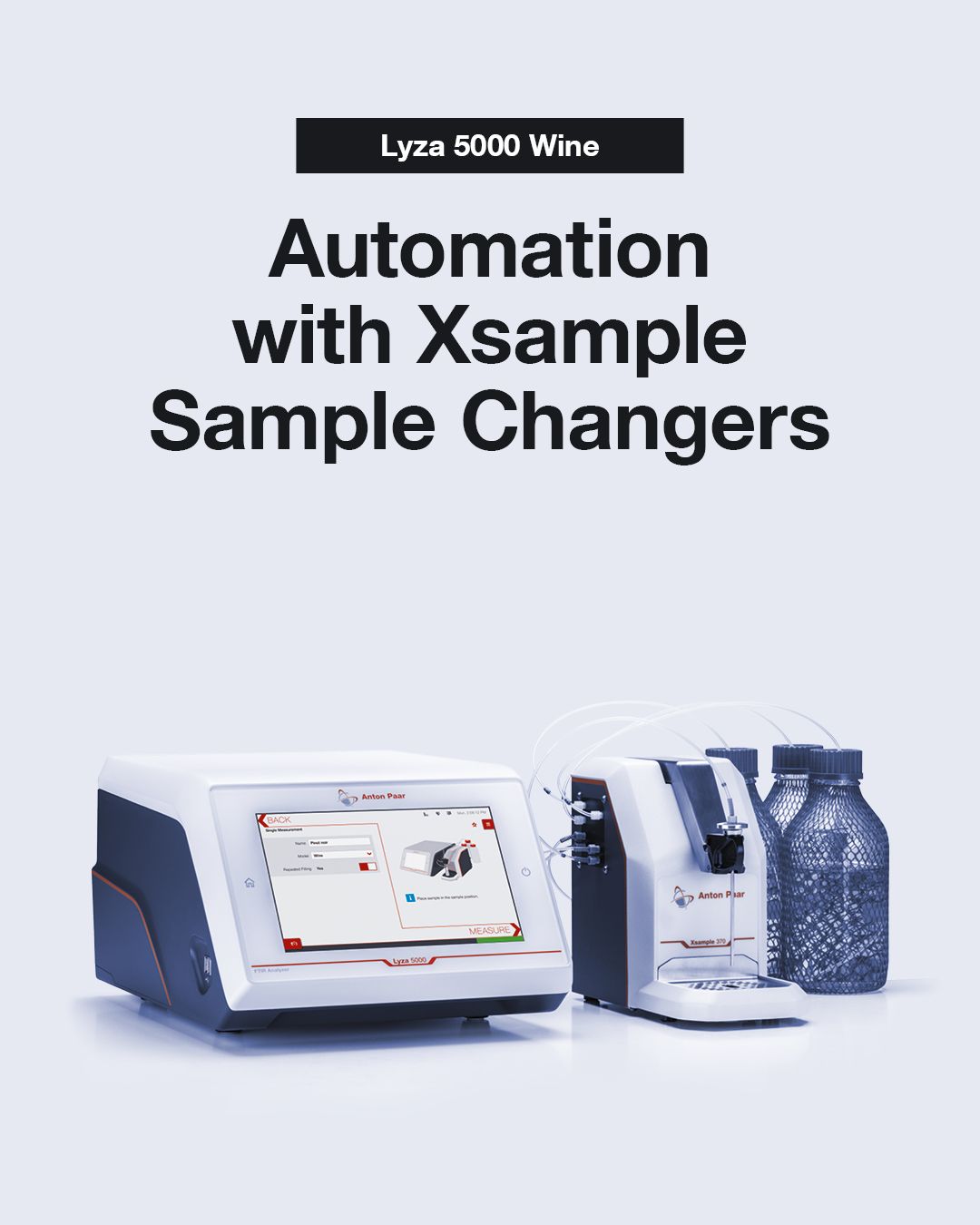
February 24, 2025
Lord of the Corks: A New Era in Sparkling Wine Analysis Strike a New Path
The SFD Filling Device, when used with high-precision measuring instruments such as CarboQC or CboxQC by Anton Paar, allows for the quick and reliable determination of dissolved COâ‚‚, dissolved oxygen, and other gases in sparkling wine and wine. Additionally, it calculates the package pressure based on total dissolved gases, providing a comprehensive analysis of the sample.
Simple and Straightforward
Designed for ease of use, the SFD Filling Device pierces the cork of a sparkling wine bottle using a manually operated threaded tube. Once the cork is fully penetrated, the sample tube is lowered into the bottle, and the sample is transferred via pressurized air or nitrogen—without exposing the liquid to the atmosphere.
A tight seal between the piercing head and the bottle’s cork ensures that no COâ‚‚ escapes during the process, preserving the sample’s integrity for precise measurement. The device can accommodate various bottle sizes, from small formats to magnums, by inserting the correct number of centering plates. It is also compatible with both plastic and traditional corks.
One Filling Device Fits All
The SFD Filling Device is not just for sparkling wine—it can also be used for still wine sampling. When analyzing wine without carbonation, simply remove the cork and adjust the pressure for an equally effective sample transfer.
Safety for the Operator
Designed with safety in mind, the SFD Filling Device features a protective housing to safeguard the operator during use. The device operates at pressures up to 7.5 bar (109 psi), but pressure is only applied once the bottle is securely locked in place, ensuring safe and controlled operation.
A New Standard for Sparkling Wine Analysis
With its innovative design, precise sampling method, and COâ‚‚-preserving technology, the SFD Filling Device is setting a new standard in sparkling wine and wine analysis. It offers a simple, accurate, and reliable way to ensure quality control while maintaining the integrity of every sample.
Ensure accurate, COâ‚‚-preserved sampling with the SFD Filling Device.
November 21, 2024
Compact Digital Refractometers by Anton Paar Experience the perfect blend of reliability, precision, and convenience with our digital refractometers
Whether you're in the food, beverage, or petroleum industry, Abbemat refractometers are the ideal solution for measuring the concentration and refractive index of liquids and pastes. They excel in any environment without needing extensive cleaning or maintenance.
With quick results in just 4 seconds, as well as precise temperature control, and compliance with ASTM and ISO standards, our refractometers transform time-consuming measurements into highly efficient quality control.

October 21, 2024
How to Measure Alcohol Content in Wine with the EasyDens & SmartRef ComboJune 21, 2023
In Vino Veritas: Anton Paar's Alcolyzer at Lagerhaus WeinbaucenterOur customers at Lagerhaus Weinbaucenter, a laboratory testing center for analytical and sensory wine analysis, talk about how they use Anton Paar's Wine Analyzing System, Alcolyzer, in their daily work.
Monitor your entire wine production process with a single measurement solution.
Learn more: https://loom.ly/xCOJ6b0
